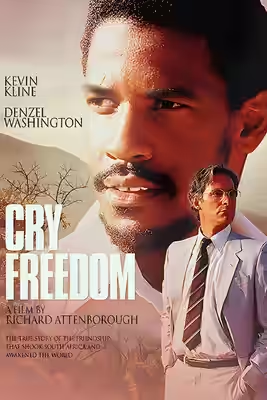
Richard Attenborough’s Cry Freedom is a forceful political drama weakened by its growing preoccupation with the Woods family. Denzel Washington gives it the conviction to survive that imbalance, though the later passages need a firmer edit.
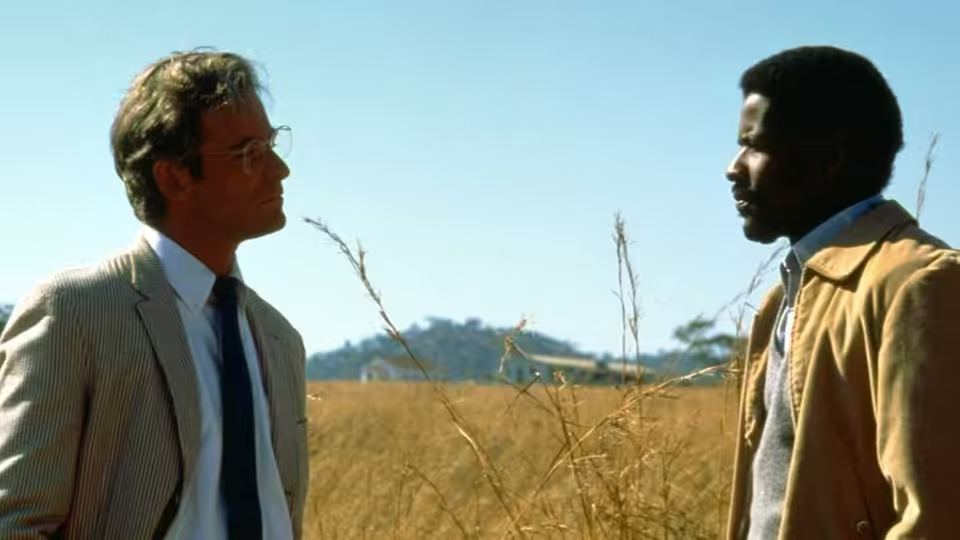
Richard Attenborough wants Cry Freedom to make the injustice of apartheid comprehensible through a friendship. It is a sound dramatic starting point, and the film is good whenever it lets Steve Biko and Donald Woods occupy our attention together. The difficulty is that John Briley’s screenplay gradually gives the Woods family’s predicament more space than it can usefully fill. We recommend it for the performances and the force of its early encounters, with a warning that the later stretch is considerably less searching.
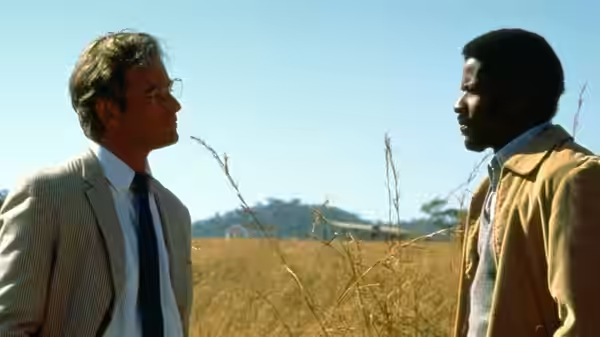
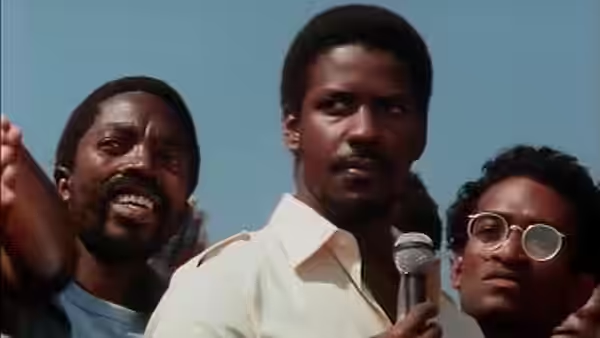
Denzel Washington gives Steve Biko an assurance that does not need constant emphasis. He makes political ideas sound thought through, with the expectation that someone else might give them proper consideration. We were gripped by the discussion of why white people call themselves white: the question interrupts an assumption so ordinary that it might otherwise pass unnoticed. The performance gives us time to consider the challenge without insisting that we applaud the person issuing it.
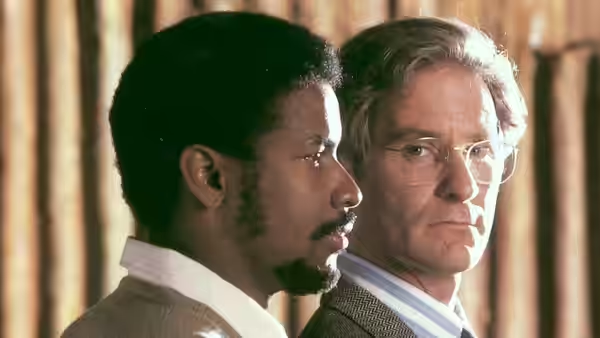
Kevin Kline has the harder task of making Donald Woods’s changing understanding interesting beside such certainty. He is persuasive when he has someone to listen to; the attention he gives Denzel Washington helps us believe these men might become friends. Penelope Wilton gives Wendy Woods sufficient weight that the family’s concerns cannot simply be dismissed as a distraction. The trouble comes from how much of the film those concerns eventually occupy, not from the actors taking them seriously.
Ronnie Taylor’s photography is most effective when faces hold our attention, allowing the actors to carry the difficult exchanges. Stuart Craig’s production design helps make this South Africa feel inhabited, even when the film’s wish to educate us becomes conspicuous. The setting has a persuasive solidity, and the people belong within it. Both contributions work well, although the handsome presentation can make the material feel more comfortably contained than it should.
George Fenton and Jonas Gwangwa’s music supplies warmth and urgency, though the emotional prompting can become insistent. The subject already has ample weight, and an extra push from the score is not always helpful. Lesley Walker’s editing gives the conversations room, which suits the actors, but the same generosity becomes a liability as the family material accumulates. At 157 minutes, Cry Freedom allows repetition to blunt concerns it has already made clear.
The structural objection matters because this is a political drama, and its choice of whom to follow affects what we come away understanding. John Briley increasingly asks us to worry about the Woods family when the exchanges involving Biko have raised questions about racial power that deserve further attention. The family’s worries are credible within the drama, and Richard Attenborough handles the pressure with considerable skill. Even so, suspense becomes the easier option, and the film spends too long taking it.
The familiar political-drama habit of giving an audience someone to learn alongside can be useful, and Kevin Kline makes a credible companion. Here it also limits how much attention Biko receives on his own terms. That is a substantial reservation, especially when Denzel Washington makes us eager to hear more from him. Choose it for the acting and the political encounters, and allow some patience for the extended attention to the Woods household.