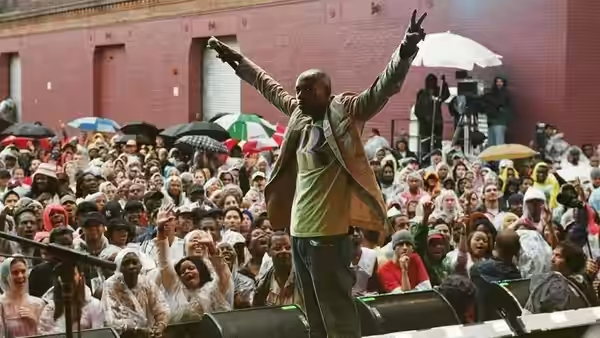
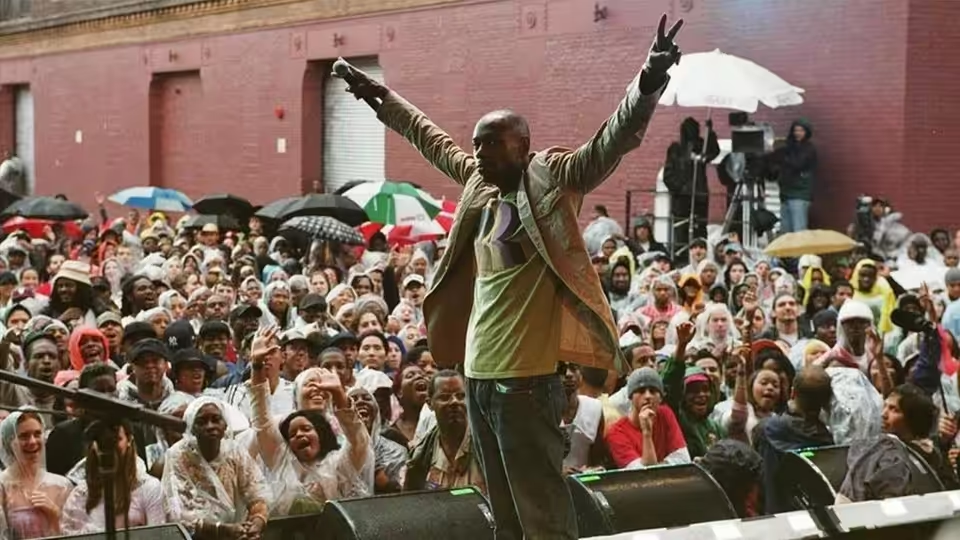
Dave Chappelle with arms raised standing before a massive outdoor crowd
Film review

Dave Chappelle's Block Party

2005 · Directed by Michel Gondry · 1h 40m

In a sentenceEveryone on the corner is happy and the camera keeps wandering off mid-song to talk to the neighbours

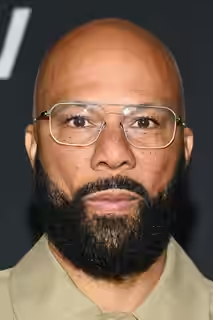
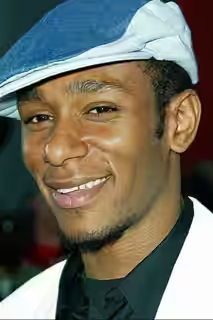
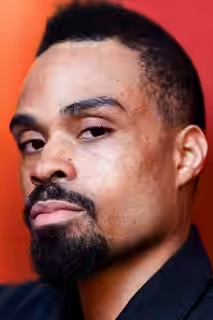
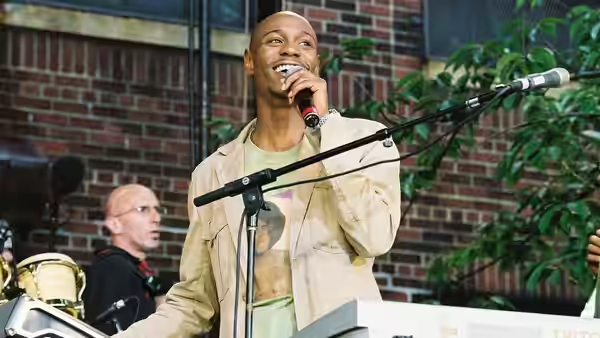
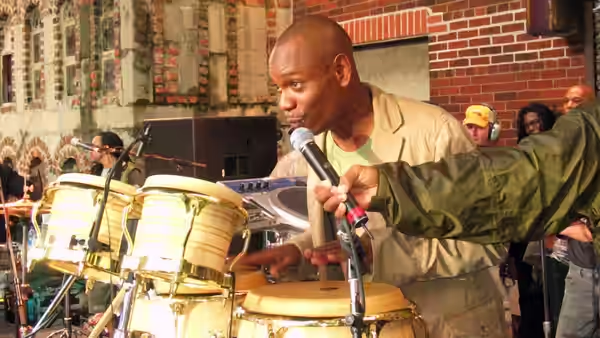
September 2004. Dave Chappelle, flush from a large television contract, decides to stage a free concert on a street corner in Bed-Stuy, Brooklyn, and to film it. He tours his home patch in Ohio handing out golden tickets to shop workers and passers-by, and invites a college marching band to come east and play. In Brooklyn a stage goes up across a residential road, beside a nursery and a ramshackle house a local couple have been building by hand for years. The bill is Erykah Badu, Common, Talib Kweli, Yasiin Bey (billed here as Mos Def), Bilal, Cody ChestnuTT and Lil’ Cease, and a reunion of Lauryn Hill, Wyclef Jean, Pras Michel and Jerry Duplessis of the Fugees. Michel Gondry’s cameras follow the preparation, the rehearsals and the day itself.

Fi1m review

Michel Gondry’s film of Dave Chappelle’s free 2004 concert on a Brooklyn corner is warm, funny and constantly interrupting its own music. The songs are strong and the host is better; you will wish the cameras had stayed on the stage a little longer.

In September 2004, with a large television contract newly signed, Dave Chappelle decided to throw a free concert on a street corner in Bed-Stuy, Brooklyn, and to invite everyone he liked. Michel Gondry, who had just made Eternal Sunshine of the Spotless Mind, came along with cameras. The result is 100 minutes of a good afternoon, which keeps cutting away from the songs to see what the host is up to. If the music is yours, it is an easy evening. If it is not, Chappelle alone is nearly enough.

He is the best thing in it, and not when he is on stage. Gondry follows him around his home patch in Ohio handing out golden tickets to people who have no idea who is on the bill: a woman behind a shop counter, a group of lads outside it, a college marching band whose directors look at him as though he has offered them the moon. Chappelle is quick, courteous and interested in the answers, and he gets more laughs here, off the cuff, than most comedians manage with a script.

The bill is one particular strand of American hip-hop and soul, and a strong one. Erykah Badu, Common, Talib Kweli and Yasiin Bey (billed here as Mos Def), with Bilal, Cody ChestnuTT and Lil’ Cease in support, and, reunited on one stage, Lauryn Hill, Wyclef Jean, Pras Michel and Jerry Duplessis of the Fugees. The sound is recorded live, in the open air, and it is rough in the way that suits it.

Ellen Kuras shoots it handheld, in daylight, with no lighting rig, so the performers are lit by whatever the sky gives them and the crowd is always in the frame. Lauri Faggioni’s stage is a scaffold across the road, and the backdrop is the neighbourhood: a nursery, and next to it a house a couple have been building by hand for decades and cheerfully lend to the production. Nothing has been dressed. That is the point, and it works.

The trouble is the cutting. Three editors, Jamie Kirkpatrick, Sarah Flack and Jeff Buchanan, have to hold a day-long concert, a week of preparation and a trip to Ohio in a hundred minutes, and their solution is to leave almost nothing whole. A song starts, gets a verse, and then we are in a rehearsal room or a doorway, and by the time we come back the chorus has gone. For a comedy that would be fine. For a concert film it means the picture keeps interrupting the one thing it has brought us to see, and we were irritated at being taken away from Badu just as she got going.

And yet. When the Ohio band arrives on the Brooklyn corner in full uniform and marches into a crowd that has never heard of them, we were caught off guard. It moved us more than we had any right to expect from a marching band. The reason is plain: Chappelle has spent the first half of the film promising ordinary people a day out, and here is the day, and here are the people, and every face on the pavement is doing what ours was. Gondry and Kuras hold on them. It is the one stretch where the film stops fidgeting.

The film catches Chappelle at a particular moment. He mentions the contract, and he seems both delighted by it and a little worn, a man who has plainly decided that the thing to do with money is spend it on other people. He plays host rather than star, and the film is better for it.

Against Wattstax (1973) and Stop Making Sense (1984), it is untidy; those trusted the stage and stayed on it. This one wants to be a concert, a portrait and a scrapbook and only fully manages the last. Watch it at home with the sound up and the neighbours warned, and accept that you will want more of nearly every song. That is a complaint, but it is the kind you make about a good party.

Critical consensus AI synthesised

73
Positive
11
Mixed
1
Negative
1

Most critics like it, and for the same two reasons: Dave Chappelle and the music. The reviews describe a sunny, good-natured concert film in which Chappelle is less a star than a genial host, wandering Bed-Stuy handing out invitations and getting laughs from whoever he meets. The lineup of socially conscious hip-hop and R&B acts draws almost as much praise, with the Fugees reunion and an Ohio marching band singled out as the moments that carry the day’s spirit.

The reservations fall on Michel Gondry’s direction. Several critics find the film loose to the point of disorganisation, and The Guardian and Slant Magazine both complain that his fast cutting interrupts performances just as they get going. The spread is otherwise narrow, with one outlier: the Evening Standard, reviewing years later, finds it noisy, adulatory and tuneless and objects to Chappelle himself. A couple of later pieces note that his subsequent career changes how the film reads.

Los Angeles Times
3 March 2006 · Kenneth Turan
85*

The musical lineup is formidable, but Chappelle's beguiling comic presence and ability to make people laugh at anything stands out as the film's biggest draw. The critic singles out Chappelle's generous, funny interactions with everyday people and the charming inclusion of an Ohio marching band for praise.

Read the full review →
Empire
26 June 2006 · Helen O'Hara
84*

The critic finds this a lively and gleeful concert film that celebrates music and comedy through its structure, which interweaves performances with preparation and comedy segments. The music from a generation of socially conscious hip-hop artists is highlighted as particularly exciting.

Read the full review →
The AV Club
28 February 2006 · B+ · Nathan Rabin
83

The critic finds the film a charming musical-concert documentary full of joy and wonder that unites Chappelle and director Gondry. It highlights the infectious sense of bliss in the performances and interactions, though some tension among the artists surfaces memorably.

Read the full review →
The Guardian
17 June 2006 · ★★★★
80

The film succeeds as a celebration of hip hop's potential and a reminder of its roots, with Chappelle in fine form handing out invitations and the artists delivering thoughtful content. Gondry's fast-cutting style sometimes disrupts the music footage, though the marching band moment stands out.

Read the full review →
The New York Times
3 March 2006 · Manohla Dargis
80*

The film is an exhilarating release-week portrait of Chappelle hosting a free block party concert in Bed-Stuy with a strong hip-hop and R&B lineup. The critic highlights how the movie feels like Chappelle's own, capturing his ebullient yet weary demeanor amid preparations and performances including a Fugees reunion.

Read the full review →
The Times
23 June 2006 · Victoria Segal
80*

Gondry’s energetic concert film is a sunny experience powered by the crowd's approval, the music's uplift, and Chappelle’s charisma as he assembles socially conscious hip-hop acts for a Brooklyn street party. Subsequent events around Chappelle cast the film in a different light.

Read the full review →

Straight answers AI written, from our review

Is Dave Chappelle's Block Party worth watching?
Dave Chappelle's Block Party is worth watching if the hip-hop and soul on the bill are yours, and we scored it 75. Chappelle is the best thing in it, handing out golden tickets in Ohio and playing host rather than star. The cutting keeps leaving songs half-finished, so expect to want more of nearly every performance.
How long is Dave Chappelle's Block Party, and what is it rated?
Dave Chappelle's Block Party runs 1h 40m. It is a comedy and music film.
Where can I watch Dave Chappelle's Block Party in the US?
Dave Chappelle's Block Party is available to rent from Amazon Prime Video and Apple TV from $3.99. Availability is checked daily; the links above go straight to each service.
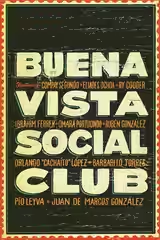
How does Dave Chappelle's Block Party compare to Buena Vista Social Club?
Dave Chappelle's Block Party is the funnier and untidier of the two, and Buena Vista Social Club is the one that stays on its musicians longer. Both care as much about the neighbours as the performers, and both cut away from the music more than they should. Choose Chappelle for the host and the party, Wenders for the faces and the playing.
What should I watch after Dave Chappelle's Block Party?
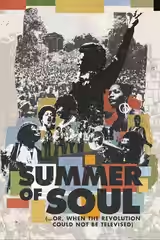
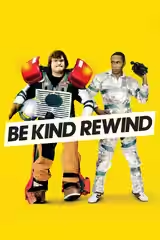
After Dave Chappelle's Block Party, try Buena Vista Social Club (1999, Fi1m 76): Wenders in Havana, another film that cares as much about the neighbours as the musicians. Then Summer of Soul (2021, Fi1m 87): Harlem, 1969, a free festival in a park, cut with rather more discipline; and Be Kind Rewind (2008, Fi1m 65): Gondry again, in New Jersey, with a neighbourhood making its own entertainment from nothing.

Cast

If you liked this, try…

  1. Wattstax (1973) · not on Fi1m yetA free concert in Los Angeles with Richard Pryor doing Chappelle’s job, three decades earlier.

  2. Stop Making Sense (1984) · not on Fi1m yetJonathan Demme plants the camera on the stage and never once wanders off.

  3. Buena Vista Social Club (1999, Fi1m 76)Wenders in Havana, another film that cares as much about the neighbours as the musicians.

  4. Summer of Soul (2021, Fi1m 87)Harlem, 1969, a free festival in a park, cut with rather more discipline.

  5. Be Kind Rewind (2008, Fi1m 65)Gondry again, in New Jersey, with a neighbourhood making its own entertainment from nothing.