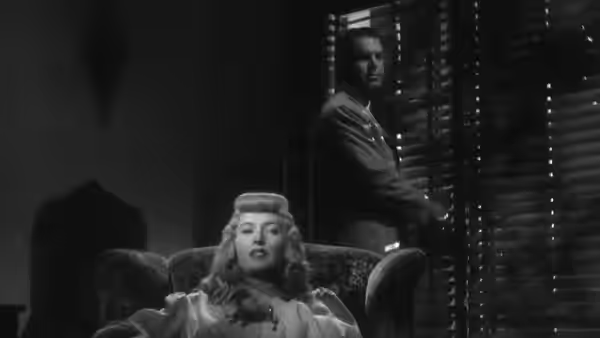
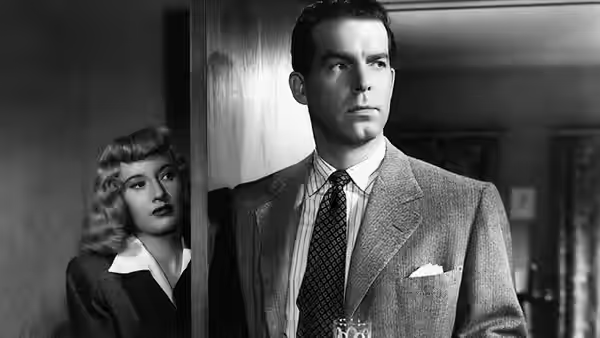
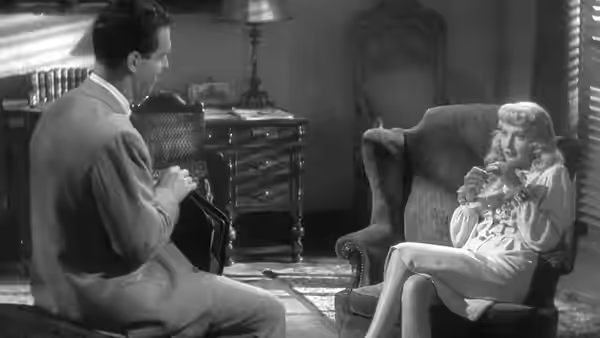
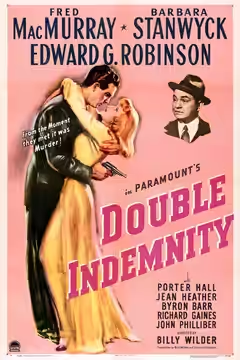
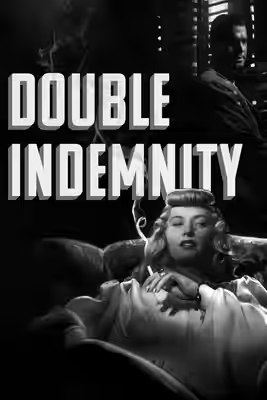
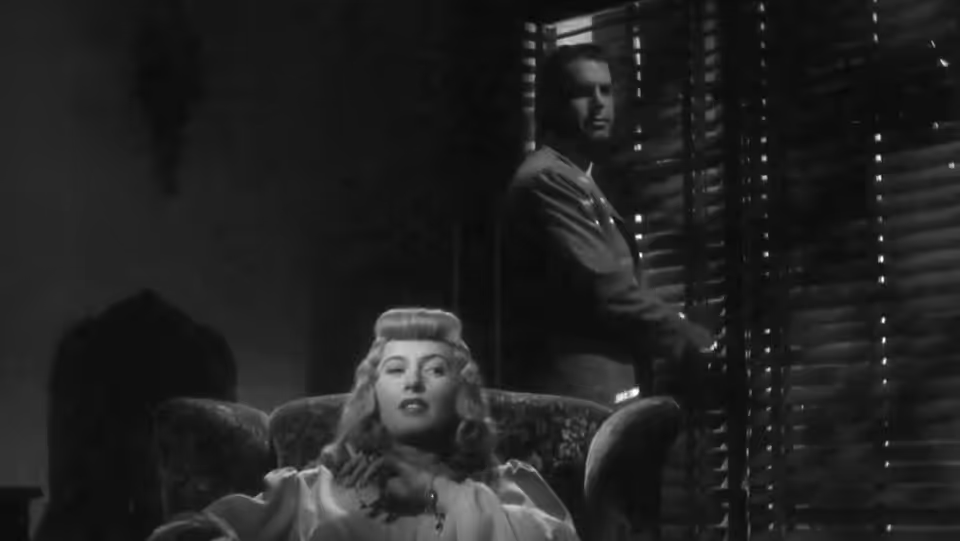
Phyllis Dietrichson (Barbara Stanwyck) reclining in an armchair as a man stands by the window
Film review

Double Indemnity

1944 · Directed by Billy Wilder · 1h 47m

In a sentenceAn insurance conversation with more sexual tension than most bedrooms

In Los Angeles, Walter Neff (Fred MacMurray) becomes entangled with Phyllis Dietrichson (Barbara Stanwyck), a woman whose interest in him brings desire and the possibility of murder into the same conversation. Their exchanges grow into a scheme involving deception and the insurance business. Barton Keyes (Edward G. Robinson) is another presence in Neff’s life, and their relationship complicates his involvement with Phyllis. Billy Wilder directs this crime thriller from a screenplay he writes with Raymond Chandler, drawing on a novel by James M. Cain. Neff’s voice-over guides the account of how the pair become involved.

Plays from YouTube when you press play; nothing loads from them until then.

Fi1m review

Billy Wilder’s crime thriller deserves its reputation, with viciously funny dialogue and three finely judged lead performances. Neff becomes willing to kill rather quickly, but we would recommend it to almost anyone.

Billy Wilder’s Double Indemnity is a crime thriller we would recommend without asking much about anyone’s taste. It makes desire, vanity and murder horribly easy to follow, giving us clever people whose intelligence does little to restrain them. Working from James M. Cain’s novel, Wilder and co-writer Raymond Chandler make the characters’ verbal cleverness part of what gets them into trouble. There is something unnerving about hearing people discuss appalling choices with such confidence.

Fred MacMurray plays Walter Neff with a smoothness that makes his bad judgement harder to dismiss. There is pleasure in hearing him work a conversation, and Barbara Stanwyck’s Phyllis Dietrichson always seems to have an answer ready. We laughed at their attempts to outtalk each other, then felt uneasy about how much we enjoyed their company. Wilder lets the flirtation run close enough to calculation that each apparent success in the exchange makes the prospect of trouble more convincing.

Stanwyck is particularly good at keeping Phyllis’s calculations from becoming a separate performance for the audience. She is cool enough to unsettle us without draining the flirtation of its pleasure, and MacMurray’s readiness to be impressed gives her something useful to play against. The weakness is how readily Neff’s attraction becomes willingness to contemplate murder. The screenplay relies on his vanity to cover a considerable distance, and there is a point where we can see it hurrying him along.

Edward G. Robinson, as Barton Keyes, gives the film its strongest relationship in his scenes with MacMurray. His conversational authority puts a different kind of pressure on Neff: suddenly the quick answer has to satisfy someone whose good opinion matters. Robinson finds warmth without softening the character’s intelligence, and the affection between the men makes Neff’s behaviour feel meaner. Wilder gives the two men room to enjoy each other’s intelligence.

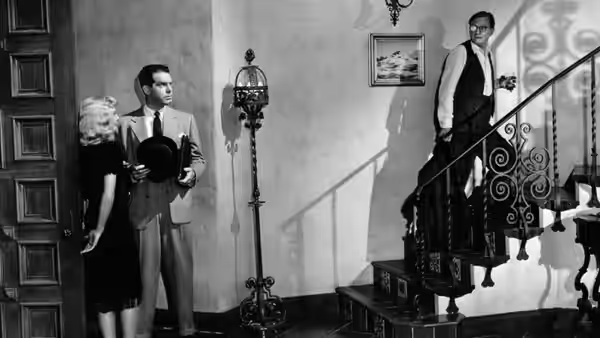
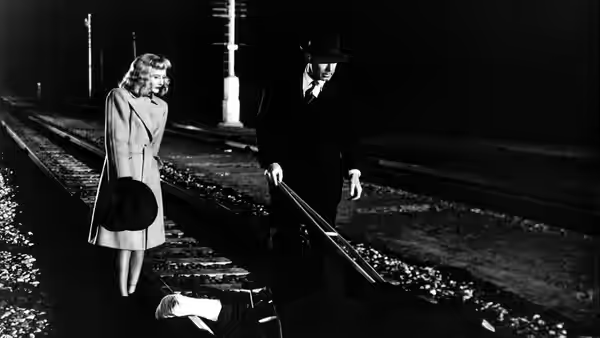
John F. Seitz uses hard contrasts of light and shadow, making the exchanges look more threatening than they sound. Even when the dialogue is funny, those shadows keep the unease in view. Doane Harrison’s editing gives the exchanges enough room for each actor’s response to count, while keeping the suspense from disappearing beneath the talk. We have time to notice how a reply lands before someone tries to take charge again.

Miklós Rózsa’s score presses harder on the danger than the performances need. The actors can make a pause troubling; the music occasionally insists that we notice. Neff’s voice-over is more persuasive, because MacMurray makes the carefully written sentences sound like a man’s preferred account of himself. Chandler and Wilder give him plenty to say, and much of the pleasure comes from listening for the self-approval beneath his fluency.

As film noir, Double Indemnity earns its reputation through the attention it pays to people enjoying their own bad judgement. Its dialogue is conspicuously written, and anyone wanting casual, naturalistic speech will need a few minutes to adjust. We would happily make that allowance for the precision of these three performances and the ugly intimacy of their conversations. Watch it for Stanwyck and stay alert whenever Robinson starts talking.
Critical consensus AI synthesised

82
Positive
13
Mixed
0
Negative
1

Most critics regard Double Indemnity as a defining film noir, with praise concentrated on its sharp dialogue, suspenseful plotting and unsentimental treatment of desire and deception. The reviews repeatedly single out Barbara Stanwyck’s calculating performance, Fred MacMurray’s work and Edward G. Robinson’s supporting role, with particular affection for the Robinson–MacMurray relationship. Billy Wilder’s direction also draws praise for sustaining tension, while several critics find caustic humour in the characters’ verbal sparring.

The spread is wide, though dissent is isolated rather than evidence of an even split. The New York Times admires the performances but finds the pace monotonous and the film long. The New Yorker questions how convincingly the protagonist’s crime is motivated. Slant Magazine offers the clearest rejection, finding the images drab, the story joyless and the leads short of chemistry, while still enjoying Robinson and parts of the dialogue and construction.

Radio Times
★★★★★ · Tony Sloman
100

This is one of the best-loved examples of film noir, with tight sexual tension and masterful visualisation of key plot points. The crackling screenplay and strong dialogue stand out as highlights.

Read the full review →
Evening Standard
10 April 2012
90*

The critic hails Double Indemnity as near-perfect, singling out Barbara Stanwyck's iconic, calculating femme fatale performance and the powerful reaction shot after the murder as one of cinema's greatest.

Read the full review →
The AV Club
13 September 2006 · A- · Noel Murray
90

Notes the film's hard-boiled dialogue, gallows humor and fatalism while acknowledging its slightly ridiculous nature. Highlights the strong performances and the way the characters' relationships are built on conversational one-upmanship.

Read the full review →
The Guardian
29 July 2012 · Philip French
90*

The film is a hard-boiled thriller that helped define film noir, greatly improving on Cain's novel with crackling dialogue and an amoral Los Angeles setting. The performances by Robinson, MacMurray and Stanwyck are standout, approaching perfection in their total absence of sentimentality.

Read the full review →
The Hollywood Reporter
24 April 2017 · THR Staff
85*

Praises the bold, unglossed story of murderers as hero and heroine and the crisp, literate dialogue from the Cain source. Singles out the three lead performances, especially Robinson's, and the suspenseful plotting for high praise.

Read the full review →
The Independent
6 November 2005
85*

The critic calls the film a bitter, brilliant noir re-issued in splendid form, praising its sharp script co-written by Wilder and Chandler that improves on the Cain novella with a rich voice-over narration and the Robinson-MacMurray relationship.

Read the full review →

Straight answers AI written, from our review

Is Double Indemnity worth watching?
Double Indemnity is worth watching for almost anyone, and we scored it 92. Billy Wilder's crime thriller has viciously funny dialogue and three finely judged performances from Fred MacMurray, Barbara Stanwyck and Edward G. Robinson. Our one reservation is how quickly Neff's attraction becomes a willingness to contemplate murder, and anyone wanting naturalistic speech will need a few minutes to adjust.
How long is Double Indemnity, and what is it rated?
Double Indemnity runs 1h 47m. It is a crime and thriller film.
Where can I watch Double Indemnity in Israel?
Double Indemnity is available to rent from Apple TV from ₪16.90. Availability is checked daily; the links above go straight to each service.
How violent or frightening is Double Indemnity, and is it suitable for children?
Double Indemnity carries a UK PG certificate, and its menace comes from talk and shadow rather than anything shown. The plot turns on a murder plan and the flirtation is charged, but the film keeps violence off screen and there is nothing here to frighten a child. Younger viewers are more likely to be bored by the dialogue than disturbed by it.
How does Double Indemnity compare to Body Heat?
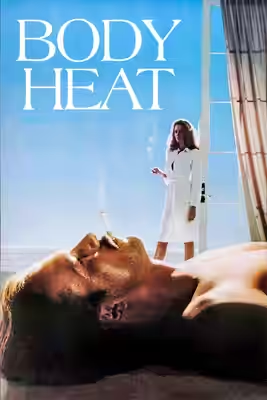
Double Indemnity is the sharper and more disciplined of the two, and the one we would recommend first. Body Heat is sweatier and more openly seductive, with William Hurt and Kathleen Turner making foolish desire entirely credible, but its debt to older noir shows too plainly at times. Watch Wilder's film for the dialogue and Kasdan's for the heat.
Is Double Indemnity based on a true story or a book?
Double Indemnity is based on a novel by James M. Cain, not a true story. Billy Wilder and Raymond Chandler wrote the screenplay from it, and they make the characters' verbal cleverness part of what gets them into trouble. Knowing the book is not necessary; the film explains itself through Neff's voice-over and the conversations that drive the scheme.
What should I watch after Double Indemnity?
After Double Indemnity, try Ossessione (1943, Fi1m 82): For another close, uncomfortable look at desire curdling into murderous calculation. Then Body Heat (1981, Fi1m 83): For a sweatier encounter with temptation, greed and dangerously confident men; and The Last Seduction (1994, Fi1m 81): Linda Fiorentino supplies the calculation, while the men keep overestimating their usefulness.

Cast

Awards

Academy Awards, 1945

Nominated
Best Actress
Nominated
Best Cinematography, Black-and-White
Nominated
Best Director
Nominated
Best Original Dramatic or Comedy Score
Nominated
Best Picture
Nominated
Best Sound
Nominated
Best Writing, Adapted Screenplay

If you liked this, try…

  1. Ossessione (1943, Fi1m 82)For another close, uncomfortable look at desire curdling into murderous calculation.

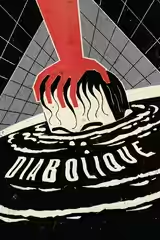
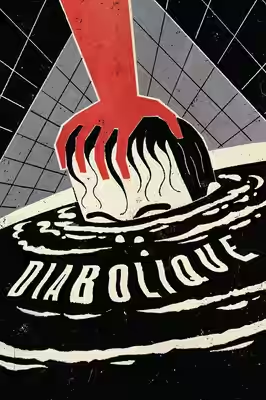
  2. Les Diaboliques (1955) · not reviewed yetAnother carefully arranged crime, with suspense built from distrust between its planners.

  3. Body Heat (1981, Fi1m 83)For a sweatier encounter with temptation, greed and dangerously confident men.

  4. The Last Seduction (1994, Fi1m 81)Linda Fiorentino supplies the calculation, while the men keep overestimating their usefulness.

  5. The Handmaiden (2016, Fi1m 85)For elaborate deception, sexual bargaining and the pleasure of watching confidence misfire.

Free account

Know what to watch tonight

Two lists that know where things are streaming, collections you can share, your own score beside ours, and Discover that remembers what you have seen.

  • Want to see, sorted by what is streaming now
  • Seen, with your score out of ten
  • No adverts, ever