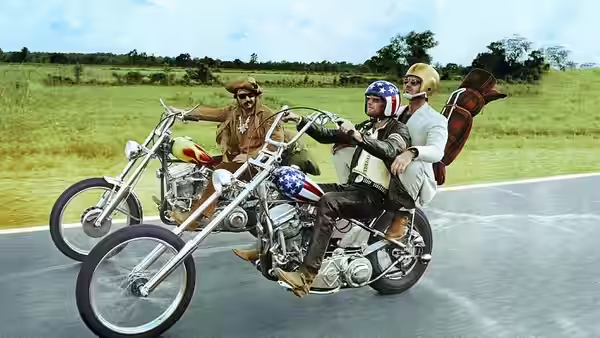
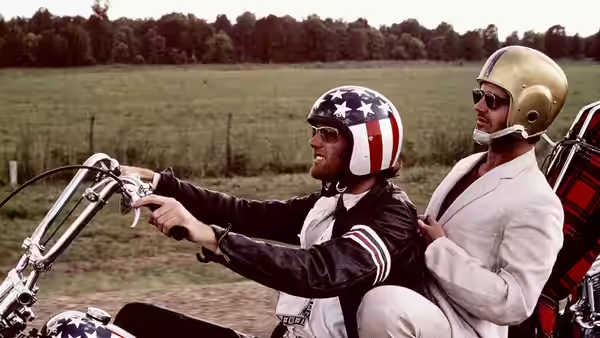
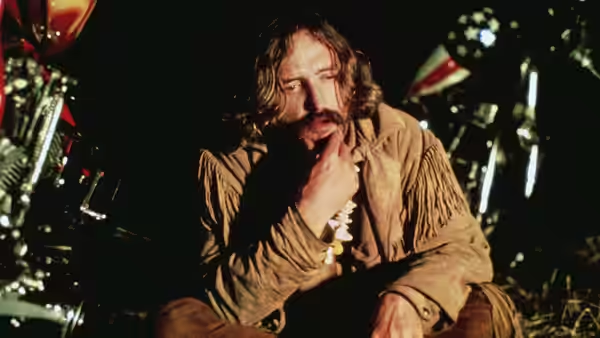
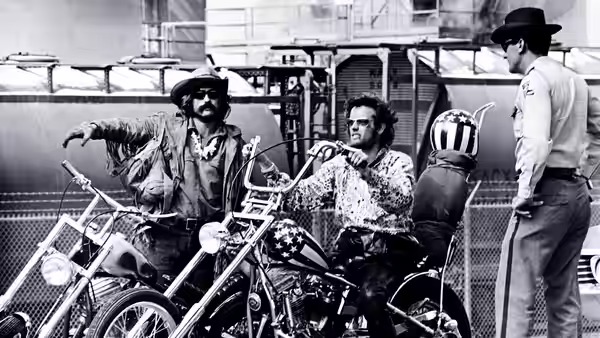
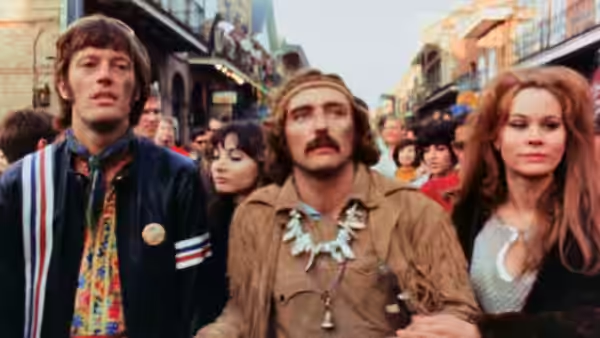
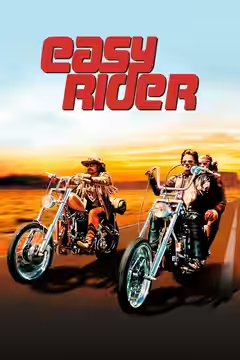
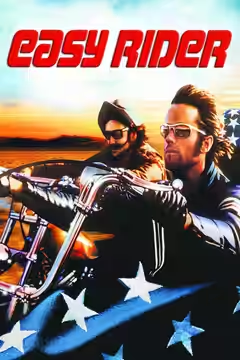
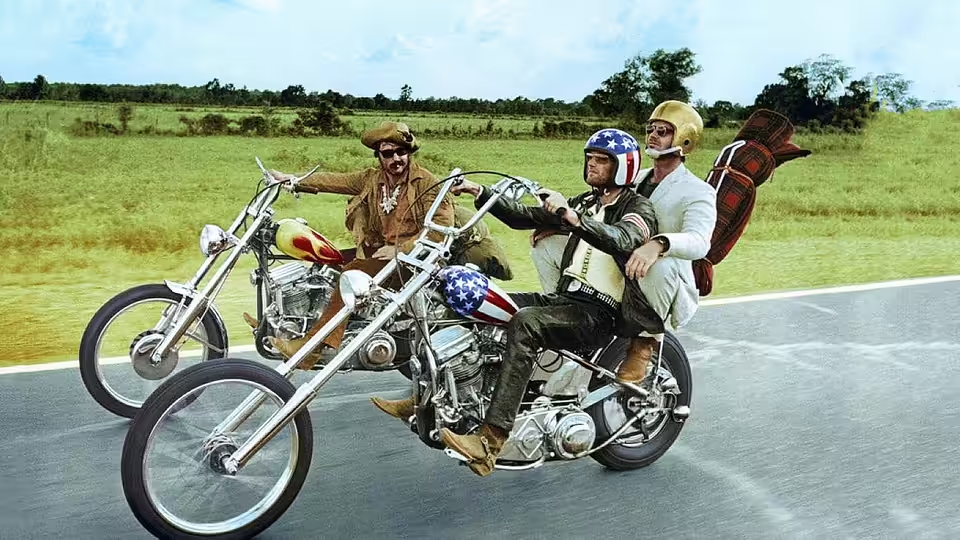
Billy (Dennis Hopper) and Wyatt (Peter Fonda) ride their motorcycles along a country road
Film review

Easy Rider

1969 · Directed by Dennis Hopper · 1h 36m

In a sentenceWe wanted to keep travelling through this America, though not necessarily with these men

Wyatt (Peter Fonda) and Billy (Dennis Hopper) travel through America, beginning a journey whose freedom rests on drug dealing. They want to live outside the expectations of conventional society, but getting away does not settle what they are looking for. Alongside them in the story is George Hanson (Jack Nicholson), another figure in the film’s account of alienation and discontent. The road takes the men through American landscapes as they pursue the possibility of living differently, beyond the routines and obligations they want to escape.

Plays from YouTube when you press play; nothing loads from them until then.

Fi1m review

Dennis Hopper’s road film is worth watching for its landscapes and Jack Nicholson’s persuasive humanity. The wandering has a pull, though thin characterisation sometimes leaves the scenery doing more work than the people.

Easy Rider is worth the journey, though its men are not always the most rewarding company. Dennis Hopper makes a road film whose strongest passages give us time to look, and whose weaker ones ask us to supply more depth than the writing provides. The scenery and Jack Nicholson are reasons enough to stay with it. At 96 minutes, it has room to wander without becoming an ordeal, but some of the wandering is more absorbing than the rest.

The drug-dealing premise complicates the film’s sympathy for men who want to live outside conventional society. The screenplay, credited to Peter Fonda, Dennis Hopper and Terry Southern, leaves a useful awkwardness here: freedom does not become admirable simply because its seekers find ordinary life unsatisfactory. We do not need these men tidied up before taking an interest in them. The trouble is that the writing sometimes seems satisfied with having established their discontent, when there are further questions worth asking about it.

László Kovács gives the landscapes enough weight to make travelling the film’s main pleasure. We were unexpectedly stirred by those views. The space in them makes the desire to keep moving easy to understand, and for a while that is enough to carry our interest in the men. The photography allows us to feel the attraction of their journey without needing to find every aspect of their behaviour sympathetic, which is a considerable part of why the film works.

Donn Cambern’s editing helps the images gather into a loose, drifting journey, with individual impressions allowed to retain their force. That looseness suits Dennis Hopper’s direction, which rarely seems anxious to hurry us towards the next piece of information. It also gives the weaker passages room to expose themselves: when our interest in the people falters, another stretch of travelling cannot always restore it. A firmer cut might have helped in places, though too much tidiness would have cost the film something we value.

Peter Fonda’s Wyatt and Dennis Hopper’s Billy can feel too dependent on what they represent, leaving us to supply some of the curiosity their characters ought to provoke. Jack Nicholson, as George Hanson, makes the film’s discontent easier to recognise as an individual person’s feeling. There is enough nuance in his performance to keep us interested without constantly translating him into a statement about America. His presence also makes the limitations of the central pair more noticeable, which is hardly his fault.

For a road film, the balance between travelling and spending time with the travellers matters. Here, the landscapes carry more than their share, and the film’s interest in alienation occasionally becomes too general to be affecting. Still, its countercultural spirit has enough conviction to survive that vagueness. The wish to live differently remains recognisable, even when the men pursuing it have not made a particularly persuasive case for themselves.

Anyone looking for a tightly built drama should make another choice. This rewards a willingness to spend time looking, and a tolerance for people whose dissatisfaction is easier to grasp than their intentions. Watch it when the prospect of going somewhere matters more than arriving promptly.

Critical consensus AI synthesised

80
Positive
6
Mixed
2
Negative
0

Most critics respond warmly to Easy Rider, with praise clustering around its countercultural spirit, visual freedom and Jack Nicholson’s performance. The reviews repeatedly single out Nicholson for giving the film emotional weight and a persuasive expression of alienation. Hopper’s direction also draws praise for its fluid, observant movement, dreamlike passages and evocative landscapes. Several critics find that its account of social unease retains its force, rather than treating it solely as a document of its period.

The reservations concern how convincingly the film makes its case and how consistently its craft holds up. The Hollywood Reporter argues that the drug-dealing premise weakens its argument, despite a strongly positive verdict. Den of Geek acknowledges its historical importance and visceral impact but finds the artistry uneven. The balance is favourable, though unavailable text for two reviews limits what can be said about the less enthusiastic responses.

Radio Times
★★★★★ · Tom Hutchinson
100

The critic praises the film’s mythic force and its influence on road movies. They single out Jack Nicholson’s performance as an eloquent expression of youthful alienation.

Read the full review →
Slant Magazine
9 May 2016 · ★★★★½ · Chuck Bowen
90

Bowen finds the film timeless, with its diagnosis of modern social malaise gaining force over time. He praises Hopper’s vivid, dreamlike visual flow and the film’s evocative landscapes.

Read the full review →
RogerEbert.com
85*

The retrospective review presents the film favorably. It singles out the film’s countercultural spirit as a key strength.

Read the full review →
The Hollywood Reporter
26 June 1969 · John Mahoney
82*

Mahoney gives the film a strongly positive verdict, while noting that its drug-dealing premise weakens its argument. He especially praises Jack Nicholson’s performance as the film’s emotional and thematic anchor.

Read the full review →
Variety
14 May 1969 · festival review · Gene Moskowitz
80*

Moskowitz finds the film perceptive, poetic, and far above typical films on the subject. He praises Hopper’s fluid, observant direction and the film’s evocative visual style.

Read the full review →
The New York Times
15 July 1969 · Vincent Canby
65*

The article appears to be a review, but its verdict and specific praise or complaint cannot be verified from the inaccessible page. The available page text provides no review details.

Read the full review →

Straight answers AI written, from our review

Is Easy Rider worth watching?
Easy Rider is worth watching for its landscapes and Jack Nicholson’s persuasive humanity, and we score it 76 out of 100. We find its drifting journey absorbing, though the central characters sometimes lack depth. It suits a patient appetite for a road film better than a wish for tightly built drama.
How long is Easy Rider, and what is it rated?
Easy Rider runs 1h 36m. It is an adventure and drama film.
Where can I watch Easy Rider in Azerbaijan?
Easy Rider is not on any streaming or rental service in Azerbaijan at the moment. It is available in 21 other countries; change your country at the top of the page to see where. Availability is checked daily.
How violent or frightening is Easy Rider, and is it suitable for children?
Easy Rider carries a UK 18 certificate, so it is an adult film rather than a choice for children or younger teenagers. Its journey begins with drug dealing, but we cannot offer a specific assessment of violence or frightening material from the certificate alone; squeamish viewers should not take that as reassurance.
How does Easy Rider compare to Five Easy Pieces?
Easy Rider offers the more landscape-led journey, while we recommend Five Easy Pieces as the stronger choice for character-focused drama. Both explore dissatisfaction, with Jack Nicholson giving it a recognisable human presence. The former asks for patience with thinly drawn travellers; the latter gives us a difficult man worth spending time with, though it sometimes indulges his behaviour.
What should I watch after Easy Rider?
After Easy Rider, try Five Easy Pieces (1970, Fi1m 88): Another unsettled American journey, with Jack Nicholson making dissatisfaction hard to dismiss. Then Vagabond (1985, Fi1m 90): For a harder look at freedom, isolation and life without shelter; and The Motorcycle Diaries (2004, Fi1m 77): Another journey across a continent, with more faith in what travel can teach.

Cast

Awards

Academy Awards, 1970

Nominated
Best Supporting Actor
Nominated
Best Writing, Original Screenplay

If you liked this, try…

  1. Five Easy Pieces (1970, Fi1m 88)Another unsettled American journey, with Jack Nicholson making dissatisfaction hard to dismiss.

  2. Alice in the Cities (1974) · not on Fi1m yetA gentler road film that lets unplanned company change the journey.

  3. Vagabond (1985, Fi1m 90)For a harder look at freedom, isolation and life without shelter.

  4. The Motorcycle Diaries (2004, Fi1m 77)Another journey across a continent, with more faith in what travel can teach.

  5. The Straight Story (1999, Fi1m 88)A slower American road journey, with patience for the people along it.