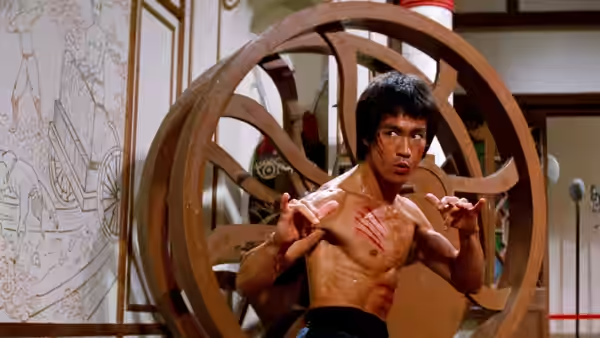
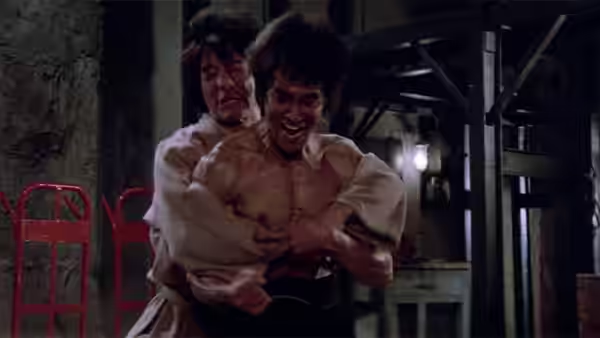
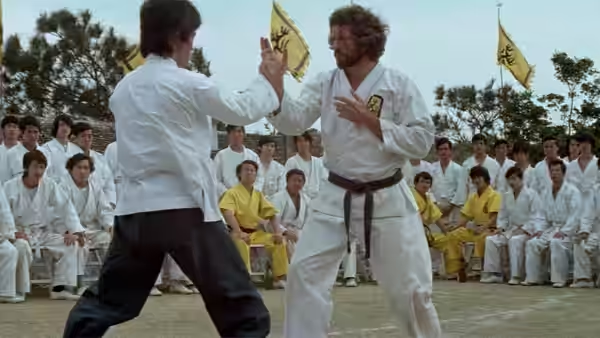
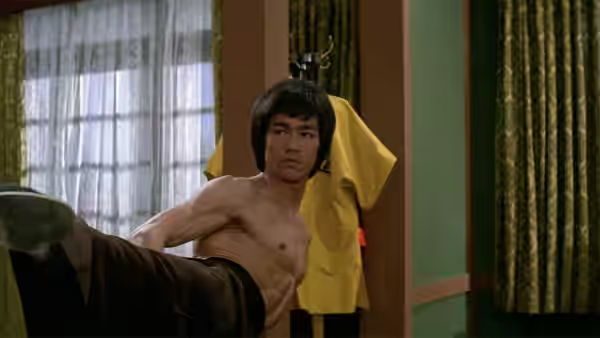
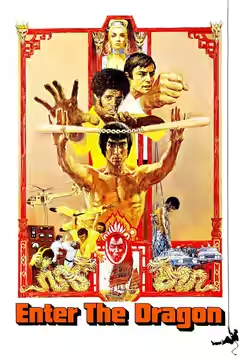
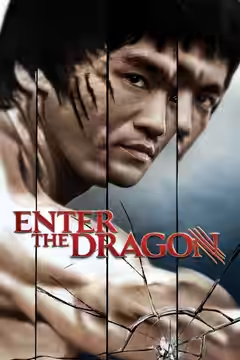
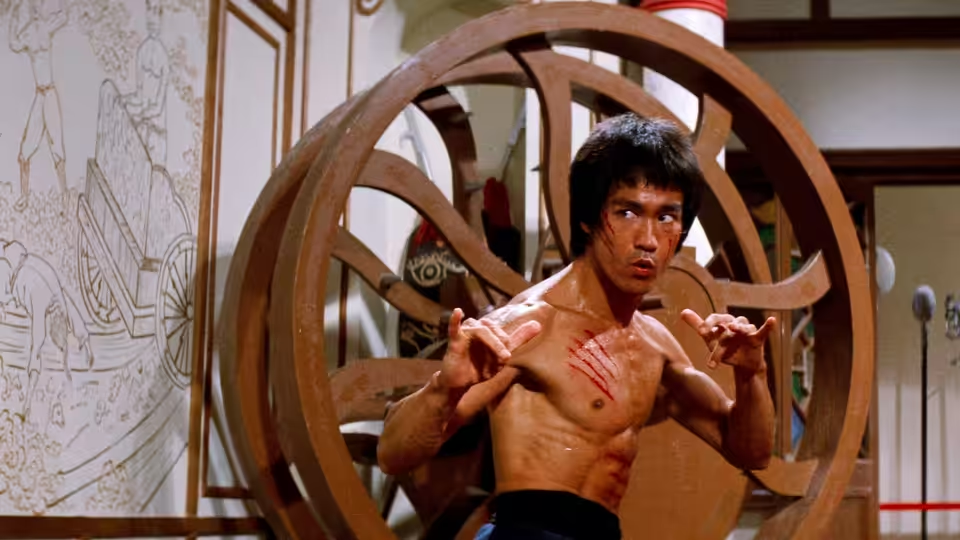
Lee (Bruce Lee) stands shirtless before a circular wooden partition, hands raised in a fighting stance
Film review

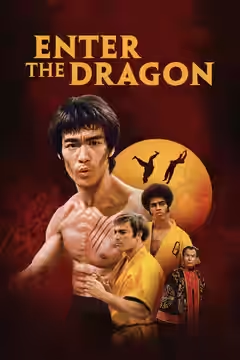
Enter the Dragon

1973 · Directed by Robert Clouse · 1h 42m

In a sentenceBruce Lee makes the fighting look effortless and the plot look like an interruption

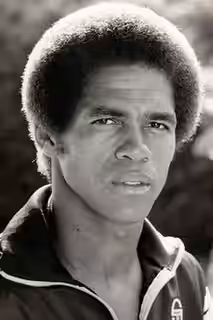
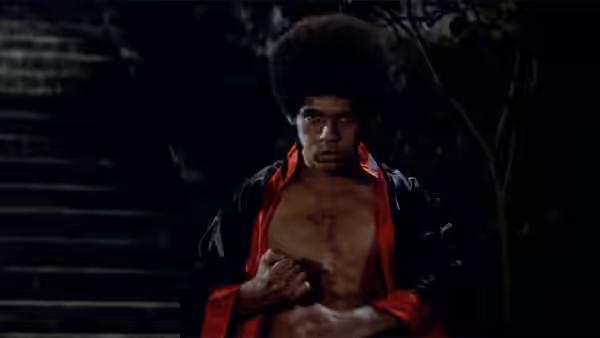
Lee (Bruce Lee) faces a mission to crack the forbidden island of Han (Shih Kien). Roper (John Saxon) and Williams (Jim Kelly) also enter a story of martial-arts combat and espionage, with the island as the focus of the assignment. Lee’s fighting skills are central to the task, but the spy business gives him an objective beyond simply winning a fight. Han is the man whose territory must be penetrated, and the mission takes the action into his domain.

Plays from YouTube when you press play; nothing loads from them until then.

Fi1m review

Bruce Lee makes Enter the Dragon worth the evening through precision, speed and sheer presence. Robert Clouse keeps the fights clear and lively, though the spy plot makes us impatient for the next one.

Enter the Dragon is worth an action lover’s evening, even though its story rarely deserves the attention its leading man commands. Robert Clouse gives Bruce Lee enough space to make fighting interesting as performance, and the pleasure survives some ordinary writing. The spy business supplies a reason for the action without giving us much to ponder between bouts. At 102 minutes, the film can accommodate these diversions, but we are seldom sorry when it returns to Lee.

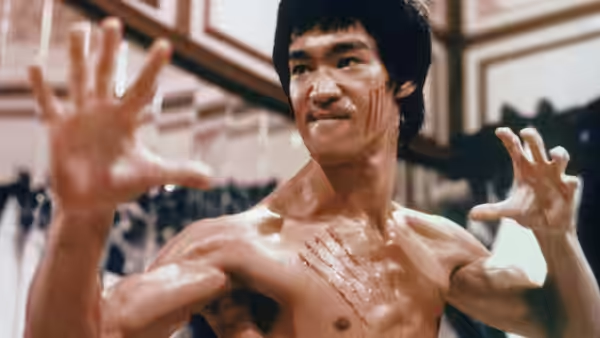
Lee’s appeal is the precision: the force of a movement never obscures how carefully it has been made. We were exhilarated by his fighting, because his speed does not turn the action into an unreadable rush. He seems to think quickly as well as move quickly, giving the fights a sense of decisions being made under pressure. That makes his skill interesting to watch even without much help from the story, and keeps our attention on the person delivering the blows.

Gil Hubbs’s cinematography serves that performance without trying to compete with it. The action is readable, and we have time to appreciate a movement instead of simply accepting that a blow has landed. Peter Cheung, Kurt Hirschler and George Watters keep the editing brisk without making Lee’s ability feel like an effect assembled after the event. The pace matters, but so does the opportunity to see what the performer is doing; the film generally gives us enough of both to enjoy the fighting without struggling to follow it.

Michael Allin’s screenplay is less sure about what should happen when nobody is fighting. The espionage material feels familiar, and the attention paid to Roper repeatedly interrupts the attraction without adding much to it. John Saxon gives Roper a welcome ease, while Jim Kelly makes Williams good company; neither is the reason the film feels slower away from Lee. The difficulty is that these passages ask for interest which the writing has not done enough to earn, however agreeable the people carrying it may be.

Lalo Schifrin’s music helps, supplying a rhythmic energy that keeps the routine material from becoming solemn. It encourages us to enjoy the adventure without insisting that we mistake it for a serious account of espionage. Shih Kien’s Han likewise benefits from a film that requires little subtlety from its antagonist, only enough presence to justify the trouble taken over him. The broadness can be agreeable, even when the dialogue gives us little to remember, and Clouse wisely avoids treating every exchange as something we ought to find important.

By the standards we ask of martial-arts entertainment, the important achievement is that the fights remain enjoyable as performances. Lee rewards close attention, and Clouse recognises that he need not complicate the presentation to keep us interested. The familiar intrigue is a limitation we can live with, although it prevents the film from being equally satisfying whenever the fists stop. It carries an 18 certificate, worth noting before making it a family choice. Choose it for an action evening, with a little patience for the passages between fights.
Critical consensus AI synthesised

67
Positive
6
Mixed
1
Negative
1

Most critics find Enter the Dragon effective, entertaining martial-arts cinema, with praise concentrated on Bruce Lee rather than the story around him. His precision, balletic movement and screen presence recur across the positive reviews, as does the energy he brings to the fights. Several critics also credit the direction and pacing for keeping the action fluid and brisk. The broad agreement is that Lee makes the film compelling even when its other elements are ordinary.

Reservations centre on an unremarkable spy plot, uneven supporting material and a loss of energy when Lee is offscreen. Slant Magazine finds both the espionage story and Roper unnecessary, despite praising the film’s efficiency. The spread is wide, though the strongest dissent stands apart from the generally favourable response: Time Out dismisses the film as inferior Lee and objects to what it sees as an American attempt to colonise the kung-fu market.

Radio Times
★★★★ · David Parkinson
80

The critic calls it a kung fu classic and says Bruce Lee is at his balletic, brilliant best. Lee’s martial-arts performance is singled out for praise, while the film’s status as his last completed work adds a tragic note.

Read the full review →
The Hollywood Reporter
13 August 1973 · Alan R. Howard
80*

Howard finds the film lavish, corny, and consistently entertaining, while lamenting that Lee did not live to become the star he deserved to be. He especially praises Lee’s charismatic presence and self-staged fight sequences, and also commends Clouse’s fluid direction.

Read the full review →
Slant Magazine
24 August 2013 · ★★★/4 · Chris Cabin
75

Cabin finds the film hugely satisfying as entertainment, though not quite a classic. He praises its efficient direction, buoyant action visuals, and exact pacing, while noting the spy plot and Roper character feel unnecessary.

Read the full review →
The Guardian
9 August 2023 · Peter Bradshaw
75*

Bradshaw finds the martial-arts classic still compelling, though it loses energy when Lee is offscreen. He especially praises Lee’s balletic movements and mesmeric screen presence.

Read the full review →
Variety
31 July 1973 · Variety Staff
75*

The review finds the actioner an exciting, effective example of martial-arts entertainment despite its unremarkable plot. It especially praises Bruce Lee’s action performance and the film’s fast-moving fights.

Read the full review →
Empire
1 January 2000 · Ian Nathan
60*

Nathan finds the film uneven by conventional standards but still worthwhile. He praises Bruce Lee’s martial-arts ability and singles out the mirror duel as sensational.

Read the full review →

Straight answers AI written, from our review

Is Enter the Dragon worth watching?
Enter the Dragon is worth an action lover’s evening for Bruce Lee’s precise, exhilarating fighting, and we score it 79 out of 100. The clear camerawork and brisk editing let us appreciate his skill, though the familiar spy plot requires patience whenever the fighting stops.
How long is Enter the Dragon, and what is it rated?
Enter the Dragon runs 1h 42m. It is an action film.
Where can I watch Enter the Dragon in Ecuador?
Enter the Dragon is not on any streaming or rental service in Ecuador at the moment. It is available in 30 other countries; change your country at the top of the page to see where. Availability is checked daily.
How violent or frightening is Enter the Dragon, and is it suitable for children?
Enter the Dragon carries a UK 18 certificate, so it is an adult action choice rather than a film for children or younger teenagers. Martial-arts combat is central, with clearly presented blows and sustained attention to the fighting; we would steer viewers uneasy with physical violence towards something gentler.
How does Enter the Dragon compare to The 36th Chamber of Shaolin?
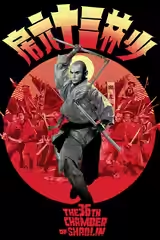
Enter the Dragon is our choice for Bruce Lee’s speed and presence, while The 36th Chamber of Shaolin offers more rewarding martial-arts storytelling through its patient attention to training. We find the espionage between Lee’s fights less engaging; the alternative suits viewers who enjoy learning the movements as much as seeing them put to use.
What should I watch after Enter the Dragon?
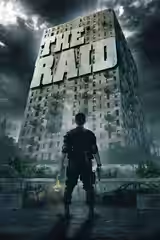
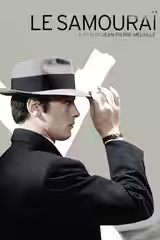
After Enter the Dragon, try The 36th Chamber of Shaolin (1978, Fi1m 83): For patient martial-arts storytelling that makes learning the movements part of the pleasure. Then The Raid (2011, Fi1m 83): For close-quarters combat that spends considerably less time on the introductions; and Le Samouraï (1967, Fi1m 88): For another commanding performer who makes precise movement more interesting than dialogue.

Cast

If you liked this, try…

  1. The 36th Chamber of Shaolin (1978, Fi1m 83)For patient martial-arts storytelling that makes learning the movements part of the pleasure.

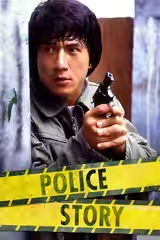
  2. Police Story (1985) · not on Fi1m yetFor action whose physical invention makes its comic interruptions worth forgiving.

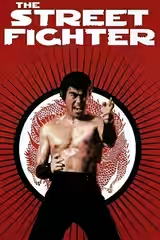
  3. The Street Fighter (1974) · not on Fi1m yetFor martial-arts fighting with a nastier temper and less interest in elegance.

  4. The Raid (2011, Fi1m 83)For close-quarters combat that spends considerably less time on the introductions.

  5. Le Samouraï (1967, Fi1m 88)For another commanding performer who makes precise movement more interesting than dialogue.