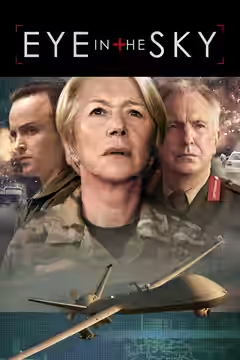
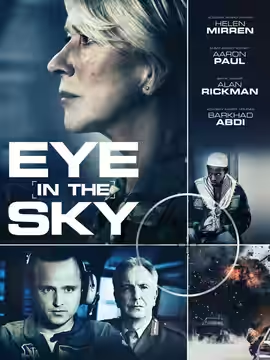
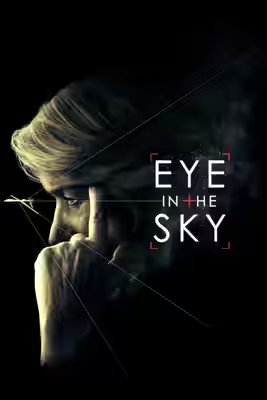
Gavin Hood’s drone thriller is lean, well cast and properly tense, and it stacks its dilemma so openly that you can watch the deck being arranged. Alan Rickman, in his final on-screen role, is the reason to stay to the end.
Guy Hibbert’s script has one idea and it is a good one. A joint British, American and Kenyan operation has a house in Nairobi under watch, three people on a kill list are inside, and the question of whether to put a missile through the roof is passed from room to room, up chains of command and across time zones, for 102 minutes. Eye in the Sky is tense, well acted and honest about what it is doing, and what it is doing is rigging the argument in full view of the audience. It is a good evening. It is not quite the serious film it keeps telling us it is.
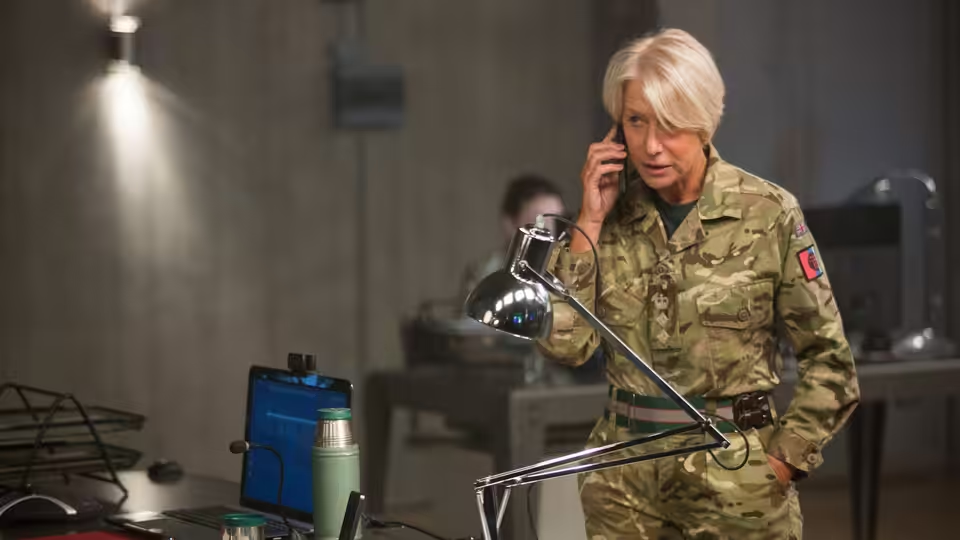
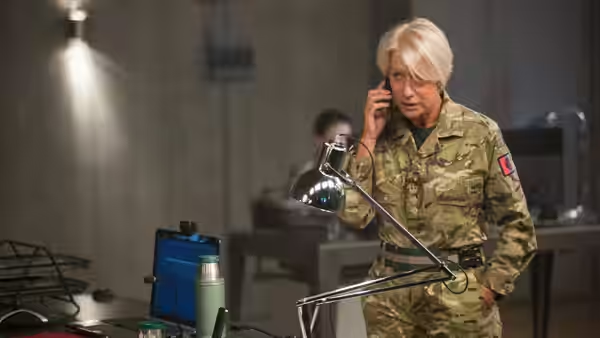
Johnny Breedt gives each party its own box. Colonel Powell (Helen Mirren) runs the operation from a grey bunker in Northwood; Lieutenant General Benson (Alan Rickman) sits in a Whitehall committee room with ministers and better furniture; the pilots Watts (Aaron Paul) and Gershon (Phoebe Fox) fly the drone from a metal trailer in the Nevada desert. Haris Zambarloukos lights the rooms cold and the Nairobi street warm and dusty, so the one place where anyone might die is the only one that looks like somewhere people live. Much of that street reaches us through the drone’s own camera, flat and grey and ringed with crosshairs, and Hood is right to leave it alone. The picture of a child inside a targeting box does the job by itself.
Rickman, in his final on-screen role, is the best thing in it. He opens the film buying a doll for a granddaughter, and he spends the rest of it in a chair, watching politicians refer the decision upwards and letting a long face do the work. Mirren plays Powell as a woman who decided an hour ago and is now managing the people who have not; it is a hard, unlovely, effective performance. Barkhad Abdi, as the agent Farah on the ground, steering a beetle-sized camera through a window and then trying to buy a child’s bread without being noticed, gives the film its only scenes where the danger is physical and nobody has to explain it. Aaron Paul has the thankless job of being the conscience. He is asked to cry, and he does, and it is the one place where the acting works harder than the writing.
Megan Gill’s editing holds it together. Four locations, a dozen speaking parts, a legal argument about the collateral damage estimate that would be inert on paper, and she cuts it so the pressure never drops: a question asked in Surrey, a shrug in Whitehall, a hand over a trigger in Nevada, a girl setting out loaves against a wall. When Alia (Aisha Takow) put her bread stall down inside the blast radius we felt our stomach go, exactly as intended, and about a minute later we felt annoyed at how neatly we had been cornered. Both feelings lasted to the end.
That is the film’s trouble. Hibbert has built his dilemma out of a known terrorist, a suicide vest and a small girl with a hula hoop, and arranged them so that the cost of each choice is as high as it can be. It is a thought experiment with faces on, and a thought experiment can only end one of two ways. The politicians are written small: Jeremy Northam’s Woodale wants someone else to decide, Monica Dolan’s Northman wrings her hands, Richard McCabe’s Matherson wants the paperwork in order. Paul Hepker and Mark Kilian’s score lays low strings under every pause to tell us the pause is serious. It is the one department working too hard.
Hood made Tsotsi (2005) and Rendition (2007), and this is nearer the first: a small thing done with care rather than a large thing done with alarm. Set beside 12 Angry Men (1957) it is thinner, because Lumet’s jurors could change their minds and these people mostly cannot. Set beside most films about drones it is sharper, because it bothers to show the legal machinery and the people hiding inside it.
See it at home, where the committee rooms look like committee rooms and Rickman’s exasperation can be enjoyed at close range. Bring someone who argues. It will give you something to argue about and then, in its last ten minutes, tell you what to think, which is the one thing it should have left alone.