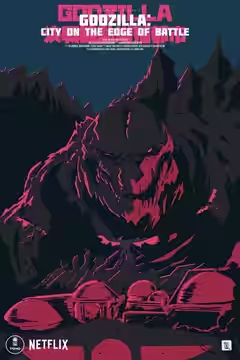
The second of the animated Godzilla trilogy is better designed than written. The nanometal city is a fine idea and Godzilla, when he finally walks, is properly enormous, but we sit through an hour of committee before either matters.
Godzilla: City on the Edge of Battle is the middle film of a trilogy, and it behaves like one. Godzilla: Planet of the Monsters (2017) brought humanity back to the Earth it had fled, twenty thousand years having passed on the ground while the ship was away, and ended with an attack on Godzilla that went the way attacks on Godzilla go. Directors Hiroyuki Seshita and Kōbun Shizuno now have to find the survivors something to do for 101 minutes, and the script, credited to Gen Urobuchi, Sadayuki Murai and Tetsuya Yamada, finds them a city. It is a good idea and it is arrived at slowly. This is a decent film with a tedious hour in the middle of it.
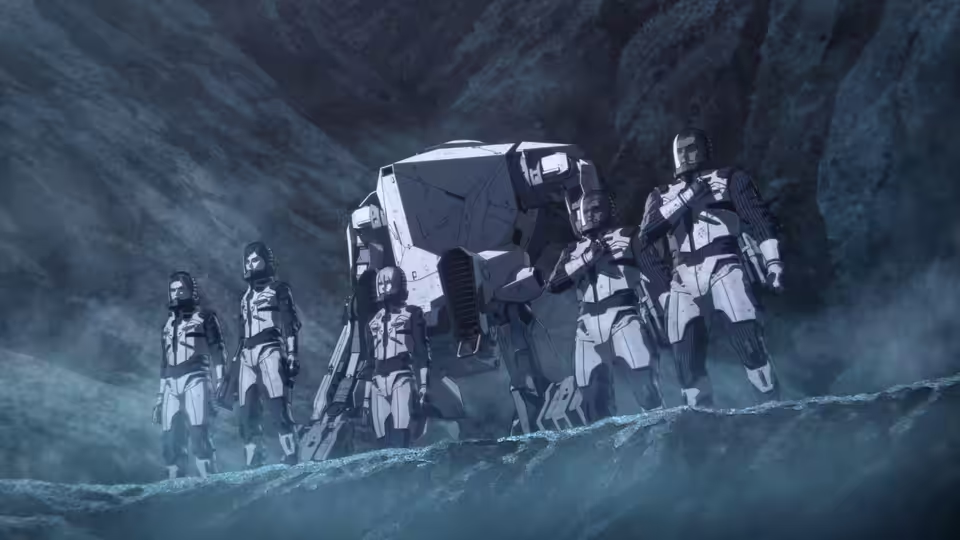
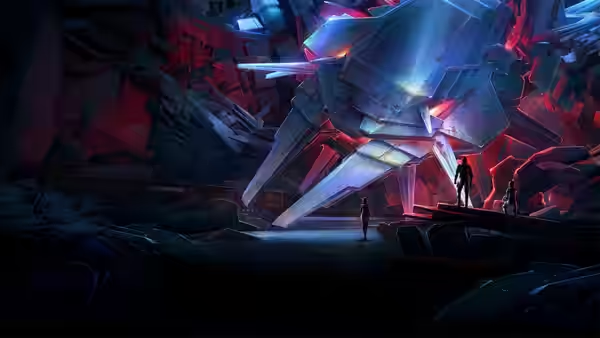
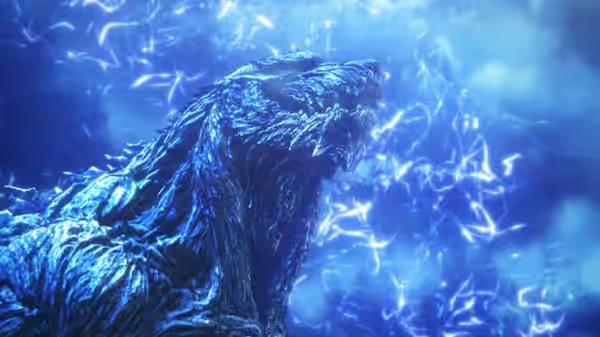
The city is the best thing in it. Naoya Tanaka and Ferdinando Patulli have designed a place grown rather than built, grey nanometal spreading like coral over a valley, with spires that lean, floors that slide and, at its centre, the head of the Mechagodzilla that never got finished. It is lit from inside in a sour orange, and when the survivors first walk into it they look the right size, which is to say tiny. The Houtua village is its opposite: woven huts, bone tools, powders and paint, and twin girls who speak with their minds. Godzilla himself is 300 metres of plated hide and glowing fissures, and the film understands that the way to show that is to put a man in the corner of the frame.
The human figures are another matter. The cel-shaded computer animation the trilogy uses gives everyone a face like a well-made mask and a walk like a careful one, and since most of this film is people standing in control rooms explaining things, we spent a great deal of time looking at masks. Mulu-elu Galu-gu (Junichi Suwabe) explains nanometal. Martin Lazzari (Tomokazu Sugita) explains the Houtua. Metphies (Takahiro Sakurai) explains nothing and smiles, which is at least a choice. Haruo Sakaki (Mamoru Miyano) shouts that Godzilla must die, the others agree, and the meeting continues.
There is an idea under all this. The Bilusaludo, the alien engineers who made the metal, want to become it, and believe the humans’ squeamishness about that is why the planet was lost. The humans think a species that turns itself into a weapon has stopped being a species. That is a proper science fiction argument, and the film has it as an argument, in a room, rather than as anything anyone does until the last twenty minutes. Yuko Tani (Kana Hanazawa), the pilot the film most wants us to worry about, is given a handful of lines and a cockpit before it asks us to worry.
We were bored, and around the hour mark we were cross about being bored by a film with a 300-metre monster in it. Then the film remembers the monster. Godzilla comes over the ridge, the city’s floors begin to move, the flying suits go up, and we sat forward and stayed forward until the end. Aya Hida’s cutting, which has spent an hour going from one talking face to another, finds a rhythm here, setting the monster’s slow steps against the city’s fast machinery. Takayuki Hattori’s score is brass and drums with a choir under the fight; in the talking scenes it is barely there, and we did not miss it.
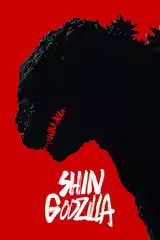
As a Godzilla film it has less Godzilla than almost any we can think of, and a fraction of what the title promises. Shin Godzilla (2016) made its endless committee scenes the point, and made them funny; here they are what happens while we wait. The Houtua are the trilogy’s most interesting invention, a people who have lived beside the monster and made a religion of an egg, and the film uses their village as somewhere to wake up and then largely forgets them.
It ends, as middle films do, on a promise of the next one, and the promise is a good one. See it if you saw the first and mean to see the third; it makes no sense otherwise and does not pretend to. About thirty of its 101 minutes are the film on the poster.