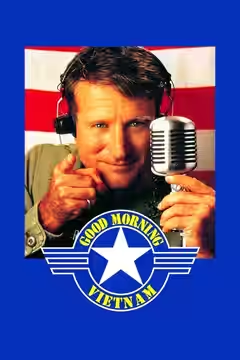
Robin Williams’s broadcasts are the reason to watch and they are reason enough. Around them Barry Levinson builds a film about Vietnam that keeps flinching from Vietnam, and its last half hour asks for a seriousness the script has not earned.
Barry Levinson’s film takes a disc jockey to Saigon in 1965 and hands him a microphone, and for long stretches that is the whole of the plan. Mitch Markowitz’s script gives Adrian Cronauer a station that plays Mantovani, two superiors who hate him and a general who likes him, and then gets out of the way so Robin Williams can talk. When Williams is talking, this is one of the funniest things put on film in the 1980s. When he stops, the film has to be about the war it has been using as scenery, and it does not know how.
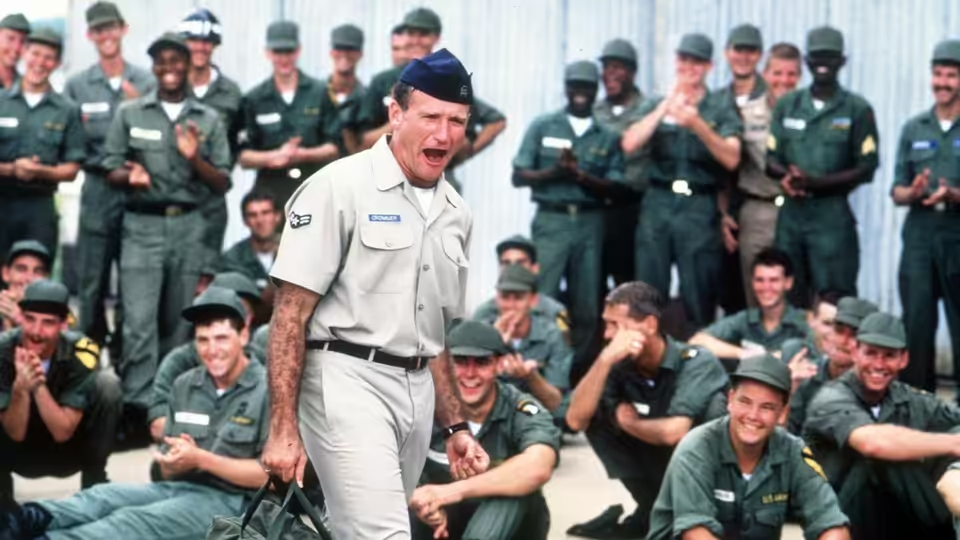
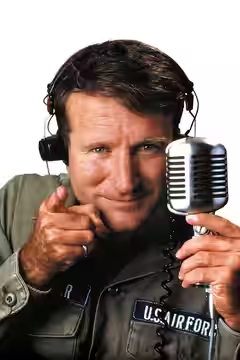
The broadcasts are the reason to see it. Williams does the weather as a stand-up routine, reads the wire copy in three voices, argues with himself as a colonel and a hippie, and plays records the station has never let through the door. Stu Linder cuts away from the booth to the men listening, in trucks and mess halls and out on the road, and their laughter is the film’s argument for him: nobody else on the air is talking to them like adults. We laughed out loud, more than we expect to at a comedy of this age, and it was the speed that did it. A joke is not finished before the next has begun, and Williams keeps three going at once, dropping each before it can wear out.
Around the booth, the station corridors hold the film’s best-written comedy. Bruno Kirby plays Lieutenant Hauk as a man who has read about humour and would like to try some, a polka enthusiast who cannot understand why the troops do not want his show, and Kirby never once lets us see him wink. J. T. Walsh’s Sergeant Major Dickerson is the opposite, all cold procedure and no jokes at all, and the film is sharpest when these two try to discipline a man who simply talks faster than they do. Forest Whitaker, as Garlick, spends much of the film watching Williams from the side of the frame and doing the reacting for us.
Peter Sova shoots Saigon in hard yellow daylight, the streets thick with bicycles and market stalls, and he shoots the station as a warren of low ceilings and glass, so the booth looks like the only room in the country with air in it. Roy Walker’s station has the particular dinginess of a place where nobody has moved a filing cabinet in years. Keith Denny puts Williams in loud shirts against everyone else’s khaki, which tells us where he stands before he opens his mouth. Alex North’s score mostly stays out of it, and rightly, because the records are doing the work. The one time the film lets a song carry the picture, Louis Armstrong’s “What a Wonderful World” over soldiers, children, a market and an explosion, Levinson makes his only sustained statement about the war, and it is a good one.
The trouble is everything the film means to be serious about. Cronauer follows a young woman, Trinh, through the streets and bribes his way into teaching her English class, and Chintara Sukapatana is asked to be looked at, to refuse politely, and little more. The classroom scenes are the sweetest in the film, but they are about how well Cronauer teaches and how much his students adore him; Trinh is the excuse for them. Tung Thanh Tran’s Tuan, her brother, has the one storyline that belongs to a Vietnamese character, and the film handles it as a lesson for most critics.
The second half takes a turn we will not describe. What we can say is that when it arrives, the film asks us to feel Cronauer’s hurt as if it were the point of the last two hours, and we found we could not. We grew impatient, and the impatience was specific: the man we had been enjoying had stopped being funny, and the man who replaced him had nothing to say that the Armstrong sequence had not said better in three minutes.
Levinson’s Diner (1982) put six men in a booth and gave every one of them a turn. Here there is one man, and the film loves him a little too plainly: everyone who does not laugh at Cronauer is either a fool or a villain, and the picture never considers that a man doing impressions on the radio might not be the most important person in Saigon. Watch it for the booth. When its door closes, you may find yourself waiting for it to open again. It runs 121 minutes and carries a 15.