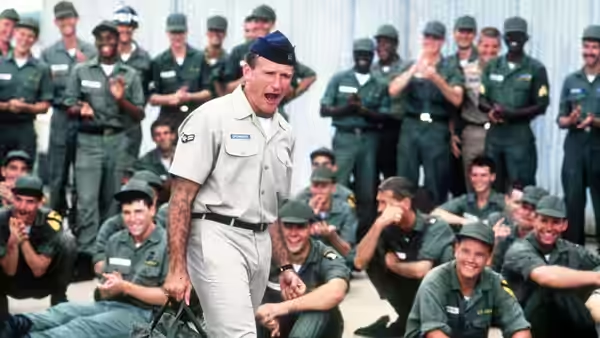
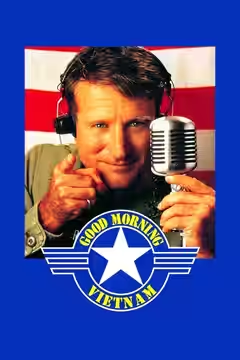
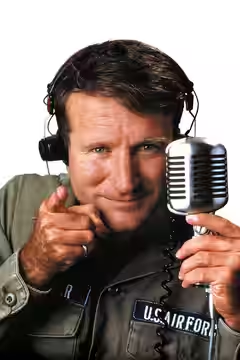
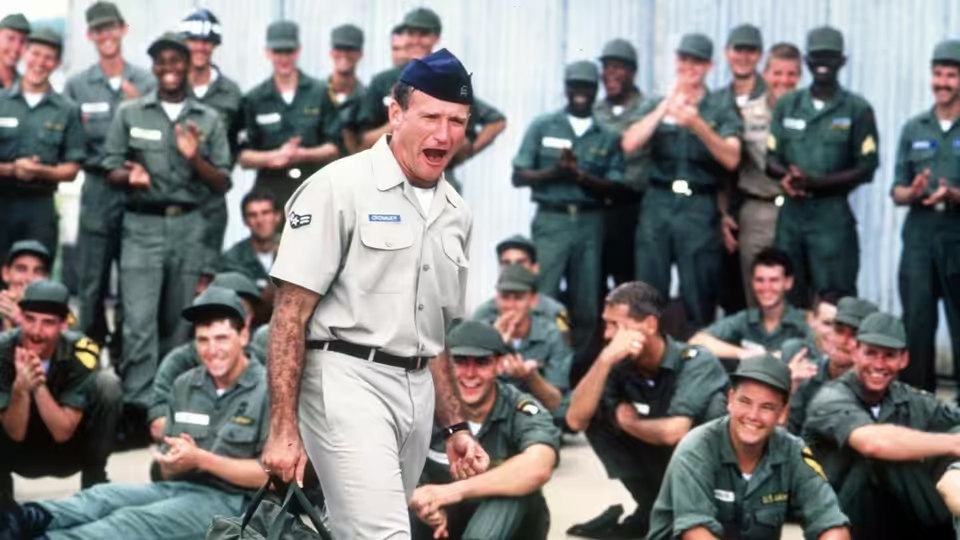
Adrian Cronauer (Robin Williams) entertains laughing soldiers outdoors
Film review

Good Morning, Vietnam

1987 · Directed by Barry Levinson · 2h 01m

In a sentenceRobin Williams talks for two hours and the war waits in the corridor for its turn

Saigon, 1965. Airman Adrian Cronauer (Robin Williams) flies in from Crete to become the new morning disc jockey on Armed Forces Radio, collected at the airport by the eager Private Edward Garlick (Forest Whitaker). The station plays Mantovani and reads censored news. Cronauer’s first broadcast opens with a bellowed greeting, a barrage of impressions and a record the station has never allowed on air, and the troops love it. His superiors do not: Lieutenant Steven Hauk (Bruno Kirby), a polka enthusiast who believes he is funny, and Sergeant Major Dickerson (J. T. Walsh), who wants him gone. Only General Taylor (Noble Willingham) is amused. Off air, Cronauer follows a young woman called Trinh (Chintara Sukapatana) through the streets, bribes his way into teaching her English class, and befriends her watchful brother Tuan (Tung Thanh Tran).

Fi1m review

Robin Williams’s broadcasts are the reason to watch and they are reason enough. Around them Barry Levinson builds a film about Vietnam that keeps flinching from Vietnam, and its last half hour asks for a seriousness the script has not earned.

Barry Levinson’s film takes a disc jockey to Saigon in 1965 and hands him a microphone, and for long stretches that is the whole of the plan. Mitch Markowitz’s script gives Adrian Cronauer a station that plays Mantovani, two superiors who hate him and a general who likes him, and then gets out of the way so Robin Williams can talk. When Williams is talking, this is one of the funniest things put on film in the 1980s. When he stops, the film has to be about the war it has been using as scenery, and it does not know how.

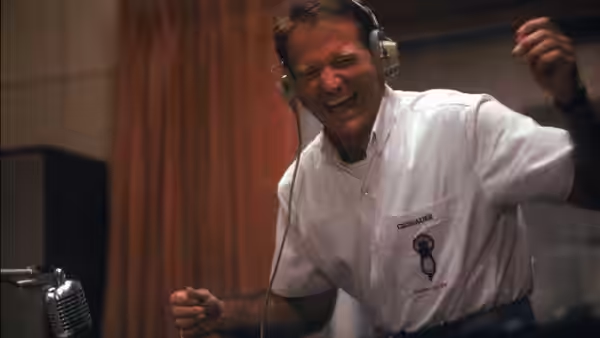
The broadcasts are the reason to see it. Williams does the weather as a stand-up routine, reads the wire copy in three voices, argues with himself as a colonel and a hippie, and plays records the station has never let through the door. Stu Linder cuts away from the booth to the men listening, in trucks and mess halls and out on the road, and their laughter is the film’s argument for him: nobody else on the air is talking to them like adults. We laughed out loud, more than we expect to at a comedy of this age, and it was the speed that did it. A joke is not finished before the next has begun, and Williams keeps three going at once, dropping each before it can wear out.

Around the booth, the station corridors hold the film’s best-written comedy. Bruno Kirby plays Lieutenant Hauk as a man who has read about humour and would like to try some, a polka enthusiast who cannot understand why the troops do not want his show, and Kirby never once lets us see him wink. J. T. Walsh’s Sergeant Major Dickerson is the opposite, all cold procedure and no jokes at all, and the film is sharpest when these two try to discipline a man who simply talks faster than they do. Forest Whitaker, as Garlick, spends much of the film watching Williams from the side of the frame and doing the reacting for us.

Peter Sova shoots Saigon in hard yellow daylight, the streets thick with bicycles and market stalls, and he shoots the station as a warren of low ceilings and glass, so the booth looks like the only room in the country with air in it. Roy Walker’s station has the particular dinginess of a place where nobody has moved a filing cabinet in years. Keith Denny puts Williams in loud shirts against everyone else’s khaki, which tells us where he stands before he opens his mouth. Alex North’s score mostly stays out of it, and rightly, because the records are doing the work. The one time the film lets a song carry the picture, Louis Armstrong’s “What a Wonderful World” over soldiers, children, a market and an explosion, Levinson makes his only sustained statement about the war, and it is a good one.

The trouble is everything the film means to be serious about. Cronauer follows a young woman, Trinh, through the streets and bribes his way into teaching her English class, and Chintara Sukapatana is asked to be looked at, to refuse politely, and little more. The classroom scenes are the sweetest in the film, but they are about how well Cronauer teaches and how much his students adore him; Trinh is the excuse for them. Tung Thanh Tran’s Tuan, her brother, has the one storyline that belongs to a Vietnamese character, and the film handles it as a lesson for most critics.

The second half takes a turn we will not describe. What we can say is that when it arrives, the film asks us to feel Cronauer’s hurt as if it were the point of the last two hours, and we found we could not. We grew impatient, and the impatience was specific: the man we had been enjoying had stopped being funny, and the man who replaced him had nothing to say that the Armstrong sequence had not said better in three minutes.

Levinson’s Diner (1982) put six men in a booth and gave every one of them a turn. Here there is one man, and the film loves him a little too plainly: everyone who does not laugh at Cronauer is either a fool or a villain, and the picture never considers that a man doing impressions on the radio might not be the most important person in Saigon. Watch it for the booth. When its door closes, you may find yourself waiting for it to open again. It runs 121 minutes and carries a 15.
Critical consensus AI synthesised

59
Positive
3
Mixed
3
Negative
2

The reviews are split, and almost all of them agree on one thing: Robin Williams. The praise clusters on his improvised radio broadcasts, the rapid-fire impressions and the energy they lend a comedy most critics find funny in bursts. Even the harsher notices call the performance a virtuoso one. Variety also finds room for Bruno Kirby’s comic moments among the supporting cast.

They part on everything around him. The most common reservation is that the film falters when it turns serious: several critics find the later stretches clumsy, the script thin and the characters flat. The spread is wide, from warm approval at The Hollywood Reporter to outright dismissal. The AV Club goes furthest, finding the manic radio routines themselves the problem and preferring the supporting cast’s quieter exchanges with their officers, while Time Out judges the whole idea thin and bathetic despite the performance.

The Hollywood Reporter
21 December 1987 · Duane Byrge
85*

Byrge finds the film a funny, sharply aimed comedy that develops a dark personal undercurrent. He especially praises Robin Williams’s brilliant comic performance and the pain behind it.

Read the full review →
Empire
20 December 2005 · Barry McIlheney
75*

The review finds the film a triumph overall, despite a clumsy final half-hour. It praises Robin Williams’s improvised radio performances and the energy they bring to the comedy.

Read the full review →
The New York Times
23 December 1987 · Janet Maslin
70*

The review presents the film as an energetic showcase for Robin Williams. It singles out his comic performance as the film’s chief strength.

Read the full review →
Radio Times
★★★ · Peter Freedman
60

Freedman finds the film entertaining when Robin Williams is performing but less successful when it turns serious. He praises Williams’s comic performance and the film’s portrayal of Vietnamese people as real individuals.

Read the full review →
Variety
31 December 1986 · Variety Staff
60*

The review finds the film an exciting, energetic ride, but says its comedy turns inward instead of engaging with the surrounding war. It praises Robin Williams’s rapid-fire impressions and Bruno Kirby’s comic moments.

Read the full review →
Los Angeles Times
25 December 1987 · MICHAEL WILMINGTON
50*

Wilmington finds the film shallow and uneven, but says Robin Williams’ performance largely makes it special. He praises Williams’ anarchic, improvised broadcasts while faulting the script for flat characters and obvious humor.

Read the full review →

Straight answers AI written, from our review

Is Good Morning, Vietnam worth watching?
Good Morning, Vietnam is worth watching for Robin Williams's radio broadcasts, which are among the funniest things put on film in the 1980s, and we scored it 68. Around the booth, Barry Levinson's film keeps flinching from the war it uses as scenery, and its serious last half hour asks for a weight the script has not earned. See it for Williams and be patient with the rest.
How long is Good Morning, Vietnam, and what is it rated?
Good Morning, Vietnam runs 2h 01m. It is a comedy and drama film.
Where can I watch Good Morning, Vietnam in Israel?
Good Morning, Vietnam is available to rent from Apple TV from ₪16.90. Availability is checked daily; the links above go straight to each service.
How violent or frightening is Good Morning, Vietnam, and is it suitable for children?
Good Morning, Vietnam carries a UK 15 and a US R, and it is a comedy first, with the war kept mostly off screen. There is one sequence that sets Louis Armstrong against an explosion, and the second half turns darker, but this is not a combat film and there is little to frighten. Not for young children; older teenagers should manage it.
How does Good Morning, Vietnam compare to M*A*S*H?
Good Morning, Vietnam is the gentler and more sentimental of the two, and *M*A*S*H* is the better film. Altman's Korea puts the jokes and the blood in the same tent and never apologises, while Levinson keeps the war in the corridor and loves his star too plainly. Choose Williams for one man talking; choose Altman for an ensemble, if you can stomach the surgeons' bullying.
What should I watch after Good Morning, Vietnam?
After Good Morning, Vietnam, try *M*A*S*H* (1970, Fi1m 72): Altman’s Korea, where the jokes and the blood share a tent and nobody apologises. Then Full Metal Jacket (1987, Fi1m 81): Kubrick’s same-year Vietnam: barracks comedy that goes somewhere far colder.

Cast

Awards

Academy Awards, 1988

Nominated
Best Actor

If you liked this, try…

  1. M*A*S*H (1970, Fi1m 72)Altman’s Korea, where the jokes and the blood share a tent and nobody apologises.

  2. Radio Days (1987) · not on Fi1m yetWoody Allen remembers what a wireless meant to a household before television arrived.

  3. Talk Radio (1988) · not on Fi1m yetOliver Stone locks a shock jock in a booth overnight and turns the lights down.

  4. The Scent of Green Papaya (1993) · not on Fi1m yetSaigon seen from a kitchen rather than a jeep, quiet and unhurried.

  5. Full Metal Jacket (1987, Fi1m 81)Kubrick’s same-year Vietnam: barracks comedy that goes somewhere far colder.

Good Morning, Vietnam (1987) review: Robin Williams is the whole show (Israel) | Fi1m