Neill Blomkamp’s races have real speed and weight, and David Harbour gives the film a pulse. Around them, Zach Baylin and Jason Hall’s script hits every beat of the underdog sports film in order, and too much of the rest is an advert for the car.
Neill Blomkamp has made a film from a PlayStation game and from a true story, and Gran Turismo spends 135 minutes trying to serve both. Zach Baylin and Jason Hall’s script follows Jann Mardenborough (Archie Madekwe) from the bedroom where he plays the game to the paddock where he drives the car, and it stops at every station of the underdog sports film on the way: the father who wants him to get a job, the coach who thinks the whole thing is a stunt, the rich rival, the montage, the podium. None of it is done badly. All of it is done in the order you expect.
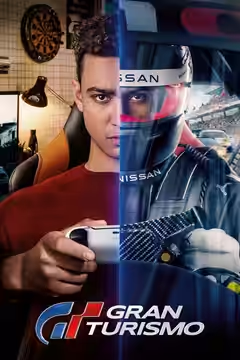
The races are what keep it upright. Jacques Jouffret puts his cameras on the cars, low by the wheels and hard against the tarmac, so that speed reads as speed and not as a smear with a soundtrack. Blomkamp’s one real idea is to let the game show through the film: a car dissolves into the wire frame a player would see, a coloured line paints itself onto the road where the game would draw it, and for a second we are inside Jann’s head, reading a real corner as a diagram. It is a gimmick, and it is the right one for this story. We sat forward during a race at the Red Bull Ring, when Jann goes for a gap the men around him have not seen, and we stayed forward until the flag.
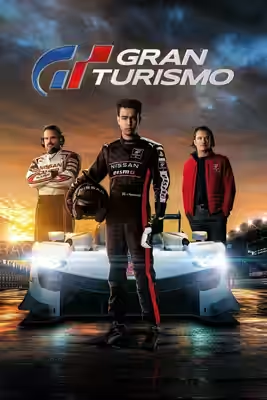
David Harbour plays Jack Salter as a man who has agreed to do something stupid for money and intends to say so. He is heavy, grey-stubbled and unimpressed, and he takes the most worn scenes in the script, the pep talk, the dressing-down in the garage, and plays them as if he has spent years in garages. When he tells the recruits that no game can teach them what fear does to a driver, we believed him, and this film badly needs someone we believe. Madekwe is quieter, a watchful boy who does his best acting with his face inside a helmet, which is an odd thing to say about a lead and is meant as praise. Djimon Hounsou, as the father, gets two good scenes and a great deal of standing in doorways.
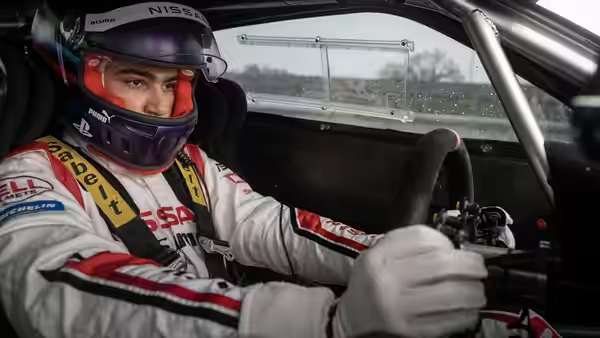
Orlando Bloom plays Danny Moore, the Nissan marketing man whose idea GT Academy is, and the film is fond of him. The recruits race in Nissans, arrive in Nissans and are photographed beside Nissans, and Terry Anderson’s costumes are honest about the arrangement: the race suits are logos with a person inside. A sports film paid for by the sport is nothing new. This one keeps stopping to thank the sponsor, and it writes the salesman as a visionary, so that a story about a boy and his father keeps turning into a story about a car company.
Colby Parker, Jr. and Austyn Daines cut the racing fast and now and then too fast; there are overtakes we could not follow, and a driving film should never leave us guessing who is in front. Lorne Balfe, Andrew Kawczynski and Boys Noize supply an electronic pulse that works under the engines and vanishes the moment the cars stop. Martin Whist’s production design is best in the paddocks, which are cramped and full of tyres and men in headsets; the Mardenborough house looks like somewhere nobody has lived.
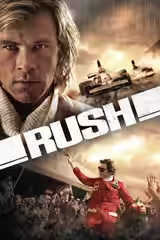
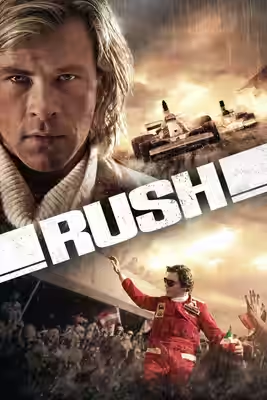
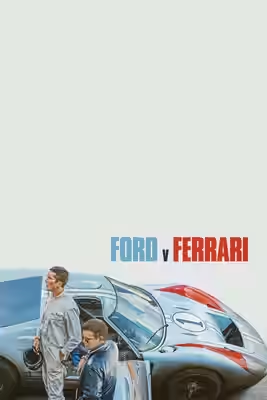
The second half takes a turn we will not describe. What we can say is that the film takes a real event from Mardenborough’s career and moves it to where the script needs it, and we were uneasy about that, because a thing that happened to a real man is being used as a plot point. Blomkamp’s District 9, from 2009, was full of invention; nothing here is invented except the wire-frame trick. Against Rush and Le Mans ‘66, it has faster cameras and slower people.
See it for the driving if driving is your thing, and see it on the biggest screen with the loudest speakers you can find, because at home the races shrink to the size of the game and the film has nothing else to fall back on. The 12A certificate is fair. The 135 minutes are about twenty too many, and most of the spare ones are spent off the track.