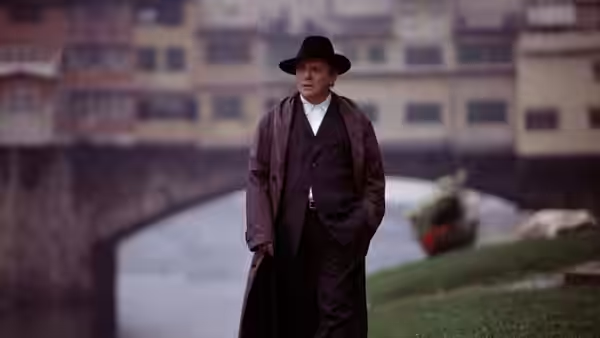
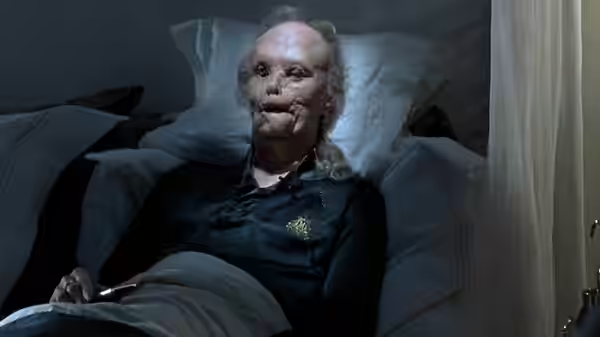
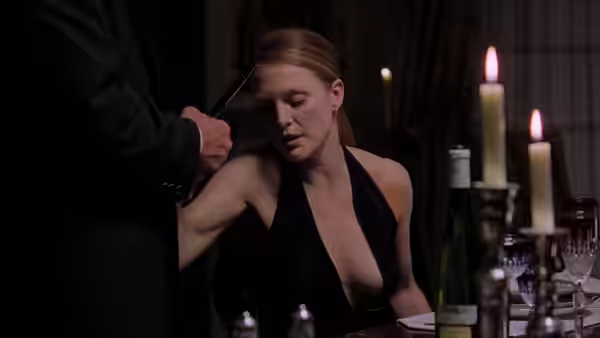
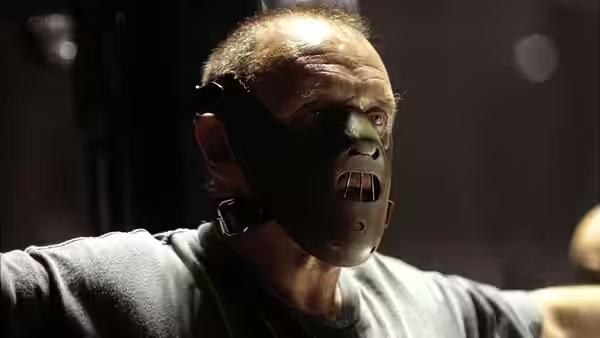
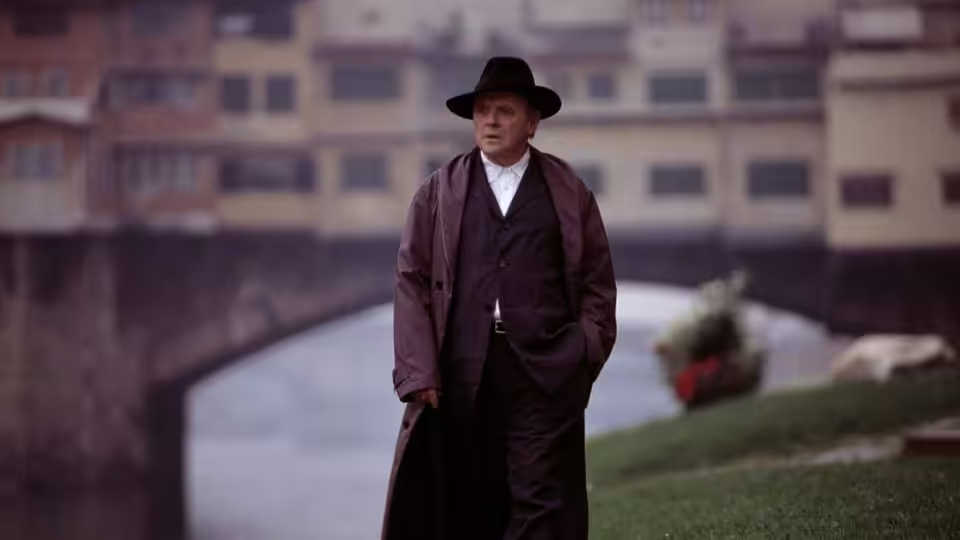
Inspector Renaldo Pazzi (Giancarlo Giannini) stands in a long coat beside the river
Film review

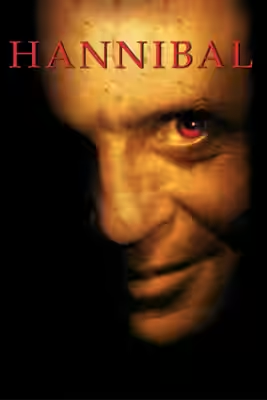
Hannibal

2001 · Directed by Ridley Scott · 2h 11m

In a sentenceAnthony Hopkins has a lovely time being appalling; everyone else has to wait their turn

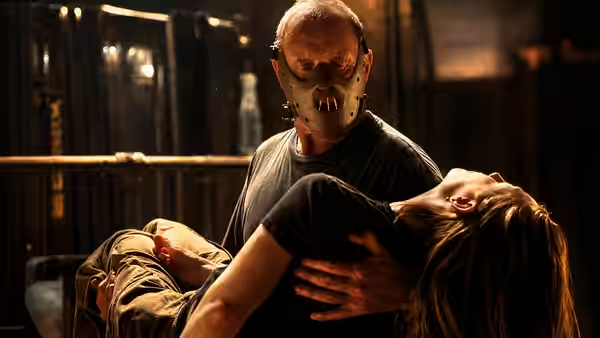
Dr. Hannibal Lecter (Anthony Hopkins), a cannibalistic serial killer with cultivated tastes, is the focus of a story that takes in Florence. Clarice M. Starling (Julianne Moore) returns to his story, alongside Insp. Renaldo Pazzi (Giancarlo Giannini), Mason Verger (Gary Oldman) and Paul Krendler (Ray Liotta). Adapted from the novel by Thomas Harris, this continuation of The Silence of the Lambs shifts its attention towards Lecter himself. The people around him have to contend with a man whose sophistication coexists with his capacity for violence.

Plays from YouTube when you press play; nothing loads from them until then.

Fi1m review

Ridley Scott gives Hannibal considerable polish, and Anthony Hopkins supplies some malicious fun. But slack suspense and the thin use of Julianne Moore leave too much resting on our appetite for grotesquerie.

Ridley Scott’s Hannibal is a polished, sporadically entertaining thriller with too little suspense to justify its 131 minutes. It invites us to enjoy the company of Dr. Hannibal Lecter, then leans heavily on that enjoyment when the story needs to move. The taste for grotesque spectacle is understandable; the lack of urgency is harder to excuse. We can enjoy an extravagantly unpleasant film, but this one spends too long assuring us how much trouble it has taken over the unpleasantness.

Anthony Hopkins supplies most of the amusement. We laughed at the pleasure he takes in Lecter’s superiority, particularly the playful manner that makes other people seem like interruptions to his day. There is precision in the performance, and enough mischief to keep the character watchable. The problem comes when that pleasure becomes the point of a scene: we begin waiting for another display of cleverness instead of worrying about what he might do.

John Mathieson’s cinematography keeps the grotesque material insistently handsome, a choice that makes revulsion oddly comfortable. Norris Spencer’s production design contributes to that well-appointed atmosphere; Florence is the stretch where looking at the surroundings is a pleasure in itself. Hans Zimmer’s music lends the material a seriousness that the plotting seldom earns. The care is evident, but the film gives us too much time to notice it when we ought to be concerned about the characters.

Julianne Moore offers the steadiness the film badly needs as Clarice M. Starling. Her seriousness gives us someone to care about without asking us to share the film’s fascination with Lecter. Yet the screenplay by David Mamet and Steven Zaillian leaves her too little scope, and we keep waiting for her to be given something substantial to do. Gary Oldman as Mason Verger and Ray Liotta as Paul Krendler have more opportunity to enjoy the excess, but their energy cannot compensate for her underuse.

Pietro Scalia’s editing has the thankless job of giving this story momentum. Individual performances hold our attention, but the stretches between them do not accumulate enough pressure, and the increasingly mechanical plotting makes the lack of suspense harder to overlook. At 131 minutes, it is not length alone that causes the trouble. It is the repeated feeling that another grotesque flourish will be offered before the film has made us care sufficiently about anyone involved.

Within the serial-killer thriller, there is nothing wrong with giving the killer charm or letting horror become funny. The risk is that everyone else begins to look like supporting entertainment for him, and Hannibal too often accepts that arrangement. Its cruelties should trouble us more than they do. The relish for Lecter keeps making him comfortable company, which is a peculiar difficulty for a film that also wants us to be frightened of him.

There is an audience for horror this pleased with its own bad taste, and parts of Hannibal reward that appetite. We would still hesitate to recommend a whole evening of it. Choose it for Anthony Hopkins enjoying himself, provided suspense is not the main requirement.

Critical consensus AI synthesised

52
Positive
2
Mixed
6
Negative
3

The reviews lean towards a mixed response to Hannibal, with praise clustering around its visual polish and performances rather than its storytelling. Anthony Hopkins’s Lecter remains a source of pleasure for several critics, who find his performance compelling or enjoy its playfulness; Julianne Moore also receives credit as Clarice Starling. The more favourable accounts find an engaging, stylish entertainment, even when the grotesque material threatens to become excessive.

Reservations centre on weak suspense, sluggish pacing and plotting that fails to sustain interest. The spread is wide: RogerEbert.com finds style and strong performances enough to keep the film engaging, while The Guardian sees a tensionless sequel whose gore and camp overwhelm the drama. Hopkins himself divides opinion, with his playfulness reading as parody to some. Even among the more receptive reviews, enjoyment often comes with the caveat that this is a less compelling sequel to The Silence of the Lambs.

RogerEbert.com
9 February 2001 · ★★★/4 · Roger Ebert
75

Ebert finds the film stylish and engaging, though its grotesque material can be excessive. He singles out the performances as a strength.

Read the full review →
Variety
4 February 2001 · Todd McCarthy
70*

McCarthy finds the film engrossing and tantalizing, though less powerful and less consistently compelling than The Silence of the Lambs. He praises Anthony Hopkins’s riveting portrayal of Lecter, while faulting the more mechanical plotting after the story leaves Florence.

Read the full review →
Screen Daily
12 February 2001 · Emanuel Levy
64*

The visible page does not reveal the critic’s verdict. It provides no praise or complaint because the review text is behind a paywall.

Read the full review →
The New York Times
9 February 2001 · A.O. Scott
64*

The page is identifiable as a review of the film, but its text is inaccessible. The critic’s verdict and specific praise or complaint cannot be verified.

Read the full review →
Time Out
· GA
64*

The available page identifies this as a review, but provides no accessible critical verdict. Its standfirst introduces Lecter as a sophisticated cannibalistic serial killer, without revealing what the critic praises or faults.

Read the full review →
Radio Times
★★★ · Jeremy Aspinall
60

The review presents the sequel as a tongue-in-cheek continuation, with Julianne Moore giving a creditable performance as Clarice Starling. It notes the production’s troubled path to the screen and Anthony Hopkins’s playful return as Lecter.

Read the full review →

Straight answers AI written, from our review

Is Hannibal worth watching?
Hannibal offers malicious fun from Anthony Hopkins, but we score it 54 out of 100 and hesitate to recommend it beyond those with an appetite for grotesque horror. Ridley Scott gives it considerable polish, yet slack suspense and too little for Julianne Moore to do make its 131 minutes feel unnecessarily drawn out.
How long is Hannibal, and what is it rated?
Hannibal runs 2h 11m. It is a crime and drama film.
Where can I watch Hannibal in Slovakia?
Hannibal is streaming on SkyShowtime in Slovakia. Availability is checked daily; the links above go straight to each service.
How violent or frightening is Hannibal, and is it suitable for children?
Hannibal carries a UK 18 certificate and is unsuitable for children, with cannibalism, violence and grotesque spectacle making it a poor choice for squeamish viewers. We find its indulgence in cruelty more prominent than sustained fear: Hopkins’s playful performance and the handsome surroundings make the horror oddly comfortable, but that does not make it family viewing.
How does Hannibal compare to Manhunter?
Hannibal is the more indulgent, grotesquely comic film; we recommend Manhunter as the stronger choice for suspense, with a more disciplined pursuit of a killer and colour that creates unease. Hopkins makes Lecter entertaining company in Hannibal, while Brian Cox’s restraint in Manhunter is frightening, and the earlier film’s controlled investigation holds our attention more firmly.
Is Hannibal based on a true story or a book?
Hannibal is adapted from a novel by Thomas Harris, rather than presented as a true story, and continues the story of The Silence of the Lambs. The film shifts attention towards Lecter himself; our reservations concern its slack suspense and underuse of Clarice, rather than any knowledge of the novel it asks viewers to bring.
What should I watch after Hannibal?
After Hannibal, try Manhunter (1986, Fi1m 84): A more disciplined pursuit of a killer, with colour doing unsettling work. Then Eyes Without a Face (1960, Fi1m 86): Surgical horror whose restraint makes its cruelty harder to shrug off; and Cure (1997, Fi1m 85): Patient police work and quiet encounters that make ordinary rooms feel unsafe.

Cast

Awards

European Film Award - People's Choice Award for Best Director, 2001

Nominated
European Film Award - People's Choice Award for Best Director

If you liked this, try…

  1. Manhunter (1986, Fi1m 84)A more disciplined pursuit of a killer, with colour doing unsettling work.

  2. Eyes Without a Face (1960, Fi1m 86)Surgical horror whose restraint makes its cruelty harder to shrug off.

  3. Cure (1997, Fi1m 85)Patient police work and quiet encounters that make ordinary rooms feel unsafe.

  4. The Cook, the Thief, His Wife & Her Lover (1989, Fi1m 78)For cultivated cruelty and grotesque appetites, with a stronger sense of purpose.

  5. Stoker (2013) · not reviewed yetPrecise compositions and poisonous family manners, for those drawn to elegant nastiness.

Free account

Know what to watch tonight

Two lists that know where things are streaming, collections you can share, your own score beside ours, and Discover that remembers what you have seen.

  • Want to see, sorted by what is streaming now
  • Seen, with your score out of ten
  • No adverts, ever