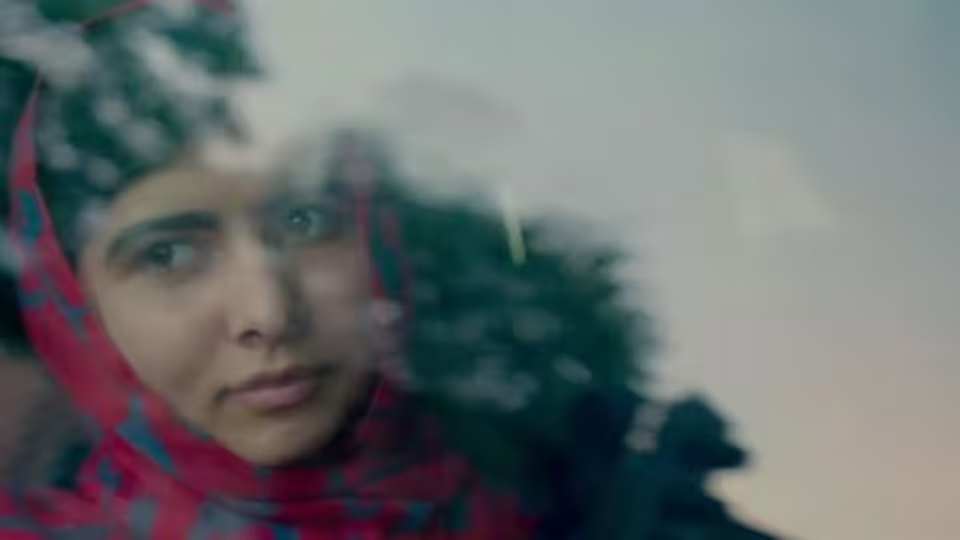
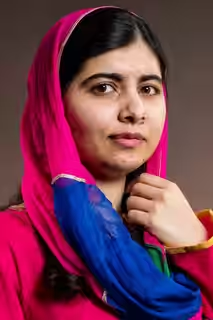
Davis Guggenheim’s film about Malala Yousafzai is at its best in the family kitchen, where she is a teenager with brothers and homework. Everywhere else it polishes her into a monument and declines to ask the one hard question its own title raises.
Davis Guggenheim, who made An Inconvenient Truth (2006) and Waiting for “Superman” (2010), spends 87 minutes with Malala Yousafzai and her family in their new home, a couple of years after a Taliban gunman shot her on her school bus in the Swat Valley. He has made two films and put them in the same box. One is a close, affectionate record of a teenager at home with a father who adores her and two brothers who do not. The other is a public monument, and the monument keeps getting in the way.
The home film is good. Khushal and Atal tell the camera that their sister is bossy and that she hits them, and she does not deny it. Malala worries about her grades, which are not what they were in Pakistan, and admits she cannot talk to boys. Toor Pekai, her mother, speaks little, looks out of the window a great deal and is plainly not where she wants to be. Guggenheim films all of this quietly, from close by, and the family seems to forget him.
Ziauddin is the film’s real subject, and the best thing in it. He is a teacher who ran a school in Swat, a man with a stammer who built his life around the spoken word, and the title is his doing: he named his daughter after Malalai of Maiwand, a girl who rallied an army and was killed for it. We were moved more than once, and each time it was by him, watching his daughter speak in a hall he could never have stood up in, his mouth moving slightly with hers. The question underneath, whether a father has the right to name a child for a martyr and then let her blog against the Taliban, is put to Malala exactly once. Her answer is good. The film should have pressed, and does not.
The animation is the film’s chief device and a mixed one. Swat, the school, the Malalai legend and the Taliban’s arrival are all drawn by hand in soft colour, and for the childhood scenes it works; there is no footage of a Swat that no longer exists, and the drawings do the remembering. The trouble comes when the same style has to carry the threat. The Taliban are a voice on the radio and some shadows on a hillside, and the shooting itself is rendered in the same pastel wash as the valley. We understood why the family might want it that way. We also noticed that the one event everything else depends on is the one the film looks at least directly.
Greg Finton’s cut moves between the new house, archive of Malala’s speeches, the animation and her trips abroad to classrooms and refugee camps, and the order is hard to follow. The attack is approached three or four times and backed away from, so that a viewer who did not already know the story would struggle to put it in sequence. Thomas Newman’s score sits under almost every scene, piano and strings, rising whenever a face is about to do something. By the last twenty minutes we were irritated by it, because the faces were doing the work on their own and the music kept interrupting to tell us so.
What the film leaves out is politics. Who the Taliban were in Swat and how they came to run it, what Pakistan made of Malala before and after the shooting, why a good many people there think ill of her and her father: each of these gets a sentence or none. Guggenheim’s earlier films were arguments, and An Inconvenient Truth was a lecture that knew it. This one wants to be intimate and inspiring at the same time, and whenever the two collide it chooses inspiring, which means the hard material goes quiet.
It is a decent film for the right audience, and the right audience is a family with a teenager in it. Watch it with one. They will see a girl their own age who is funny and vain about her grades and frightened of boys, and who did a brave thing anyway, and the brothers will make them laugh. Then go and read something about Swat, because the film is not going to tell you.