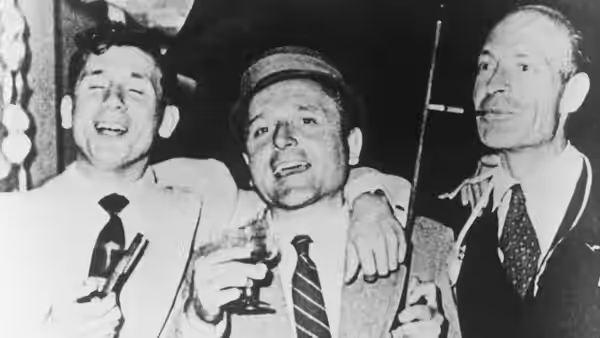
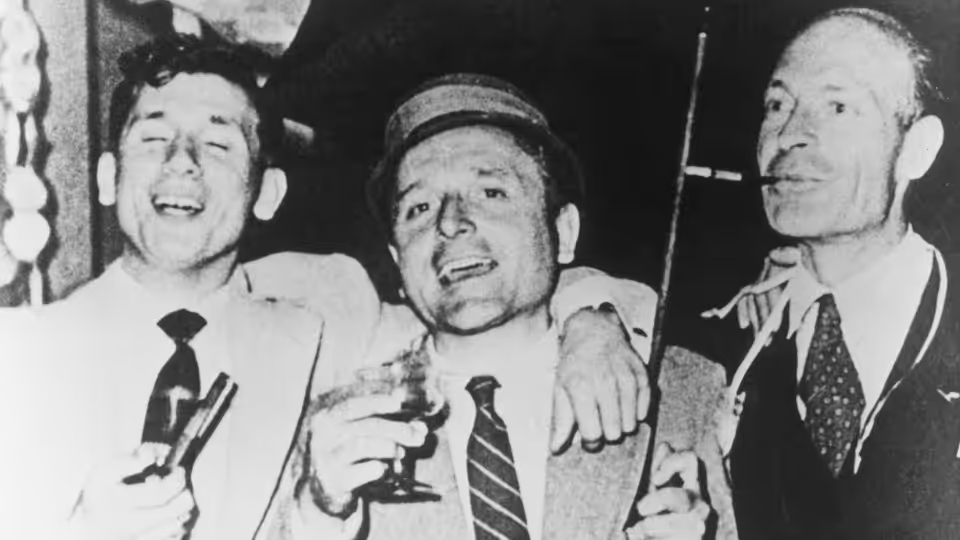
Three men in suits stand together, smiling and holding drinks at a gathering
Film review

Hôtel Terminus: The Life and Times of Klaus Barbie

1988 · Directed by Marcel Ophüls · 4h 28m

In a sentenceFour and a half hours of Ophüls knocking on doors; the neighbours are more frightening than the Gestapo man

Marcel Ophüls sets out to account for Klaus Barbie, head of the Gestapo in Lyon during the German occupation, whose headquarters were the Hôtel Terminus. The film is built around Barbie’s trial in Lyon in 1987, and from there it goes back: to Lyon in the 1940s, to Germany, where old acquaintances remember a pleasant young man, and to Bolivia, where he lived for decades under another name. Ophüls interviews the people who chased him and the people who sheltered him: Beate Klarsfeld and Serge Klarsfeld, who tracked him down in South America; Jacques Vergès, the lawyer who defends him; Raymond Aubrac and Lucie Aubrac, who knew his methods from the inside. Ophüls appears throughout, knocking on doors and asking questions the people behind them would rather not answer.

Fi1m review

Marcel Ophüls’s four-and-a-half-hour pursuit of Klaus Barbie is documentary at its most patient and most sceptical, and it is more interested in the people who found him useful than in the man himself. Long, occasionally self-regarding, and we would cut very little of it.

Klaus Barbie ran the Gestapo in Lyon during the occupation, and the Hôtel Terminus is where he did it. Marcel Ophüls spends surprisingly little of his 268 minutes in the building. He spends them in Bolivia, where Barbie lived for decades under another name; in Germany, where schoolfriends and neighbours remember him; in America, with the intelligence men who employed him after the war; and in Lyon in 1987, around the court where he was finally tried. Barbie himself, first in the cast list, is mostly an old face in archive footage and a man who declines to be interviewed. The film is not really about him. It is about everyone who found him useful.

Ophüls made The Sorrow and the Pity in 1969, and the method here is the same, carried further and with less patience for evasion. He appears in frame, knocking. He knocks on doors that stay shut and films the door. When a retired American officer explains that Barbie was a good source and that the Russians were the enemy by then, Ophüls lets him finish, waits, and asks the next question, and the pause does more than any narration could. We have rarely seen a documentary maker so willing to be rude, or so careful about when.

What made us angry, and we were angry for long stretches, was not Barbie. It was the tone of the people around him. Former associates in Bolivia and old acquaintances in Germany describe a courteous man, a good neighbour, a loyal friend. These are ordinary sentences and Ophüls films them at ordinary length, and by the second hour their ordinariness had become the most frightening thing on screen. Nobody in this film thinks of himself as a villain. That is what it is for.

The editors, Albert Jurgenson and Catherine Zins, cut the testimony against itself. Raymond Aubrac, arrested in Lyon in 1943, and Lucie Aubrac, who got him out, talk about what happened in Barbie’s cells; a man in a comfortable chair, a continent away, explains that it was a long time ago. Reuben Aaronson shoots the interviews plainly, medium shots in living rooms and offices with whatever light was already there. Nothing is dressed. When the camera moves it is because Ophüls is walking towards somebody, and the handheld wobble tells us he is not sure he will be let in.

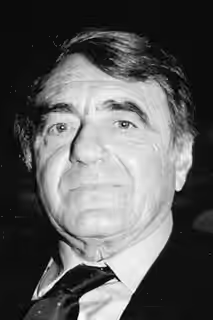
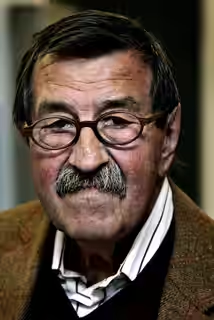
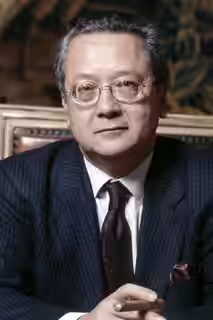
Beate Klarsfeld and Serge Klarsfeld, who spent years tracking Barbie in South America, are the film’s conscience and its plot, and Ophüls lets them be tired as well as right. Jacques Vergès, Barbie’s defence lawyer, is given room to argue that France has crimes of its own to answer for, and Ophüls neither agrees nor cuts him off; he lets us watch a clever man enjoy himself, which is more damaging than an interruption. Claude Lanzmann, whose Shoah had come out three years earlier, Günter Grass, Daniel Cohn-Bendit, Régis Debray and Bertrand Tavernier appear as commentators on what France and Germany chose to remember. Some of these appearances are brief, and one or two feel like Ophüls ringing round his friends.

It is long, and it knows it. There are stretches in the Bolivian section where a fourth witness makes a point three have already made, and Ophüls’s habit of putting himself in the picture, sighing, needling, occasionally performing exasperation for the camera, tips from method into mannerism more than once. We also wanted more of Lyon. The city where the crimes were committed is less present than the countries where they were excused, and that may be Ophüls’s argument, but it leaves the victims quieter than the bystanders.

Watch it over two evenings, as you would read a long book, and do not expect to be told what to think at the close; Ophüls assumes you have been listening. Set aside the time. It does not get easier as it goes, and it should not.
Critical consensus AI synthesised

3 of 6
Positive
1
Mixed
2
Negative
0
Los Angeles Times
26 October 1988 · Kevin Thomas
95*

Thomas calls the documentary devastating, monumental, and engrossing, praising its force as historical drama. He singles out Ophüls’s deft cross-examination and tightly propelled structure.

Read the full review →
RogerEbert.com
65*

The page could not be accessed, so the critic’s verdict and specific praise or complaint are unavailable. No review text or rating could be verified.

Read the full review →
Time Out
· SGr
65*

The available page metadata frames this as Ophüls’ documentary review, but provides no critic verdict. It describes the film’s interview-and-newsreel construction, without revealing what the reviewer praised or criticized.

Read the full review →

Straight answers AI written, from our review

Is Hôtel Terminus: The Life and Times of Klaus Barbie worth watching?
Hôtel Terminus: The Life and Times of Klaus Barbie is worth watching for anyone prepared to give a documentary four and a half hours, and we scored it 89. Marcel Ophüls spends less time on the Gestapo man than on the neighbours, employers and friends who found him useful, and their ordinariness is the point. It is long and occasionally self-regarding; we would cut very little of it.
How long is Hôtel Terminus: The Life and Times of Klaus Barbie, and what is it rated?
Hôtel Terminus: The Life and Times of Klaus Barbie runs 4h 28m. It is a war and documentary film.
Where can I watch Hôtel Terminus: The Life and Times of Klaus Barbie in Portugal?
Hôtel Terminus: The Life and Times of Klaus Barbie is not on any streaming or rental service in Portugal at the moment. It is available in 3 other countries; change your country at the top of the page to see where. Availability is checked daily.
How violent or frightening is Hôtel Terminus: The Life and Times of Klaus Barbie, and is it suitable for children?
Hôtel Terminus: The Life and Times of Klaus Barbie carries no certificate, and what it contains is testimony rather than images: people talking in living rooms and offices about torture, deportation and complicity, with archive footage of Barbie himself. Nothing we saw is graphic, but the subject and the 268-minute length make it a film for adults and older teenagers who already know something of the war. Young children would be lost.
How does Hôtel Terminus: The Life and Times of Klaus Barbie compare to Shoah?
Hôtel Terminus: The Life and Times of Klaus Barbie is the shorter, more pointed film: Ophüls pursues one man and the people who sheltered him, uses archive footage, and appears on screen knocking on doors. Shoah is nine hours of testimony with no archive at all, and it remains the greater achievement. Start with Ophüls if you want an argument, with Lanzmann if you can bear to be told everything.
What should I watch after Hôtel Terminus: The Life and Times of Klaus Barbie?
After Hôtel Terminus: The Life and Times of Klaus Barbie, try Shoah (1985, Fi1m 93): Lanzmann’s nine hours of testimony, no archive footage, and the same refusal to hurry. Then The Act of Killing (2012, Fi1m 88): Indonesian death squad veterans re-enact their crimes cheerfully; the bystander problem, forty years on; and The Fog of War (2003, Fi1m 84): One powerful man explains himself to camera for two hours and never quite manages it.

Cast

Awards

Academy Awards, 1989

Won
Best Documentary Feature Film

If you liked this, try…

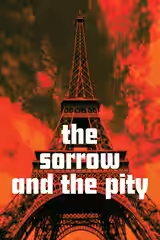
  1. The Sorrow and the Pity (1969) · not on Fi1m yetOphüls’s earlier account of occupied France, where the method was first worked out.

  2. Shoah (1985, Fi1m 93)Lanzmann’s nine hours of testimony, no archive footage, and the same refusal to hurry.

  3. The Act of Killing (2012, Fi1m 88)Indonesian death squad veterans re-enact their crimes cheerfully; the bystander problem, forty years on.

  4. The Fog of War (2003, Fi1m 84)One powerful man explains himself to camera for two hours and never quite manages it.

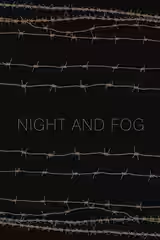
  5. Night and Fog (1956, Fi1m 91)Resnais’s half-hour on the camps, made when the grass had barely grown back.

Hôtel Terminus (1988) review: Ophüls’s patient hunt for Barbie’s helpe (Portugal) | Fi1m