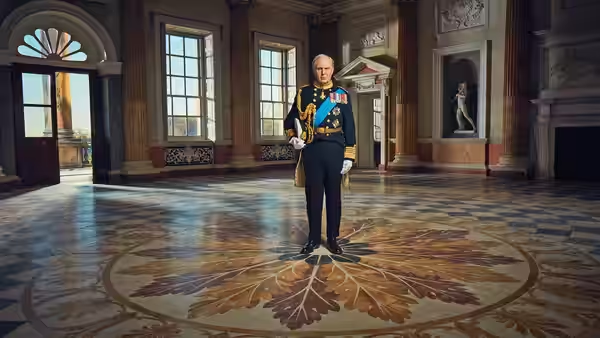
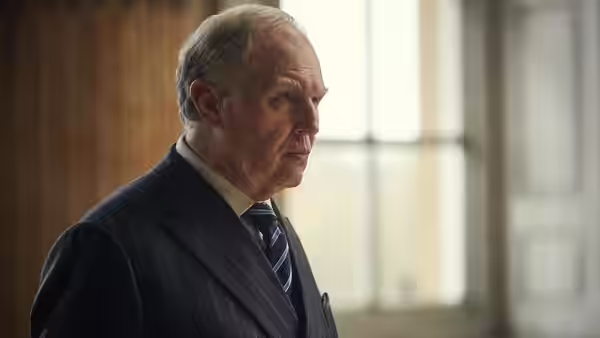
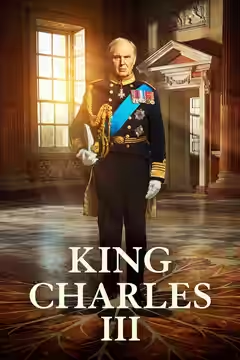
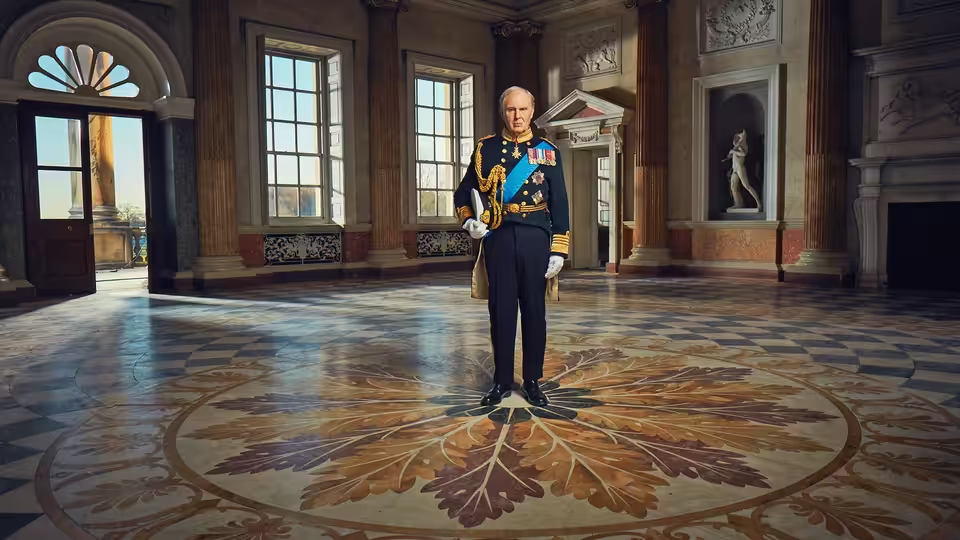
Charles (Tim Pigott-Smith) stands in a palace hall wearing a decorated military uniform
Film review

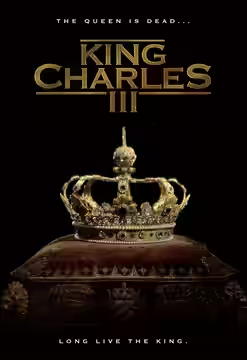
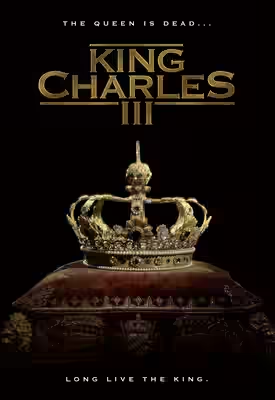
King Charles III

2017 · Directed by Rupert Goold · 1h 29m

In a sentenceTim Pigott-Smith makes a persuasive case for letting Charles finish his sentence

Charles (Tim Pigott-Smith) is at the centre of King Charles III, with William (Oliver Chris), Kate Middleton (Charlotte Riley) and Prime Minister Tristram Evans (Adam James) among the other principal figures. Harry (Richard Goulding), Camilla (Margot Leicester) and Jess (Tamara Lawrance) also form part of the drama. Mike Bartlett writes their exchanges in blank verse, giving political discussion the rhythm of a stage tragedy. Rupert Goold directs this 89-minute film, which combines political drama with tragedy and dark humour.

Fi1m review

Tim Pigott-Smith makes King Charles III worth the effort. Mike Bartlett’s blank verse gives Charles dignity but can become wearing, while the unlikely politics need indulgence; this darkly funny drama rewards an appetite for formal language.

King Charles III is worth watching for Tim Pigott-Smith, whose Charles makes an unlikely political tragedy feel personal. Rupert Goold directs Mike Bartlett’s drama with a seriousness that suits its central performance, though the sustained blank verse makes a considerable demand on the ear. We recommend it to anyone with an appetite for talk and political drama. The qualification matters: the writing sometimes insists on formality long after we have accepted the convention.

Charles needs to interest us as a person if this is to work, and Tim Pigott-Smith gives him enough dignity to hold our attention. We were moved by the seriousness with which he speaks the verse. He makes the formal language sound like something this man needs to explain himself, and the feelings remain recognisable even when the circumstances stretch belief. He earns our sympathy without asking us to agree with Charles. That performance keeps the film’s more questionable ideas from becoming fatal to it.

Mike Bartlett’s writing is less consistent. The blank verse gives the drama gravity and a useful distance from ordinary political conversation; nobody need mistake this for a transcript. It also helps the humour, because the language retains its composure while the material grows darkly absurd. Yet an entire film pitched this way needs changes of pace and pressure. There are stretches when we find ourselves noticing the effort of the phrasing more than the thought being expressed.

The same imbalance affects the visual work. Philippe Kress’s cinematography and Andrew McAlpine’s production design are supporting contributions here, and neither distracts from the actors. That restraint is sensible, although the film’s visual choices do less to hold our attention than its leading performance. Rupert Goold keeps the writing central to the experience. We sometimes wanted a stronger sense of what the camera could contribute beyond giving us access to the speaking.

Elen Pierce Lewis’s editing faces a related problem. At 89 minutes, this is a compact film, yet the verse can make individual passages feel longer than they need to be. The pacing is most persuasive when the language is allowed to gather force without our becoming conscious of its demands. Jocelyn Pook’s music contributes less to our sense of momentum than the speech does. That leaves a considerable amount resting on the delivery of each sentence.

Political implausibility is the other reservation, and a larger one than the occasional stiffness. A drama about public power has to persuade us that its people might behave this way, however unlikely their situation. Here the wish to create a tragedy occasionally seems to determine the behaviour before the characters have had much say in it. The intelligence and dark humour survive that pressure. But we have to supply some belief that the writing ought to have earned, particularly when the drama asks to be taken most seriously.

This calls for a particular sort of attention, and its brevity should not be mistaken for lightness. Watching while doing something else would make the formal speech an obstacle almost immediately. We would give the actors time to make the language sound natural, while accepting that some passages remain more laborious than they should. Save it for an evening when there is time to listen.
Critical consensus AI synthesised

2 of 6
Positive
2
Mixed
0
Negative
0
Los Angeles Times
12 May 2017 · Robert Lloyd
75*

Lloyd finds the production a smart, dark, amusing good time despite its far-fetched events. He praises Tim Pigott-Smith’s moving portrayal of Charles and the dignity of Bartlett’s blank verse.

Read the full review →
The Guardian
11 May 2017 · Sam Wollaston
75*

Wollaston finds the adaptation a sharp, politically relevant tragedy, though its sustained blank verse can feel excessive on television. He especially praises Tim Pigott-Smith’s mesmerising and poignant final performance as Charles.

Read the full review →

Straight answers AI written, from our review

Is King Charles III worth watching?
King Charles III is worth watching for Tim Pigott-Smith’s sympathetic performance and its darkly funny political drama; we score it 73 out of 100. We recommend it to anyone with an appetite for formal language, though the sustained blank verse can become wearing and the unlikely politics require some indulgence.
How long is King Charles III, and what is it rated?
King Charles III runs 1h 29m. It is a drama film.
Where can I watch King Charles III in Austria?
King Charles III is available to rent from Amazon Prime Video and Apple TV from €2.99. Availability is checked daily; the links above go straight to each service.
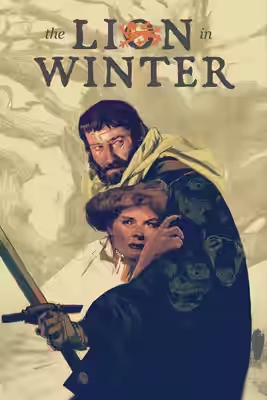
How does King Charles III compare to The Lion in Winter?
King Charles III offers a more formally demanding royal quarrel than The Lion in Winter, which we favour for the combative exchanges between O’Toole and Hepburn. Both turn family tensions into politics, but Pigott-Smith’s dignity is the chief attraction here; Bartlett’s blank verse and the implausible politics require more patience, while the other film’s plotting circles without exhausting its leads.
What should I watch after King Charles III?
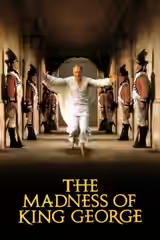
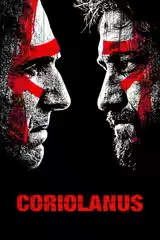
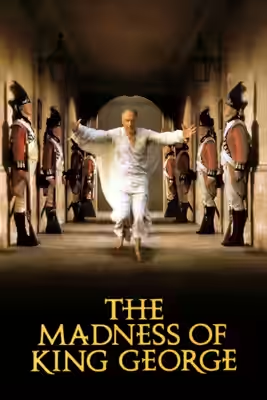
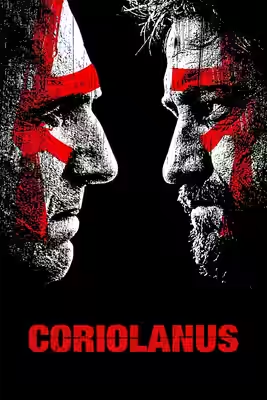
After King Charles III, try The Lion in Winter (1968, Fi1m 81): Royal family quarrels sharpen into politics, with nobody inclined to forgive. Then The Madness of King George (1994, Fi1m 83): A monarch’s vulnerability becomes a matter for doctors, ministers and relatives; and Coriolanus (2011, Fi1m 74): Formal language meets modern political violence, with equally little room for compromise.

Cast

If you liked this, try…

  1. The Lion in Winter (1968, Fi1m 81)Royal family quarrels sharpen into politics, with nobody inclined to forgive.

  2. The Madness of King George (1994, Fi1m 83)A monarch’s vulnerability becomes a matter for doctors, ministers and relatives.

  3. Coriolanus (2011, Fi1m 74)Formal language meets modern political violence, with equally little room for compromise.

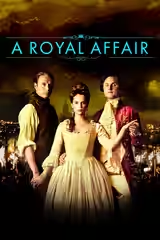
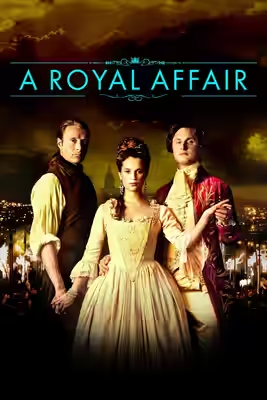
  4. A Royal Affair (2012, Fi1m 70)Private feeling and public power collide inside a tightly governed court.

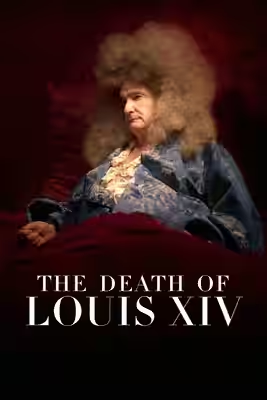
  5. The Death of Louis XIV (2016) · not reviewed yetCourtly ceremony grows oppressive around a king whose body is failing.

Free account

Know what to watch tonight

Two lists that know where things are streaming, collections you can share, your own score beside ours, and Discover that remembers what you have seen.

  • Want to see, sorted by what is streaming now
  • Seen, with your score out of ten
  • No adverts, ever