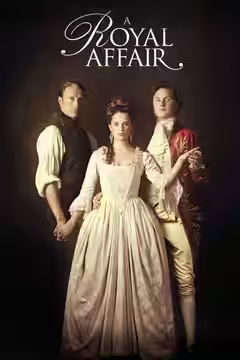
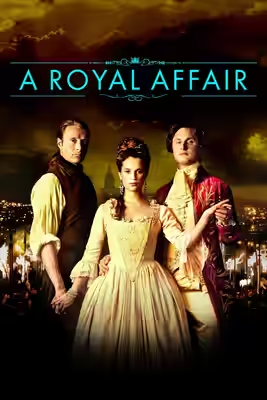
Nikolaj Arcel’s Danish court drama is handsome, intelligent and well acted, and its love story is the least interesting thing in it. Come for Mikkel Boe Følsgaard’s damaged king and the politics; the romance is there to hang them on.
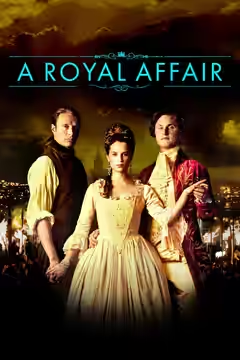
Nikolaj Arcel takes a true scandal from the Danish court and makes a film that wants to be two things: a love story and a political thriller about a doctor who ran a kingdom through a mad king. Arcel and Rasmus Heisterberg adapted it from Bodil Steensen-Leth’s novel, and the result is handsome, intelligent and well acted. It is better at the politics than at the love, and since the love is what the title promises, that matters. Worth an evening, if court intrigue is your thing.
The best reason to see it is Mikkel Boe Følsgaard. His Christian VII giggles at his own council, is cruel to his wife in company, and then turns to the one man who will talk to him with the face of a boy hoping to be liked. Følsgaard plays the madness as fear and bad manners rather than as a diagnosis, so the king is funny, awful and pitiable within a single scene. There is a moment early on when he asks the doctor to come home with him to Copenhagen, like a child asking a stranger not to leave, and it got to us more than anything the lovers do later.
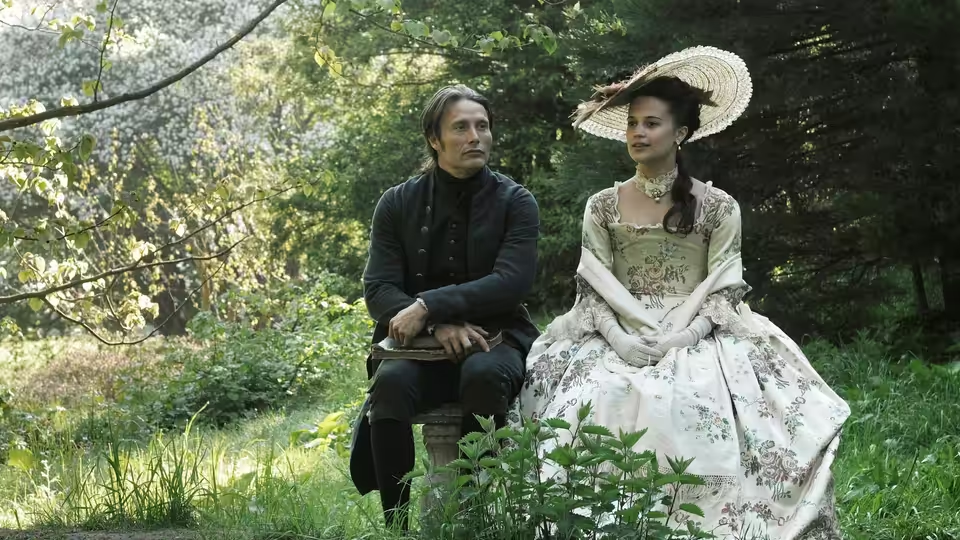
Mads Mikkelsen plays Struensee as a man who keeps his opinions in a locked trunk and his face still. He is good, and his scenes with the king, coaxing, flattering, steering, are the ones that make the court’s machinery turn. Alicia Vikander gives Caroline Mathilde a hard, watchful intelligence and a temper kept on a short lead. The trouble is between them. They fall in love over Rousseau, and the film shows it almost literally: a book passed across a table, a pamphlet read by candle, a conversation about the rights of man that is meant to be foreplay. We believed they respected each other. We did not quite believe they wanted each other, and a film with this title needs us to.
Rasmus Videbæk shoots the palace by candle and window, with a camera that follows the actors round rooms rather than waiting for them to arrive in a composition, which keeps it from stiffening into a tour of the furniture. Niels Sejer’s court looks used: long council tables, bare corridors, the king’s rooms cluttered with his dog and his toys. Manon Rasmussen dresses the old guard in powder and pale silk and sets Caroline apart in plainer lines than the court around her. Gabriel Yared and Cyrille Aufort’s score is strings and piano, used sparingly, and it mostly keeps out of the way, which is a compliment.
Where the film sags is in its middle hour. Once Struensee has the king’s ear, the reforms come in a rush, and Kasper Leick and Mikkel E.G. Nielsen cut them as a list: a decree, a reaction, a decree, a reaction, each argued in the council chamber and then stamped. At 137 minutes the film has room it does not use. Trine Dyrholm’s dowager queen glares from doorways, and David Dencik’s Guldberg purses his mouth at every mention of Voltaire. Both actors are better than this, and Dyrholm in particular finds a hurt pride the script never writes, but the film has decided who the villains are and does not let them argue back. The people who feared these changes deserved a better case.
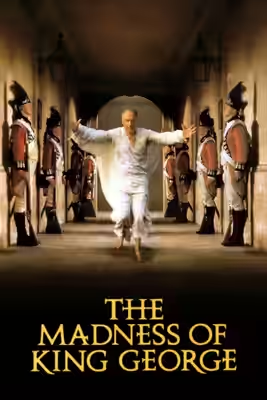
Set beside the costume dramas it resembles, it comes out well. It takes its politics seriously, which most do not; a council argument about whether to abolish torture is more gripping than any of the dances. Against The Madness of King George (1994) it is more earnest, and it never dares to be as funny about its monarch as Følsgaard is ready to be. Arcel directs with taste, and taste is the limit: there is a scene at a masked ball that wants to be reckless and settles for being pretty.
Watch it for the king, and for the odd pleasure of a period film in which the arguments matter more than the frocks. It opens with a letter, and tells you in its first minute roughly how things will go; the interest is in watching how. It runs 137 minutes and carries a 15.