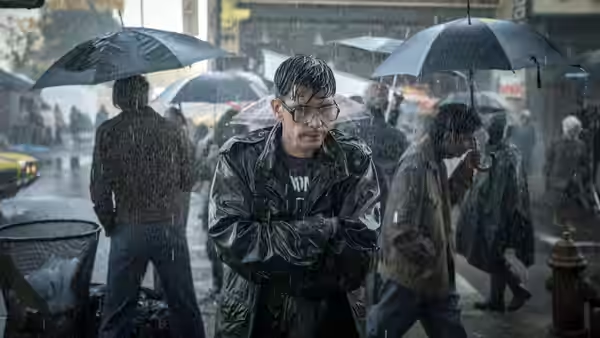
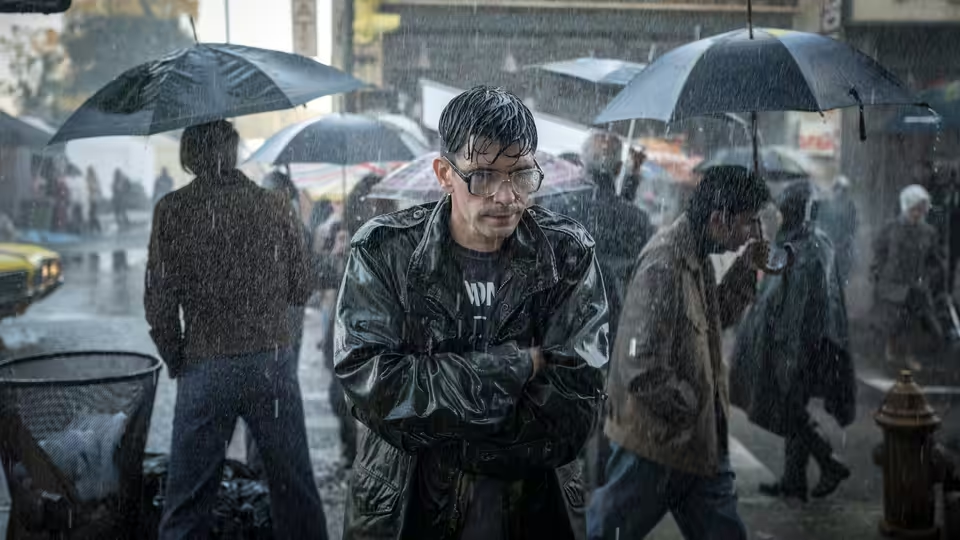
Eddie Limonov (Ben Whishaw) stands with folded arms in a rain-soaked city street
Film review

Limonov: The Ballad

2024 · Directed by Kirill Serebrennikov · 2h 13m

In a sentenceBen Whishaw works hard enough without having to compete with the camera

Eduard ‘Eddie’ Limonov (Ben Whishaw) is the central figure in this biographical drama adapted from Emmanuel Carrère’s novel. Elena (Viktoriya Miroshnichenko) and Anna (Masha Mashkova) feature in his story, alongside Stephen (Tomas Arana), Lonya (Corrado Invernizzi) and Kuznetsov (Yevgeny Mironov). The cast also includes Andrey Burkovskiy as Yevgeny Yevtushenko / Poet and Donald Sumpter as Eddie’s Father. Kirill Serebrennikov directs from a screenplay written with Ben Hopkins and Paweł Pawlikowski, following Limonov in a film running 133 minutes.

Plays from YouTube when you press play; nothing loads from them until then.

Fi1m review

Ben Whishaw keeps this restless biographical drama watchable, and the long takes have real excitement. But Kirill Serebrennikov allows the staging to distract from a thin account of what drives Eddie.

Limonov: The Ballad gives Ben Whishaw an unruly central role and Kirill Serebrennikov plenty of opportunities to keep the camera moving. It is an intermittently exciting biographical drama, but we cannot recommend it without a substantial interest in the actor. The film is eager to make Eddie compelling, and much less successful at explaining what compels him. At 133 minutes, that becomes a considerable limitation: we spend a long time in his company without feeling that the film has asked enough difficult questions.

Ben Whishaw is the reason to stay with it. Playing Eduard ‘Eddie’ Limonov, he sustains a sense of unpredictability that keeps us watching even when the writing gives us little help in understanding the man. His commitment prevents Eddie’s contradictions from becoming merely a list of problems for the screenplay to address. There is always something worth attending to in the performance, although the actor cannot supply every connection the writing has neglected to make.

Roman Vasyanov’s cinematography is most impressive in the long takes, where the movement of crowds gives the camera something substantial to organise. We were exhilarated by those passages; the pleasure comes from watching so many people move through a shot without the staging becoming confused. Vladislav Ogay’s production design gets room to be seen within these extended shots, rather than disappearing behind the lead actor. The difficulty is that we often finish a sequence still thinking about how everybody was arranged, with little new understanding of Eddie.

Yuri Karikh’s editing does less to solve the larger problem of pace. Individual stretches have energy, yet the film grows wearing as it continues, and the later passages do not justify the time they take. Massimo Pupillo supplies the music, while the frequent soundtrack songs add another demand that we respond to Eddie’s rebelliousness. We do not need each fresh push quite so much as a pause in which to think about the man.

The screenplay by Kirill Serebrennikov, Ben Hopkins and Paweł Pawlikowski adapts Emmanuel Carrère’s novel, and it has a difficult task in making a coherent portrait of this contradictory subject. Coherence need not mean smoothing away the unpleasant or inconvenient parts of a life. Here, though, the contradictions too often serve as permission to move on before a behaviour has been examined. After a while, our curiosity became frustration, because the film kept presenting Eddie’s provocations as if their mere presence explained him.

A biographical drama can leave its subject difficult to like and still make the time spent with him worthwhile. This one sometimes seems too impressed by the difficulty itself. The director’s willingness to keep things unruly has its pleasures, and Ben Whishaw gives that approach more credibility than the writing earns. But another energetic sequence does not necessarily tell us anything we need to know about the person at its centre.

There is enough skill here to make the shortcomings irritating rather than merely dull. The long takes are worth attending to, and the central performance never feels like somebody simply fulfilling a contract. Neither can make up for the thinness of the portrait surrounding them. Approach it for Ben Whishaw, with the understanding that the writing leaves him doing considerably more than his share.

Critical consensus AI synthesised

55
Positive
2
Mixed
2
Negative
2

Critics are divided on Limonov: The Ballad, with praise clustering around Ben Whishaw’s committed performance and the film’s restless visual style. Whishaw’s ability to keep an elusive character compelling is central to Deadline’s enthusiastic response. IndieWire likewise finds the film entertaining and stylistically exuberant, despite reservations about its closing stretch. Even some less persuaded reviews admire the visual craft: The Hollywood Reporter praises the long takes and crowd choreography while finding the portrait irritating and undisciplined.

The broad spread of responses turns on whether that energy brings Limonov into focus or substitutes for understanding him. Deadline welcomes the refusal to pin him down; The Wrap finds that style overshadows insight. Variety offers the sharpest rejection, seeing lifeless mythologising beneath the rebellious presentation and faulting the handling of a troubling sexual encounter. The disagreement concerns the film’s approach to its subject, rather than simply its uneven pacing.

IndieWire
19 May 2024 · B+ · Ryan Lattanzio
83

The critic finds the film wildly entertaining and stylistically exuberant, despite pacing issues near the finale. They single out Ben Whishaw’s fearless, career-best performance and the film’s restless visual energy for praise.

Read the full review →
Screen Daily
19 May 2024 · festival review · Jonathan Romney
64*

The accessible text identifies this as a Cannes review but does not reveal the critic’s overall verdict. The standfirst singles out Ben Whishaw’s commitment to playing Eduard Limonov.

Read the full review →
The Hollywood Reporter
19 May 2024 · festival review · Leslie Felperin
30*

Felperin finds the biopic irritating and undisciplined, with its subject’s contradictions failing to cohere into a satisfying portrait. She praises the bravura long takes and crowd choreography, though she questions the frequent Lou Reed soundtrack.

Read the full review →
Variety
19 May 2024 · festival review · Jessica Kiang
20*

Kiang finds the film a showily unconvincing, lifeless mythologization that mistakes rebellious style for substance. She particularly faults its blunt treatment of a troubling sexual encounter, which fails to interrogate the assumptions behind it.

Read the full review →
Deadline
19 May 2024 · festival review · Damon Wise
85*

Wise finds the film an exhilarating, anarchic portrait that resists pinning down its subject. He especially praises Ben Whishaw for keeping Limonov’s slippery, enigmatic character compelling.

Read the full review →
The Wrap
24 May 2024 · festival review
60*

The review finds the film visually galvanizing but ultimately limited, with style overshadowing insight into Limonov. It praises Serebrennikov’s distinctive visual language and Ben Whishaw’s committed performance.

Read the full review →

Straight answers AI written, from our review

Is Limonov: The Ballad worth watching?
Limonov: The Ballad is worth considering chiefly for Ben Whishaw’s performance; we score it 58 out of 100. We find real excitement in the crowded long takes, but the restless staging distracts from a thin account of Eddie’s motives, and 133 minutes becomes wearing without a substantial interest in the lead actor.
How long is Limonov: The Ballad, and what is it rated?
Limonov: The Ballad runs 2h 13m. It is a history and drama film.
Where can I watch Limonov: The Ballad in Azerbaijan?
Limonov: The Ballad is not on any streaming or rental service in Azerbaijan at the moment. It is available in 9 other countries; change your country at the top of the page to see where. Availability is checked daily.
How does Limonov: The Ballad compare to Mishima: A Life in Four Chapters?
Limonov: The Ballad is the less searching portrait; we recommend Mishima: A Life in Four Chapters for its more absorbing treatment of a writer’s art and political extremism. Whishaw and the energetic long takes sustain Limonov, while Mishima rewards patience with theatrical shifts between life and fiction, although we find its political questioning insufficient too.
Is Limonov: The Ballad based on a true story or a book?
Limonov: The Ballad is a biographical drama about Eduard ‘Eddie’ Limonov, adapted from Emmanuel Carrère’s novel rather than written directly for the screen. We find the screenplay’s account of his motives thin: it repeatedly presents his contradictions and provocations without examining them closely enough to explain the man.
What should I watch after Limonov: The Ballad?
After Limonov: The Ballad, try Mishima: A Life in Four Chapters (1985, Fi1m 86): A writer’s art and political extremism receive a more searching formal treatment. Then I'm Not There (2007, Fi1m 74): A fragmented portrait that makes changing identities worth the effort of following; and Naked (1993, Fi1m 84): Another abrasive central performance, with sharper attention to the people around him.

Cast

If you liked this, try…

  1. Mishima: A Life in Four Chapters (1985, Fi1m 86)A writer’s art and political extremism receive a more searching formal treatment.

  2. I'm Not There (2007, Fi1m 74)A fragmented portrait that makes changing identities worth the effort of following.

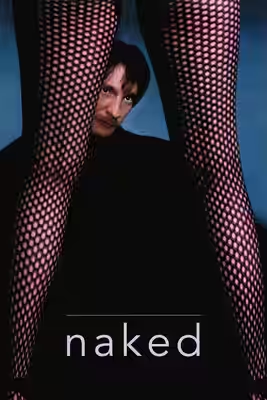
  3. Naked (1993, Fi1m 84)Another abrasive central performance, with sharper attention to the people around him.

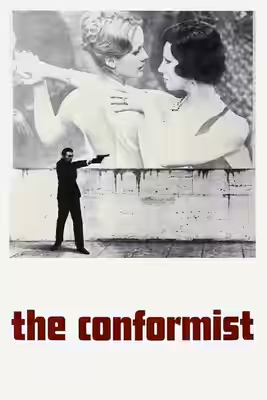
  4. The Conformist (1970, Fi1m 87)Political allegiance and personal weakness examined through precise, unsettling images.

  5. An Angel at My Table (1990, Fi1m 87)A writer’s life given patience, room and an interest in ordinary experience.

Free account

Know what to watch tonight

Two lists that know where things are streaming, collections you can share, your own score beside ours, and Discover that remembers what you have seen.

  • Want to see, sorted by what is streaming now
  • Seen, with your score out of ten
  • No adverts, ever