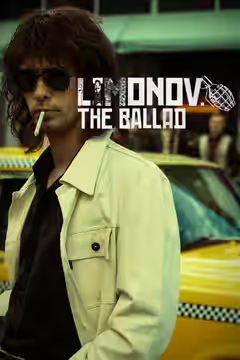
Ben Whishaw keeps this restless biographical drama watchable, and the long takes have real excitement. But Kirill Serebrennikov allows the staging to distract from a thin account of what drives Eddie.
Limonov: The Ballad gives Ben Whishaw an unruly central role and Kirill Serebrennikov plenty of opportunities to keep the camera moving. It is an intermittently exciting biographical drama, but we cannot recommend it without a substantial interest in the actor. The film is eager to make Eddie compelling, and much less successful at explaining what compels him. At 133 minutes, that becomes a considerable limitation: we spend a long time in his company without feeling that the film has asked enough difficult questions.
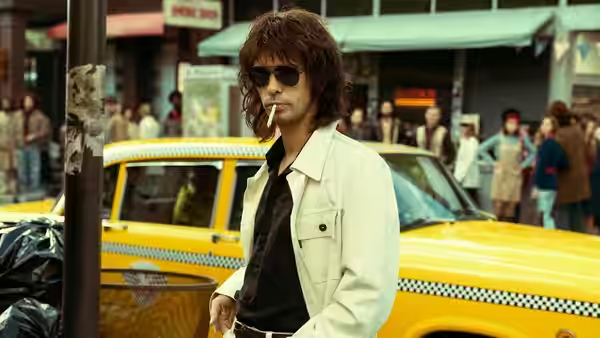
Ben Whishaw is the reason to stay with it. Playing Eduard ‘Eddie’ Limonov, he sustains a sense of unpredictability that keeps us watching even when the writing gives us little help in understanding the man. His commitment prevents Eddie’s contradictions from becoming merely a list of problems for the screenplay to address. There is always something worth attending to in the performance, although the actor cannot supply every connection the writing has neglected to make.
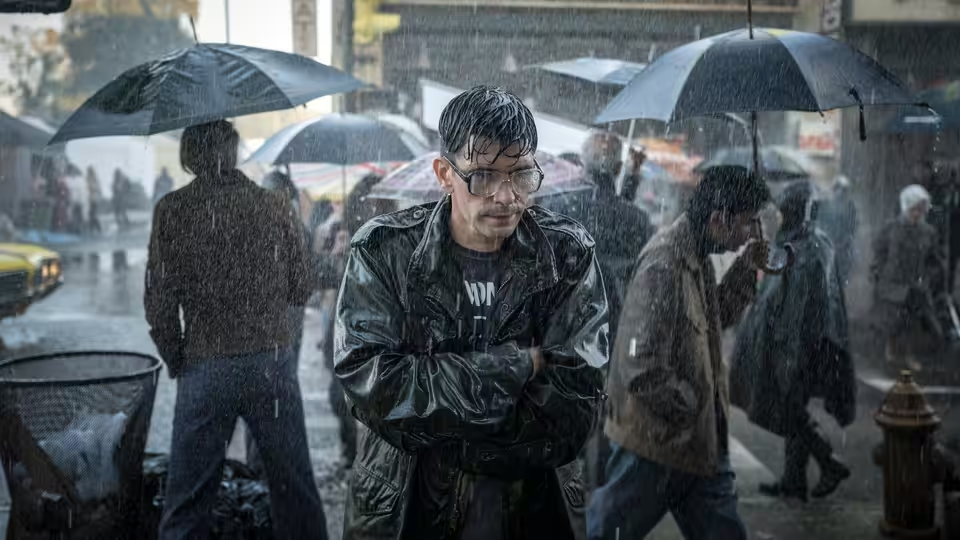
Roman Vasyanov’s cinematography is most impressive in the long takes, where the movement of crowds gives the camera something substantial to organise. We were exhilarated by those passages; the pleasure comes from watching so many people move through a shot without the staging becoming confused. Vladislav Ogay’s production design gets room to be seen within these extended shots, rather than disappearing behind the lead actor. The difficulty is that we often finish a sequence still thinking about how everybody was arranged, with little new understanding of Eddie.
Yuri Karikh’s editing does less to solve the larger problem of pace. Individual stretches have energy, yet the film grows wearing as it continues, and the later passages do not justify the time they take. Massimo Pupillo supplies the music, while the frequent soundtrack songs add another demand that we respond to Eddie’s rebelliousness. We do not need each fresh push quite so much as a pause in which to think about the man.
The screenplay by Kirill Serebrennikov, Ben Hopkins and Paweł Pawlikowski adapts Emmanuel Carrère’s novel, and it has a difficult task in making a coherent portrait of this contradictory subject. Coherence need not mean smoothing away the unpleasant or inconvenient parts of a life. Here, though, the contradictions too often serve as permission to move on before a behaviour has been examined. After a while, our curiosity became frustration, because the film kept presenting Eddie’s provocations as if their mere presence explained him.
A biographical drama can leave its subject difficult to like and still make the time spent with him worthwhile. This one sometimes seems too impressed by the difficulty itself. The director’s willingness to keep things unruly has its pleasures, and Ben Whishaw gives that approach more credibility than the writing earns. But another energetic sequence does not necessarily tell us anything we need to know about the person at its centre.
There is enough skill here to make the shortcomings irritating rather than merely dull. The long takes are worth attending to, and the central performance never feels like somebody simply fulfilling a contract. Neither can make up for the thinness of the portrait surrounding them. Approach it for Ben Whishaw, with the understanding that the writing leaves him doing considerably more than his share.