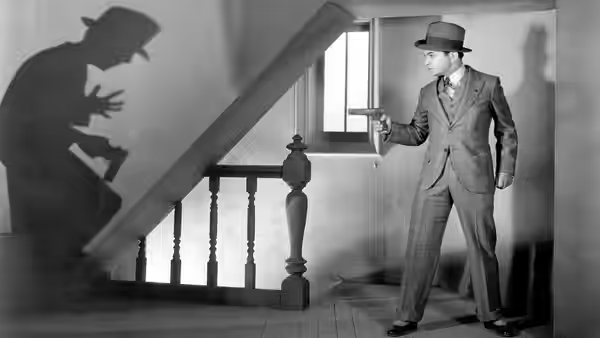
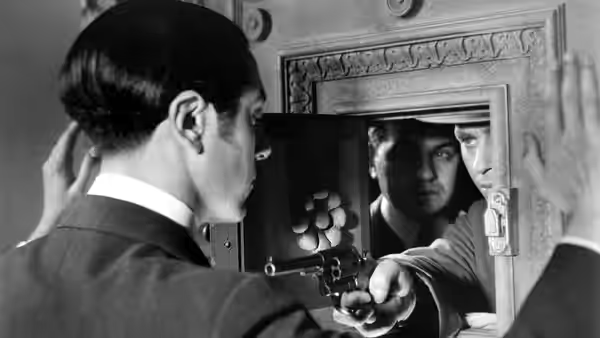
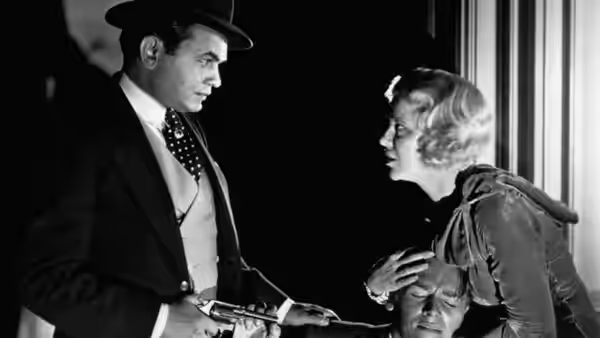
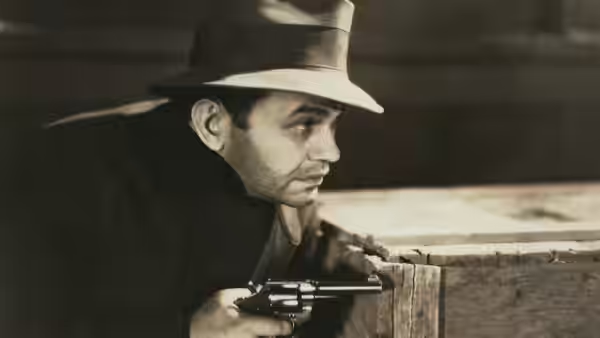
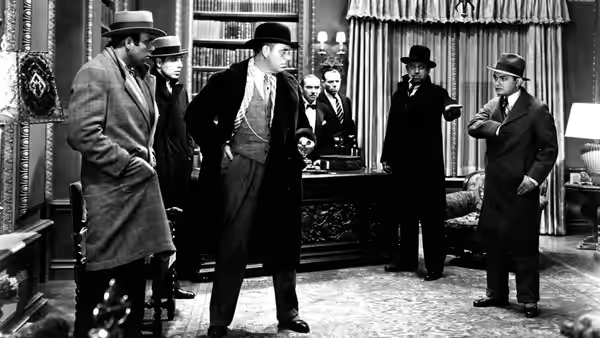
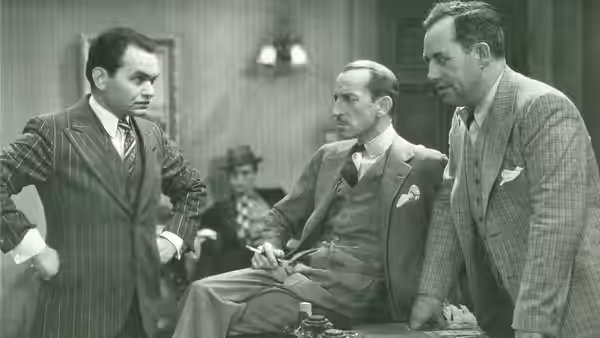
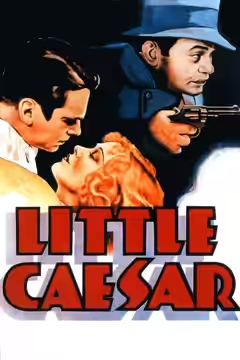
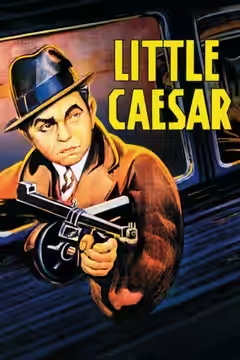
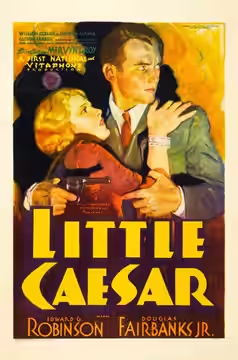
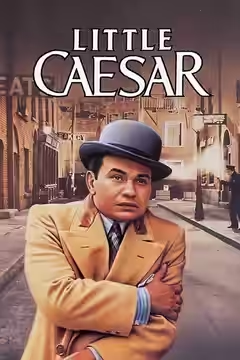
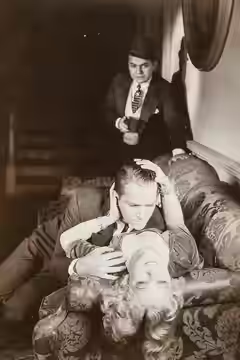
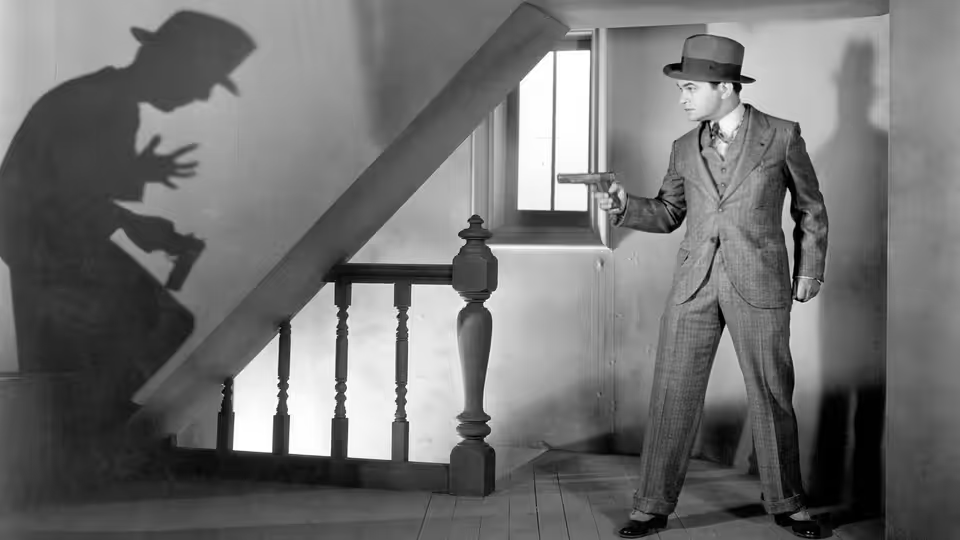
A suited man stands beside a staircase, aiming a pistol toward a shadow on the wall
Film review

Little Caesar

1931 · Directed by Mervyn LeRoy · 1h 18m

In a sentenceRico makes wanting to be the boss look like an exhausting full-time job

Caesar Enrico ‘Rico’ Bandello (Edward G. Robinson) is Little Caesar, the power-hungry figure at the centre of this crime drama. Joe Massara (Douglas Fairbanks Jr.) and Olga Stassoff (Glenda Farrell) are among the people in his story. The other figures include Sam Vettori (Stanley Fields), Tony Passa (William Collier Jr.), Pete Montana (Ralph Ince) and Big Boy (Sidney Blackmer). Sgt. Flaherty (Thomas E. Jackson) supplies the police presence. Rico’s ambition is to command; the question is what sort of authority a man like him can hold.

Fi1m review

Little Caesar is worth seeing for Edward G. Robinson’s force and unexpected pathos. Mervyn LeRoy’s stiff direction and a familiar crime story limit it, but the brisk pace helps.

Mervyn LeRoy’s Little Caesar is worth 78 minutes for Edward G. Robinson, provided a gangster’s hunger for power is your idea of an evening’s entertainment. The performance keeps a familiar crime story involving, even when the direction grows stiff. The film asks us to understand the desire to command and the importance it assumes in one man’s life. Its lead supplies that understanding more convincingly than the writing does.

As Caesar Enrico ‘Rico’ Bandello, Edward G. Robinson makes the hunger for power feel aggressive and painfully needy. He gives the forceful playing enough vulnerability to prevent Rico becoming merely an unpleasant man we are obliged to watch. We found him unexpectedly touching, because the performance never quite hides his need to be taken seriously. Understanding that need does not make him agreeable, but it keeps our attention on him even when the surrounding drama becomes predictable.

That is useful work for a screenplay by Robert N. Lee and Francis Edward Faragoh, adapted from W.R. Burnett’s novel. The hardboiled plotting is familiar enough that the writing rarely surprises us on its own. Too often, we seem to understand a character’s function before we have much sense of the person. The central performance has to supply the complications that the writing leaves out, and there are stretches when the supporting characters could use some of that attention.

Douglas Fairbanks Jr. plays Joe Massara and Glenda Farrell plays Olga Stassoff, but neither gives us quite the same reason to lean forward. That is partly the drawback of such a forceful lead: the surrounding performances begin to look smaller even when there is little wrong with them. We wanted more from these people than a temporary change of company. They do not leave as clear an impression as Rico, and the film feels thinner whenever our interest in him has to sustain everything else.

Tony Gaudio’s cinematography gives the acting room, though Mervyn LeRoy’s staging can leave the images feeling inert. The patience is welcome when a performance rewards it, but elsewhere we become conscious of how little the direction contributes. The stiffness matters because it makes already familiar writing harder to overlook. Being made in 1931 explains why a film might look its age; it does not oblige us to find every limitation charming.

Ray Curtiss’s editing helps considerably, keeping the drama moving rather than allowing the familiar plotting to become ponderous. At 78 minutes, the film does not demand much indulgence. The music credited to David Mendoza makes less impression than the acting, which is not a serious complaint when the central performance offers so much to attend to. The pace gets us through the stiff passages without making them any more expressive.

A gangster film needs to make the attraction of power comprehensible, and this one succeeds whenever Rico holds our attention. It is less persuasive when the other characters must carry the drama without him. The limitations matter, particularly for anyone hoping for equally forceful work across the cast, but the central performance remains worth the evening. Choose it for Edward G. Robinson, and accept that the direction will not always keep up.
Critical consensus AI synthesised

68
Positive
3
Mixed
3
Negative
0

The reviews lean towards appreciation rather than unqualified enthusiasm, with praise clustering around Edward G. Robinson’s performance as Rico. Critics repeatedly find him convincing, forceful and charismatic; even the more reserved notices treat his acting as a strength. Several reviews also value Little Caesar’s importance to the gangster film, though that historical standing does not always translate into enthusiasm for how it plays. Its pace and entertainment value receive some praise despite the familiar story.

Reservations centre on stiffness, dated presentation and dependence on gangster conventions. The New Yorker admires Robinson but finds the direction static and the story reliant on hardboiled clichés. Slant Magazine offers the coolest assessment, finding the film stilted and less forceful than its contemporaries. The spread runs from strong approval to mixed appreciation, with no outright dismissal: Robinson is the clearest point of agreement.

Empire
1 January 2000 · Kim Newman
85*

Newman regards the film as a brilliant early crime epic and a landmark gangster picture. He especially praises Edward G. Robinson’s electric, pathos-rich performance as Rico.

Read the full review →
Time Out
· GA
70*

The review recognizes the film’s seminal importance despite its dated appearance. It singles out the classic adaptation’s importance as its main strength.

Read the full review →
Variety
31 December 1930 · Variety Staff
70*

Variety finds the film entertaining despite its familiar gangster-story formula. It especially praises Edward G. Robinson’s convincing performance and the film’s pace.

Read the full review →
The New York Times
10 January 1931 · Mordaunt Hall
69*

The headline suggests a favorable notice, though the inaccessible article prevents confirming the critic’s overall verdict. It singles out Edward G. Robinson’s acting as notable.

Read the full review →
The New Yorker
65*

The capsule is appreciative of the film while noting its limitations. It singles out Edward G. Robinson’s forceful performance, while describing the direction as static and the story as built from hardboiled clichés.

Read the full review →
Slant Magazine
7 February 2005 · ★★/4 · Jeremiah Kipp
50

Kipp finds the film stilted and less forceful than its gangster-film contemporaries. He singles out Edward G. Robinson’s charismatic performance as the film’s chief strength.

Read the full review →

Straight answers AI written, from our review

Is Little Caesar worth watching?
Little Caesar is worth watching for Edward G. Robinson’s forceful, unexpectedly touching performance, and we score it 74 out of 100. Its familiar gangster story and stiff direction hold it back, but the brisk 78-minute running time makes it a good choice if crime drama is your sort of evening.
How long is Little Caesar, and what is it rated?
Little Caesar runs 1h 18m. It is a drama and crime film.
Where can I watch Little Caesar in Colombia?
Little Caesar is not on any streaming or rental service in Colombia at the moment. Availability is checked daily.
How violent or frightening is Little Caesar, and is it suitable for children?
Little Caesar has no UK certificate supplied and is listed as NR in the US, so those ratings offer no reliable guidance on its suitability for children. Its gangster story centres on an aggressive, power-hungry man, but we cannot give a dependable account of violence or frightening scenes from the information available.
How does Little Caesar compare to The Long Good Friday?
Little Caesar is our pick for a compact gangster drama carried by one performance; The Long Good Friday offers more reasons to watch beyond its lead. Robinson supplies force and vulnerability, while Bob Hoskins brings humour and menace to a London crime thriller with Helen Mirren as another strength, though its plot takes some following.
Is Little Caesar based on a true story or a book?
Little Caesar is adapted from W.R. Burnett’s novel, rather than presented as a true story. Robert N. Lee and Francis Edward Faragoh’s screenplay gives Robinson a familiar hardboiled crime story to carry; we find the performance more compelling than the writing, but knowing the book is not necessary to appreciate it.
What should I watch after Little Caesar?
After Little Caesar, try The Public Enemy (1931, Fi1m 83): Another forceful central performance makes criminal ambition seem dangerously easy to understand. Then The Long Good Friday (1980, Fi1m 88): A would-be ruler discovers how much effort it takes to stay frightening; and A Prophet (2009, Fi1m 86): A patient account of criminal ambition, with each gain making freedom more complicated.

Cast

If you liked this, try…

  1. The Public Enemy (1931, Fi1m 83)Another forceful central performance makes criminal ambition seem dangerously easy to understand.

  2. The Asphalt Jungle (1950) · not on Fi1m yetFor criminals given enough ordinary human weakness to complicate the job.

  3. The Long Good Friday (1980, Fi1m 88)A would-be ruler discovers how much effort it takes to stay frightening.

  4. Pusher (1996) · not on Fi1m yetCriminal pride and practical panic, with remarkably little room to look important.

  5. A Prophet (2009, Fi1m 86)A patient account of criminal ambition, with each gain making freedom more complicated.