Henry King’s Hong Kong romance is handsomely photographed and hopelessly overscored, and Jennifer Jones is miscast as the Eurasian doctor whose in-between life is the whole story. Yet the last reel caught us off guard, and it may catch you too.
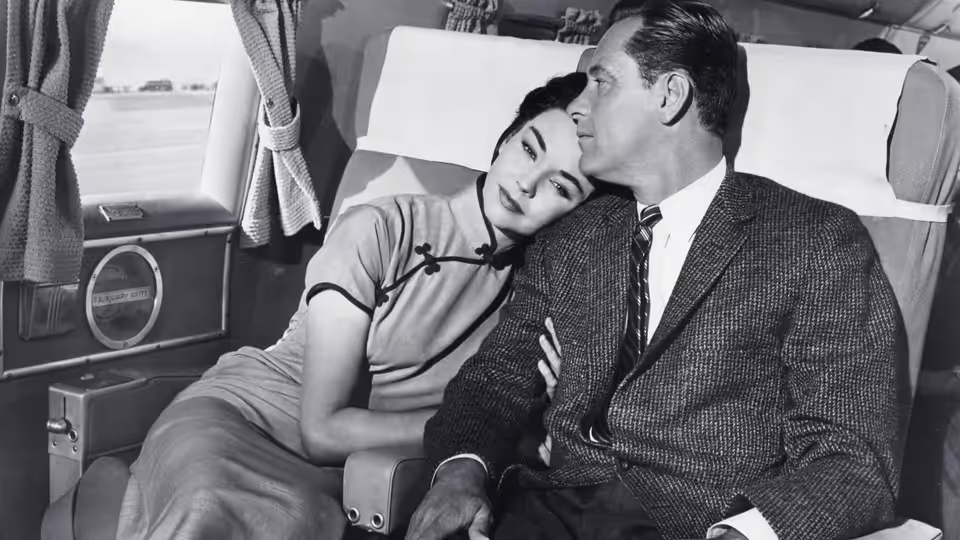
Henry King takes Han Suyin’s novel about her own life and makes of it a studio romance shot against a real city. A Eurasian doctor, an American correspondent, a colony that watches everyone: the material has weight, and the film knows it. What it does with that weight is mostly to arrange it prettily behind two people talking about whether they are allowed to be in love. It is decent, it is often lovely to look at, and it is flawed in a way that sits right at its centre.
Start with what works, because it works well. Leon Shamroy’s Hong Kong looks like a city rather than a set. The harbour is full of junks. The streets behind the hospital are crowded with people who have somewhere else to be. The hill where Mark and Suyin meet looks down on a skyline with weather in it. Shamroy lets the frame fill up at the edges, so that even the love scenes have a city going on around them, and that is the best idea in the film.
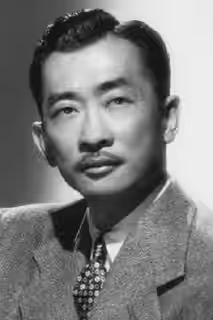
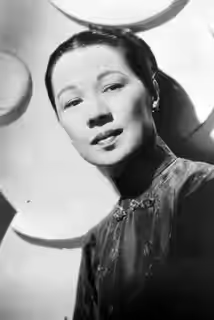
Now the trouble. Han Suyin is half Chinese, and her difficulty in every scene is that neither the British nor the Chinese quite claim her. Jennifer Jones is not, and plays her in eyeliner and a straight black fringe. It was the practice of the time and we are not pretending to be shocked by it, but it hollows the picture out. Every scene about prejudice is played by someone the prejudice could never touch, and Jones, who is a careful and intelligent actress, spends her energy on posture and vowels rather than on feeling. The Chinese performers the film does have, Richard Loo, Soo Yong, Philip Ahn and Keye Luke, are given relatives and servants to play and very little to say.
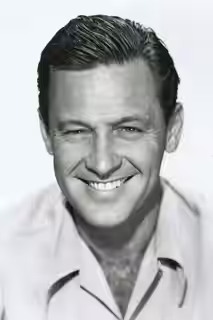
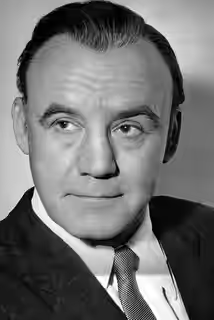
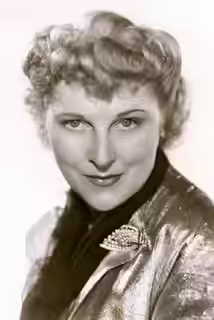
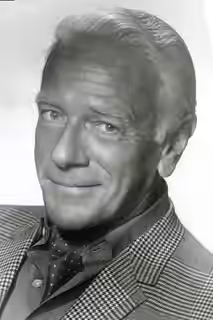
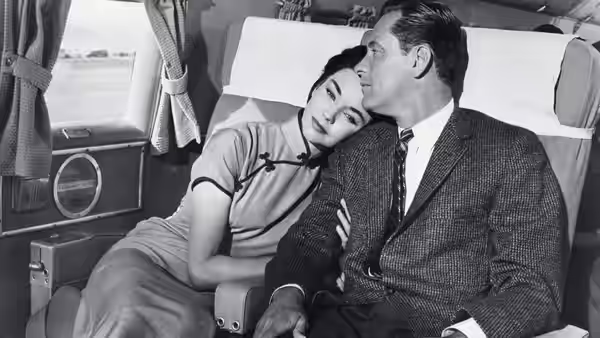
William Holden does what Holden does: loosens his tie, leans on a doorframe, and says his lines as if they had only just occurred to him. He is likeable and he is not much more than that, because John Patrick’s screenplay gives him almost nothing to do except propose things and be refused. The two of them discuss their love the way colleagues might discuss a difficult case, at length and in full sentences. Murray Matheson’s Dr. John Keith supplies the disapproval, Torin Thatcher and Isobel Elsom the gossip, and Jorja Curtright, as Suyin’s friend Suzanne, gets the one properly sharp scene, about what the colony does to a woman who chooses the wrong man.
Then there is the music. Alfred Newman’s score is loud, and it is nearly constant. It arrives before the feeling, swells under the feeling, and then stays on after the feeling has left. There are scenes here that would be quietly affecting if the orchestra allowed them to be, and it does not. William H. Reynolds cuts with the patience of a man who trusts his images, long dissolves, unhurried two-shots, and that patience is right for Shamroy and wrong for Patrick’s dialogue, which needed somebody to hurry it along.
We will not say what the last reel shows. We can say that it moved us more than the ninety minutes before it had earned, and we were annoyed about that on the walk home. What did it was simple: King finally stops the talking. There is a stretch near the end with Jones alone on the hill, Shamroy holding a wide shot, the wind moving the grass, and for once the film lets a face and a landscape do the work the script had been doing badly. It is the kind of ending that makes you forgive things you should not, and we forgave some of them.
Set against the best of its kind it comes up short. Brief Encounter got more out of a railway buffet and a speck of grit than this gets out of a whole colony. But it runs 102 minutes, most of them are handsome, and the last few are more than that. Watch it for Shamroy’s Hong Kong and for the hill, and have something to hand for the end, because the film will insist.