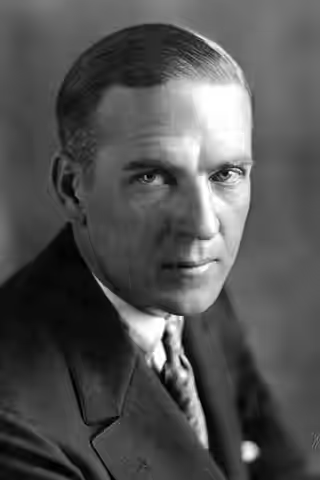
Henry King made more than a hundred films the plain way: real places, big crowds, actors left alone to do their work. A studio director who seldom reached for effect, he was as good as his material, and at Fox the material was often only decent.
Fi1m perspective
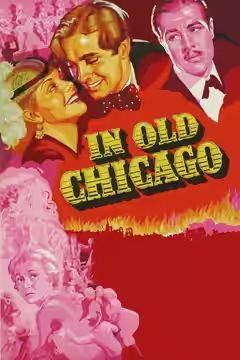
Near the end of In Old Chicago (1938) a lantern goes over in a barn, and Henry King stops directing a melodrama and starts directing a fire. Wooden houses go up one after another, crowds are pushed onto the river bridges, stockyard cattle are driven through burning streets, and Marley shoots much of it in silhouette, figures against a wall of flame. We sat up. We had spent an hour with the O'Learys waiting for the film to matter, and for twenty minutes it did, because the scale was real: whole streets, not a matte painting and a fan.
That is the King worth knowing about. He came into films as an actor in 1912 and was directing by about 1915 or 1916; his silent reputation rests on Tol'able David (1921) and The White Sister (1923). In 1930 he went to Fox and stayed at the studio until Tender Is the Night (1962). Across those years he directed Tyrone Power eleven times and Gregory Peck four, worked repeatedly for Darryl F. Zanuck, and took whatever came down the corridor: literary adaptations, westerns, musicals, small-town pictures, historical spectacle.
What he did well was leave things alone. He liked to shoot on location and tell a story straight, without the flourishes that get a director noticed, and in a busy scene he trusted the set and the crowd to carry it. He was kind to actors. In In Old Chicago Alice Brady plays Molly O'Leary as a woman who has decided grief is something other people can afford, and the prologue, Brady kneeling in the grass beside a dead husband and standing up again before she has finished, moved us more than we expected. Nothing in the staging asks for credit. King gives her the frame and waits.
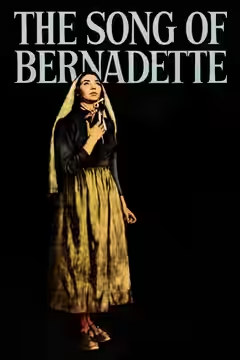
The trouble is that the same modesty served the studio's recipes too well. In Old Chicago is Zanuck's answer to MGM's San Francisco (1936), big Irish family, crooked city, singer in feathers, disaster at the end, and King follows the recipe faithfully for an hour that only Brady makes tolerable. The charge that his Fox years produced conventional studio product, whatever the subject, has stuck, and it is not unfair. Nor is it the whole story. The Song of Bernadette (1943) is remembered for the sympathy he showed his cast, Twelve O'Clock High (1949) is a war drama with Peck that spends more time on the mind than the mission, and The Gunfighter (1950) is the tough, offbeat western his admirers reach for first. We have not weighed those here. On the evidence of the one we have, King is a director to watch for the twenty minutes when he stops following the recipe, and to forgive for the hour when he does not.
Biography
Henry King (24 January 1886 – 29 June 1982) was an American film director and actor. Born in Christiansburg, Virginia, he began his career as a stage actor before appearing in small film roles from 1912 and directing his first feature in 1915.
King became one of the most commercially successful Hollywood directors of the 1920s and 1930s. He directed more than 100 films, often working at 20th Century Fox with stars including Tyrone Power and Gregory Peck. Among his notable credits are In Old Chicago (1938), The Song of Bernadette (1943), Twelve O'Clock High (1949), The Gunfighter (1950) and Carousel (1956).
He was twice nominated for the Academy Award for Best Director and received the first Golden Globe Award for Best Director in 1944 for The Song of Bernadette. King was one of the 36 founders of the Academy of Motion Picture Arts and Sciences.