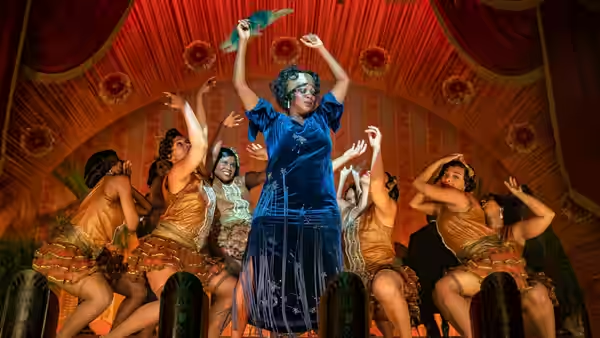
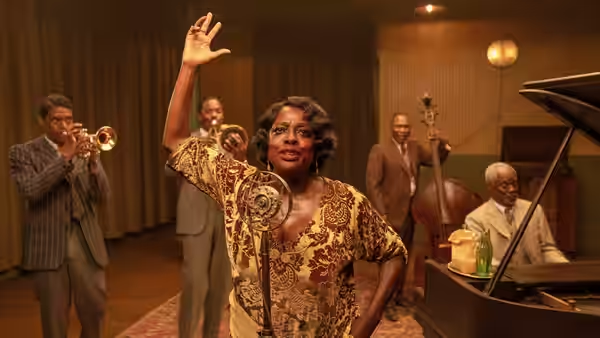
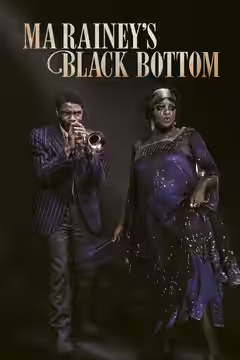
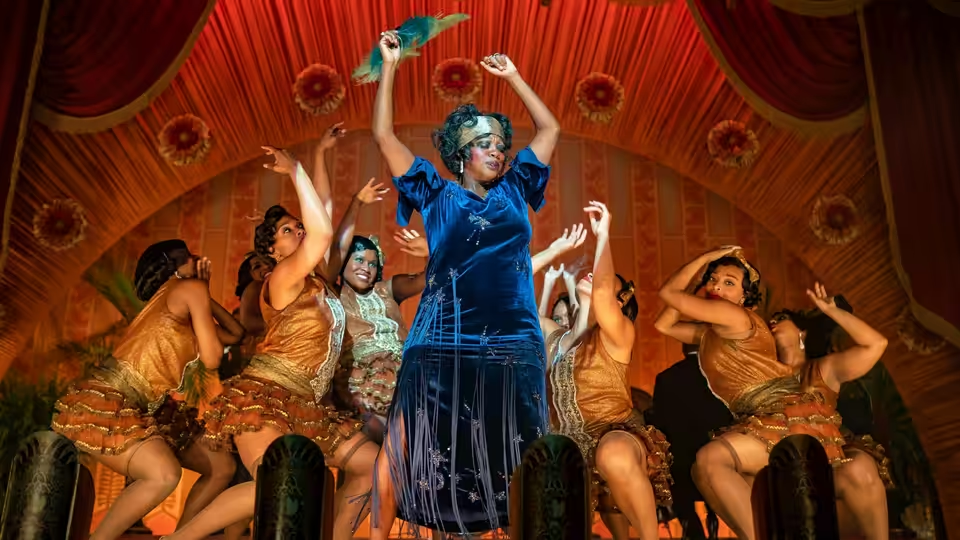
Ma Rainey (Viola Davis) raises a feathered fan as dancers move around her onstage
Film review

Ma Rainey's Black Bottom

2020 · Directed by George C. Wolfe · 1h 33m

In a sentenceA hot afternoon in a Chicago basement, and the trumpet player has new shoes and nowhere to go in them

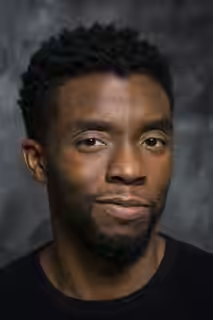
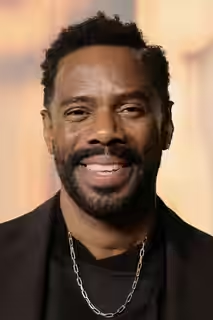
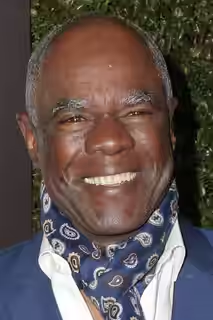
Chicago, 1927, one hot afternoon. Four musicians wait in the basement rehearsal room of a recording studio for the singer they back, Ma Rainey (Viola Davis), who is late. Cutler (Colman Domingo) leads the band and wants the session done. Toledo (Glynn Turman) reads books and lectures the others about them. Slow Drag (Michael Potts) plays bass and keeps his head down. Levee (Chadwick Boseman), the trumpet player, has bought new yellow shoes, written his own arrangement of Ma’s song, and means the white men upstairs, the manager Irvin (Jeremy Shamos) and the studio owner Sturdyvant (Jonny Coyne), to hear it. When Ma arrives she brings a dented car, a policeman, her stammering nephew Sylvester (Dusan Brown) and her girlfriend Dussie Mae (Taylour Paige), and she has her own ideas about how the record will be made.

Plays from YouTube when you press play; nothing loads from them until then.

Fi1m review

George C. Wolfe has filmed August Wilson’s play with such care that it never stops being a play. It is worth 93 minutes of your evening for Chadwick Boseman and Viola Davis, who do two different kinds of great work in the same small room.

George C. Wolfe has taken August Wilson’s play about a single afternoon in a Chicago recording studio and filmed it faithfully, which is both the point and the problem. Ruben Santiago-Hudson’s screenplay keeps Wilson’s long speeches close to whole. Nobody has tried to turn this into something it is not. What we get is 93 minutes of two great performances and a good deal of standing around, and the two performances are enough. Just.

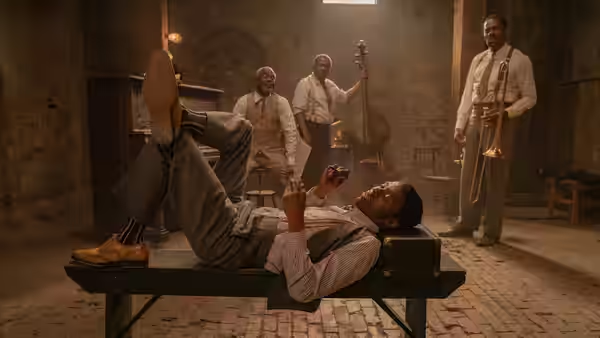
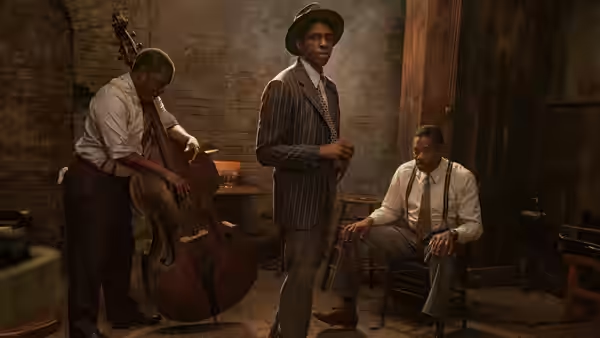
It opens away from the studio, at a tent show at night in the South, a crowd packed in under canvas while Ma Rainey (Viola Davis) sweats through greasepaint and grins with gold teeth. Then Chicago, 1927, and a basement rehearsal room where her band waits for her. Cutler (Colman Domingo) runs things and wants the session over. Toledo (Glynn Turman) has read a book and would like to tell everyone about it. Levee (Chadwick Boseman) has bought a pair of yellow shoes and cannot stop looking at them, and he has his own arrangement of Ma’s song in his pocket and a plan for what the men upstairs will do when they hear it.

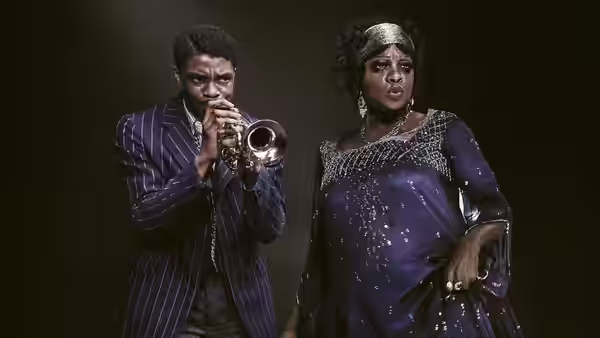
Davis plays Ma as a woman who has worked out precisely how much power she has in that building and spends every ounce of it. She will not sing until someone has fetched her a Coca-Cola. She insists that her nephew Sylvester (Dusan Brown), who stammers, does the spoken introduction, and she makes the manager Irvin (Jeremy Shamos) and the owner Sturdyvant (Jonny Coyne) stand there and wait while he tries. Ann Roth dresses her in sequins and heavy stuff that has no business in that heat, and Davis lets the sweat run through the make-up and does not wipe it. The singing scenes are her weakest; the voice never quite belongs to the woman we have been watching. Everything else does.

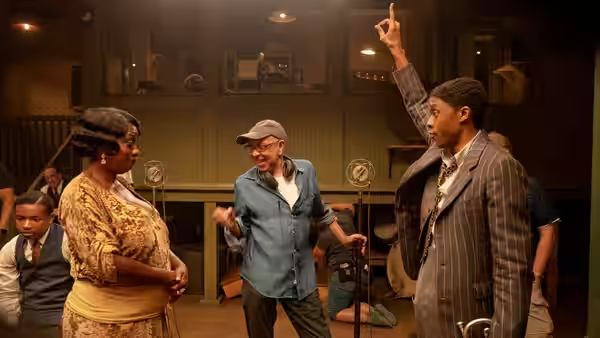
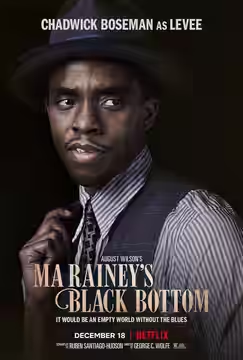
Boseman is the one who moves. Levee bounces on those shoes, shadow-boxes, rattles the locked door at the back of the basement that leads nowhere, and talks, and talks. He gets two long speeches, one about what happened to his mother in the Georgia countryside when he was eight, one aimed straight at God, and Boseman plays both as a man trying to shout down a memory. We sat very still through the first one. We are aware, as everyone watching will be, that this is his last performance, and we tried to put that aside and could not; but the speech would have floored us anyway, because he lets the charm fall off Levee’s face a piece at a time and never puts it back.

The craft is sound and it is modest. Tobias A. Schliessler lights the basement yellow and close, the studio upstairs pale and cool, so that going up the stairs feels like surfacing. Mark Ricker’s basement is pipes, a ceiling fan and that useless door, a room built to make grown men feel like boys kept after school. Andrew Mondshein cuts between the two floors so the waiting has a rhythm, and the recording takes, with Branford Marsalis’s tight period brass, are the best filmed music in the film because they are really arguments about whose version gets made. What Wolfe rarely finds is a shot that says something the words have not. The camera stands back and waits for the speech to finish.

Turman is quietly superb as Toledo, the only man in the basement who has thought about why they are all in it, and Domingo holds the band together with the weariness of someone who has done this a hundred times. Taylour Paige, as Dussie Mae, understands exactly what Levee’s shoes are for. The last act takes a turn we will not describe. The film hurries it, and then adds a coda about who ends up owning this music that is blunt and, we thought, earned.

Denzel Washington, who produces here, directed Fences (2016), the last Wilson adaptation to reach a screen, and that too felt like a very good production seen from the stalls. This one is shorter, hotter and better acted, and no more of a film. See it for the two of them, and give the speeches room; they were written to be heard, not glanced at.
Critical consensus AI synthesised

72
Positive
22
Mixed
4
Negative
4

Most critics like George C. Wolfe’s adaptation of August Wilson’s play, and nearly all of them like it for the same reason. Chadwick Boseman’s Levee, his final screen performance, is praised in almost every review, for the speeches, the restlessness and the slide from charm into rage. Viola Davis’s Ma Rainey is the second name on most lists, described as commanding by review after review, with the crackling ensemble scenes close behind.

The reservations cluster around the staging. Many reviews find the film stage-bound, the speeches sitting awkwardly on camera and the direction doing little to open them up. A few think the story belongs to Ma and resent Levee taking it over; Sight and Sound and Little White Lies both wish it had stayed with her. The spread is wide at the bottom: The New Yorker finds it dull and visually inert, and Vulture calls it a lifeless recorded play, objecting to Davis’s performance and to the handling of Ma’s queerness while still admiring Boseman.

Los Angeles Times
20 November 2020 · Justin Chang
90*

Chang praises the adaptation as urgent and sharply focused, with Boseman delivering a spellbinding final performance. He especially singles out Boseman’s intense, physically vivid portrayal of Levee, while also praising Davis’s commanding Ma Rainey.

Read the full review →
The AV Club
20 November 2020 · A- · Shannon Miller
90

Miller praises the film as a reverent, compelling adaptation, ultimately centered on Chadwick Boseman’s final screen performance. She singles out Boseman’s electrifying delivery of August Wilson’s dialogue, while also praising Viola Davis and the ensemble.

Read the full review →
The Guardian
20 November 2020 · Peter Bradshaw
88*

Bradshaw praises the film as a ferocious, intelligent drama, though he finds some of its theatrical speeches contrived. He singles out the powerful performances of Chadwick Boseman and Viola Davis, especially Boseman’s emotionally transparent portrayal.

Read the full review →
The Hollywood Reporter
20 November 2020 · David Rooney
85*

Rooney finds the adaptation uniquely powerful, though its theatrical roots remain visible. He especially praises Chadwick Boseman’s emotionally explosive final performance.

Read the full review →
Variety
20 November 2020 · Critics Pick · Peter Debruge
85*

Debruge praises the film as a powerful, timely drama about Black artistry and exploitation. He singles out Chadwick Boseman’s restless, layered performance, while also highlighting Viola Davis’s commanding portrayal of Ma Rainey.

Read the full review →
Evening Standard
18 December 2020 · ★★★★ · Charlotte O'Sullivan
80

O’Sullivan finds the adaptation compelling, especially because of Boseman and Davis’s performances. She criticizes Davis’s singing and calls the direction unimaginative, though these flaws do not diminish the actors’ impact.

Read the full review →

Straight answers AI written, from our review

Is Ma Rainey's Black Bottom worth watching?
Ma Rainey's Black Bottom is worth 93 minutes of your evening for Chadwick Boseman and Viola Davis, and we scored it 69. George C. Wolfe films August Wilson's play so faithfully that it never stops being a play, so expect long speeches and a good deal of standing around in one basement. Come for the two performances, not for the filmmaking.
How long is Ma Rainey's Black Bottom, and what is it rated?
Ma Rainey's Black Bottom runs 1h 33m. It is a drama and music film.
Where can I watch Ma Rainey's Black Bottom in Slovenia?
Ma Rainey's Black Bottom is streaming on Netflix in Slovenia. Availability is checked daily; the links above go straight to each service.
How violent or frightening is Ma Rainey's Black Bottom, and is it suitable for children?
Ma Rainey's Black Bottom carries a UK 15 certificate and is a film of talk rather than action, unsuitable for younger children mainly for its adult subject matter. The hardest moments are recounted, not shown: Levee's speech about what was done to his mother in Georgia when he was a boy is harrowing to hear. One late scene, which we will not describe, turns sharper.
How does Ma Rainey's Black Bottom compare to Fences?
Ma Rainey's Black Bottom is the shorter, hotter and better-acted of the two August Wilson adaptations, and no more of a film than Fences. Both keep the camera at a respectful distance and let the speeches run whole; Denzel Washington directed the earlier one and produces this. Choose Fences for a father and a back yard, this one for Boseman.
What should I watch after Ma Rainey's Black Bottom?
After Ma Rainey's Black Bottom, try Fences (2016, Fi1m 70): Denzel Washington’s earlier Wilson adaptation; a back yard, a father and the same long speeches. Then 12 Angry Men (1957, Fi1m 91): One hot room, twelve men and an argument; the model for this kind of confinement.

Cast

Awards

Dorian Award for LGBTQ Film of the Year, 2020

Won
Dorian Award for LGBTQ Film of the Year

If you liked this, try…

  1. Fences (2016, Fi1m 70)Denzel Washington’s earlier Wilson adaptation; a back yard, a father and the same long speeches.

  2. Bessie (2015) · not on Fi1m yetQueen Latifah as Bessie Smith, with Mo’Nique as a very different Ma Rainey.

  3. 12 Angry Men (1957, Fi1m 91)One hot room, twelve men and an argument; the model for this kind of confinement.

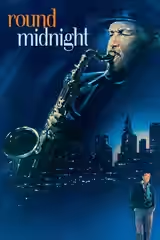
  4. Round Midnight (1986) · not on Fi1m yetDexter Gordon in Paris; jazz as a life rather than a soundtrack.

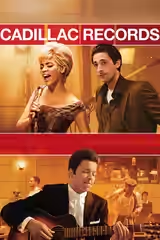
  5. Cadillac Records (2008) · not on Fi1m yetChicago, a record label and the question of who got paid, told faster and looser.

Ma Rainey’s Black Bottom (2020) review: two great turns, one small roo (Slovenia) | Fi1m