Adam Elliot’s stop-motion memoir is handmade down to the thumbprints and it is close to unbearably sad, sometimes on purpose and sometimes not. See it for Jacki Weaver’s Pinky, who walks in partway through and cheers the whole thing up.
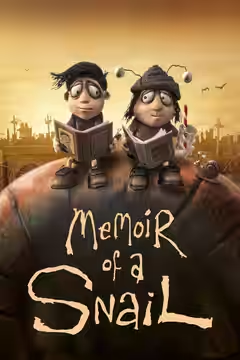
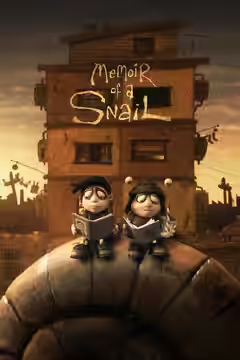
Adam Elliot wrote, directed, designed and co-produced Memoir of a Snail, and it looks it: every set and every face has been pressed into shape by hand, and the fingerprints are still on them. It is a film about a woman telling the story of her life, and the life is a catalogue of misfortune played for laughs and then, increasingly, for tears. It is the best-looking thing Elliot has made and the one that most tests our patience, because it does not know when to stop hurting its heroine. It is worth an evening; line up something cheerful for afterwards.
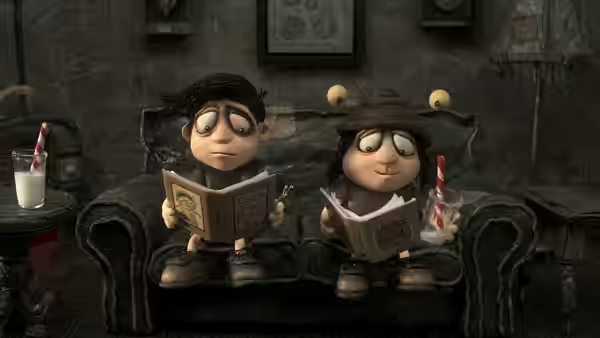
Grace Pudel (Sarah Snook) grows up with a twin brother, Gilbert (Kodi Smit-McPhee), and a father, Percy (Dominique Pinon), to whom Pinon gives a warmth the film misses once he is gone. The twins are separated: Grace to Ian and Narelle, both voiced by Paul Capsis; Gilbert to the Applebys, headed by Magda Szubanski’s Ruth. They write letters. The first act is the film’s strongest stretch, brisk and cruel and funny, and Snook’s narration has a flatness that suits a woman who has learned not to expect much.
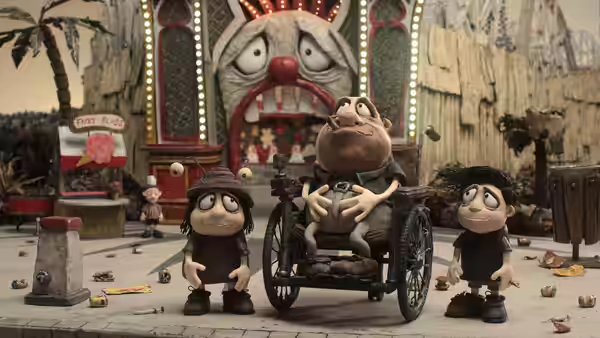
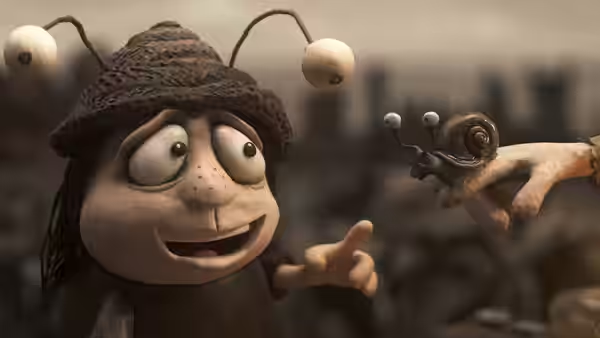
Elliot’s design is the reason to go. Grace’s house fills up with snail lamps, snail salt cellars, snail cushions, until the rooms are more collection than home and she is a small brown shape in the middle of it. Gerald Thompson shoots all this close and with almost no depth, so that a room is three objects and a blur, and the palette is brown, beige and the green of old kitchen lino. The clay is left lumpy on purpose. Teeth are crooked, eyes are too large, and every character looks as though a thumb has been pushed into them, which for most of them is true.
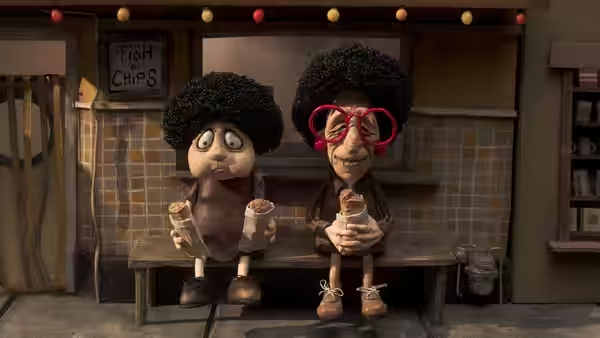
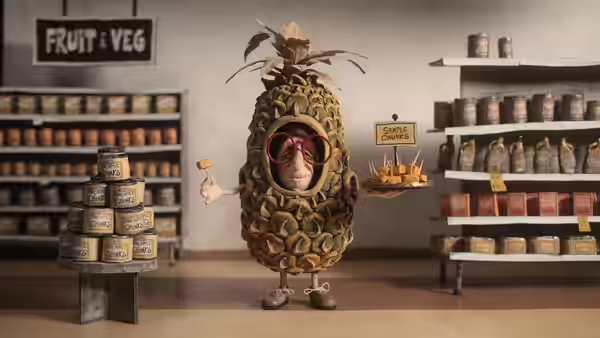
Then Pinky. Jacki Weaver gives her a past full of travel and near misses she describes as though they were bus journeys. Weaver plays her at full volume with no fear of the material, and we laughed for the first time in half an hour, then kept laughing, because the film had finally found someone who was not a victim of it. When the film cuts away from her to check on Grace’s latest disaster, we found ourselves waiting for her to come back.
The trouble is the misery. The film leans heavily on Snook’s narration, and Bill Murphy cuts the picture to the rhythm of her sentences, so that a scene ends when the line does rather than when the image has finished with us. Elliot shows us a thing, then tells us the thing, and sometimes has a character say it as well. And the things keep coming: a death, a betrayal, a humiliation, another death. Around the hour mark we noticed we had started to brace before each new scene, and bracing is not the same as feeling. Elena Kats-Chernin’s score is lovely in its small early cues and by the last third is swelling to tell us to cry at moments when we had already decided.
Elliot’s Mary and Max (2009) had the same clay, the same pen-friend letters and the same tenderness for people nobody else wanted, and it kept to two lives and let them breathe. This has one life and crams in more than any one life should carry, so the compassion that is plainly there gets buried under the next blow. The second half takes a turn we will not describe. Having taken it, the film relaxes, and the last twenty minutes are the warmest since Percy left.
It carries a 15 certificate and earns it; the clay will draw children to the poster and the film is not for them.