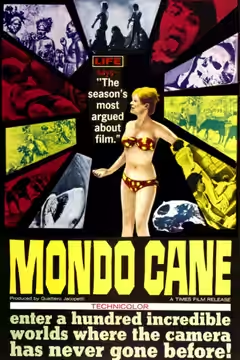
The film that named a genre is cut with real skill and scored with a tune far kinder than its pictures. It is also cruel, condescending and impossible to take at its word, and sixty years have not made it any more trustworthy.
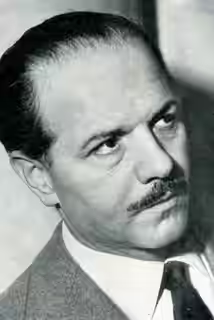
Three Italians, Gualtiero Jacopetti, Paolo Cavara and Franco E. Prosperi, took cameras around the world at the start of the 1960s and came home with 105 minutes of things they thought would shock a cinema audience. Some of it is beautiful, some of it is unbearable, and all of it is arranged to tell you that people are ridiculous wherever you find them. The film gave its name to a whole genre of shock documentaries, the mondo film, and it is cleverer than nearly everything that followed. It is not much kinder. We would not send you to it, but if you go, you will not forget it.
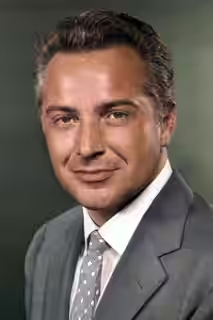
The method is the cut, and Jacopetti, who edited the film himself, is good at it. Rossano Brazzi is chased down an Italian street by women; cut to a Pacific island where the women chase the men. Californians weep at a pet cemetery in Pasadena; cut to a restaurant where dogs are hanging from hooks. Geese in Strasbourg are force-fed for their livers; cut to a village where girls are force-fed to fatten them for marriage. Every sequence is a set-up for the next, and the punchline is always the same: you think you are better than these people, and you are not.
Antonio Climati and Benito Frattari shoot it in bright, saturated colour, the funnel going down the goose’s throat in close-up and the crowds from above so they look like insects. Riz Ortolani and Nino Oliviero wrote the score, and the main theme, which later became the song More, is one of the loveliest tunes ever put over pictures this ugly. That is the trick. The music forgives everything, the camera forgives nothing, and Stefano Sibaldi’s narration sits between them, dry and amused, reading out atrocities as if they were items on a menu.
Here is what it did to us. At Bikini Atoll, the commentary says the nuclear tests have confused the sea turtles so badly that they crawl inland to lay their eggs and die, and Climati and Frattari hold on one turtle on its back in the sand, legs working at nothing. We were horrified. Then we were unsure whether we were allowed to be, because by that point the film had told us so many things it plainly could not know that we no longer believed it about the turtles either. Earlier, in a Hamburg beer hall, we had laughed at drunk Germans singing and falling over, and felt slightly ashamed a moment later when the film moved on to somebody’s funeral and expected us to laugh at that too.
The contempt is not spread evenly. When the film mocks Europeans and Americans, they are mocked for what they do. When it films people in New Guinea or Malaysia, the joke is that they are not us, and the narration guesses at their beliefs with a confidence it never earns. The trade press at the time wondered whether two sequences had been staged; we wondered about more than two. Once you have caught a documentary arranging a scene, you cannot trust its funerals.
Luis Buñuel pulled the same trick in Land Without Bread (1933) in under half an hour and with a straighter face, and the mondo films that came after this one kept the cruelty and lost the wit. Mondo Cane sits in the middle. The cutting is sharper than in anything Jacopetti’s imitators managed, the music is better than the film deserves, and the intelligence on display is real. It is just an intelligence that has decided the whole species is beneath it, including the audience.
If you watch it, watch it at home, where you can stop it, and know that the animals are real and several of them die on camera. It has aged in two directions at once, quainter than it was and nastier than it knew. The song outlived the film, and deserved to.