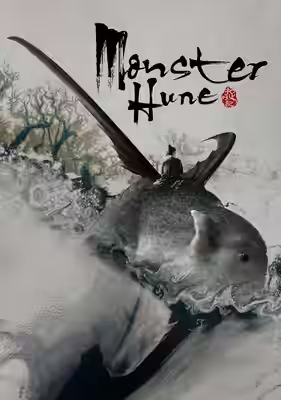
Raman Hui’s human-and-creature comedy has a radish-shaped baby monster worth an evening on his own and a plot that cannot keep its own rules straight. Children will be delighted; adults will be charmed for an hour and lost for the next.
Raman Hui, who co-directed Shrek the Third before coming home to make this, has built a live-action fantasy comedy around a man who gives birth to a monster, and that sentence tells you most of what the film is. Alan Yuen’s script sets up a world in which monsters were driven off the land by humans long ago and now live in hiding, hunted for a bounty, eaten by the rich, and then mostly uses that world as somewhere to put a baby. The baby is the reason to watch. The world is the reason you will lose track.
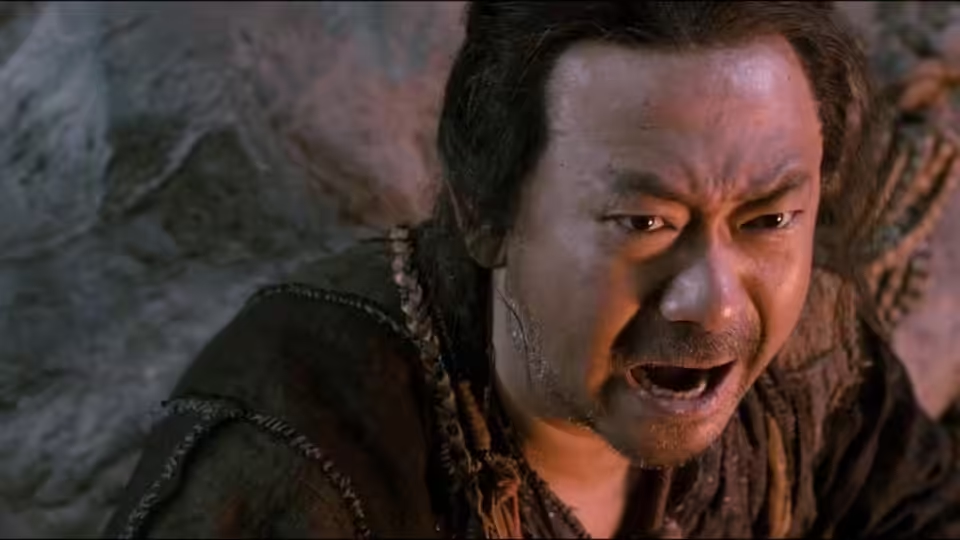
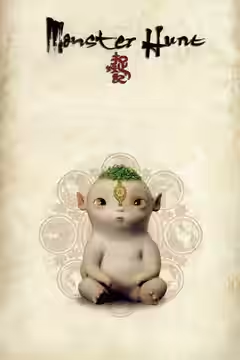
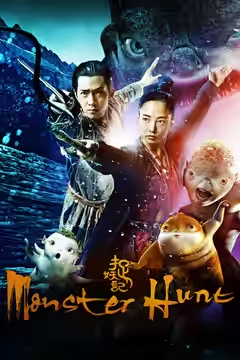
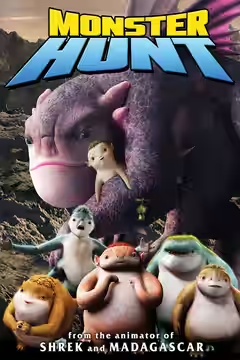
Wuba, the creature in question, is a pale, round, radish-shaped thing with four stubby limbs, a tuft of hair and a face that is nearly all cheeks, and he is a lovely piece of design. He eats constantly, sings when he is pleased and bites when he is not. We laughed, properly and without irony, at the birth, which Hui plays as pure farce: Jing Boran’s Tianyin wailing on his back, Bai Baihe’s Xiaolan treating the whole business as a job with a deadline, and the thing itself arriving like a vegetable pulled from wet soil. Cheung Ka-Fai cuts the scene so the gags land on the actors’ faces rather than on the effect, which is the right instinct and one the film forgets later.
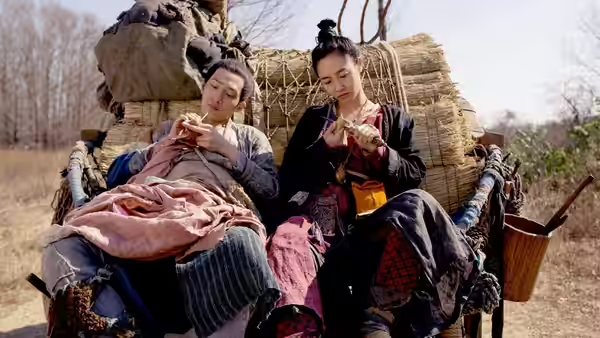
The two leads are good together. Bai plays Xiaolan as a bossy, mercenary professional who would sell the child for a fair price and is annoyed with herself when she finds she cannot, and she gives the film what pace it has. Jing’s Tianyin is a sweet, flapping coward who learns to hold a sword about as well as you would expect. They bicker in an old-fashioned screwball rhythm, and the middle stretch, in which the two of them travel with Wuba strapped to a chest like an infant, is the warmest thing here. Eric Tsang and Sandra Ng play Zhu Gao and Pang Ying as broad Hong Kong comedy, all leers and sudden violence, and Tang Wei turns up for a few minutes as a pawn shop owner who can tell at a glance what Xiaolan is carrying. Wallace Chung’s Ge Qianhu is handsome, well dressed and given almost nothing to do.
Anthony Pun Yiu-Ming shoots the village and the forest in bright, slightly over-lit colour that flatters the animation and leaves the human actors looking a little flat beside it. Yee Chung-Man’s costumes, layered robes and padded hats and a good deal of embroidery, are more fun than most of the sets. Leon Ko supplies a score that is happy to become a song and dance at a moment’s notice, and the film breaks into musical numbers two or three times with no warning at all. The first, in Tianyin’s kitchen, is charming. By the last we were checking our watches.
The plot is the problem, and it is a problem of accumulation rather than of any single bad idea. Monsters disguised as humans, humans hunting monsters, a chef who cooks them, a conspiracy at the top of the hunters’ order, a long-lost father: Yuen keeps adding, and the rules about who can see what and who is after whom shift from scene to scene. The second half moves to a city and a restaurant and becomes a chain of chases. The animated monsters other than Wuba are rubbery and weightless, and when they knock actors across a room there is no sense of anything having touched anything. We were charmed for an hour and then we were tired, and then we were mildly cross, because the film plainly had something and would not stop piling furniture on it. At 118 minutes it is long for a film pitched this squarely at children.
The Shrek years show in the best of it: the taste for the grotesque made cuddly, the bodily humour, the idea that a monster might be the most decent creature on screen. Against the Hong Kong fantasy comedies it descends from, it is softer and far less sure of its tone, swinging from slapstick to tears to a dance number inside ten minutes. Most critics have split on it, and the split is honest; the same scene can read as delightful or shambolic depending on how tired you are.
Watch it with a child, who will forgive the plot for the radish. On your own, you may find yourself waiting for Wuba to come back on, which is a compliment to him and not quite to the film.