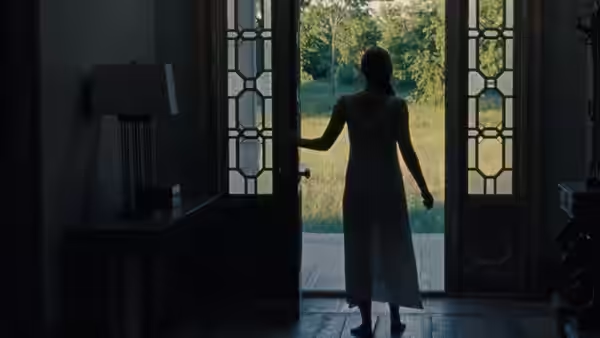
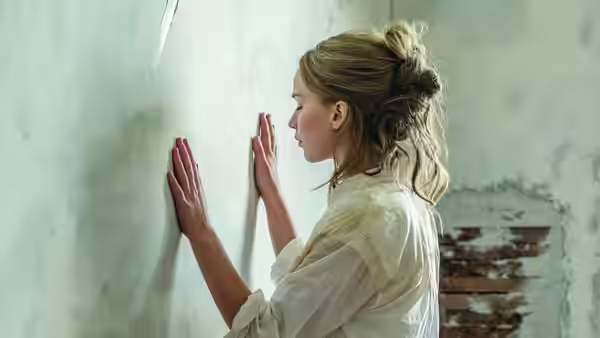
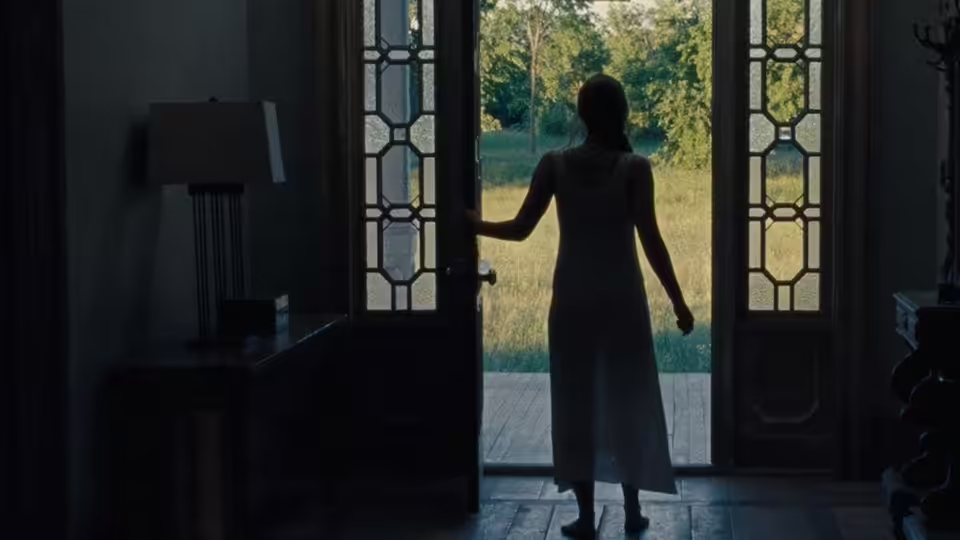
Mother (Jennifer Lawrence) stands in the open doorway, facing the garden
Film review

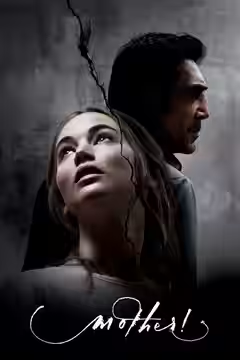
mother!

2017 · Directed by Darren Aronofsky · 2h 01m

In a sentenceTwo hours of Jennifer Lawrence asking people to leave her house and not one of them doing it

A young woman, credited only as Mother (Jennifer Lawrence), lives with her much older husband, a poet credited as Him (Javier Bardem), in a large old wooden house standing alone in a meadow. The house burned once; she has rebuilt it herself and is still plastering the walls while he sits at his desk unable to write. One night a stranger (Ed Harris) knocks, saying he took the place for a bed and breakfast. The husband invites him to stay. The next morning the stranger’s wife (Michelle Pfeiffer) arrives, uninvited, and settles in, asking questions about children and the marriage that she has no business asking. Then the couple’s two sons (Domhnall Gleeson and Brian Gleeson) turn up, fighting over their father’s will, and the house begins to fill.

Plays from YouTube when you press play; nothing loads from them until then.

Fi1m review

Darren Aronofsky’s horror about a house that fills with uninvited guests is tightly controlled for an hour, and Michelle Pfeiffer is the worst of them. Then the allegory takes over, the volume goes up, and the second half is mostly spent explaining the first.

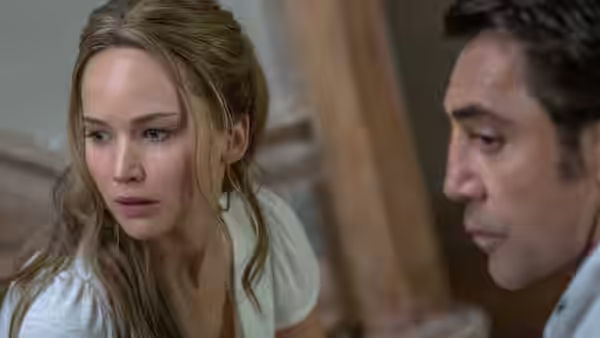
Darren Aronofsky has made a horror film about a woman who cannot get anyone to leave her house. Jennifer Lawrence, credited only as Mother, has spent months rebuilding a burned-out house in the middle of a meadow for her husband, a poet credited as Him (Javier Bardem), who has not written a line since they moved in. A stranger knocks. The husband lets him stay. For an hour this is as tight a piece of dread as Aronofsky has made, and then the film decides it would rather be a parable and stops trusting us.

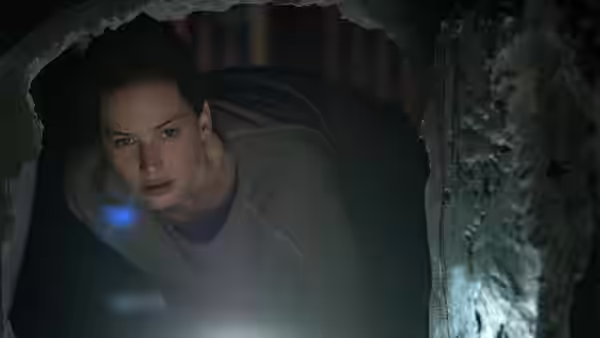
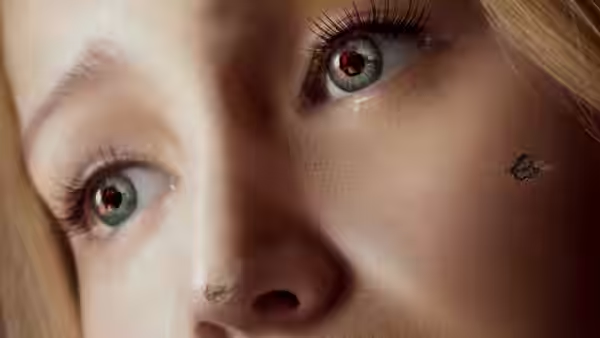
Philip Messina’s house is the best thing in it. It stands alone in long grass with no road leading to it, and inside it is never finished: wet plaster on the landing, a hole where a wall should be, a lavatory that backs up with something that is not water. Matthew Libatique shoots nearly the whole film from a foot behind or in front of Lawrence’s head, handheld and grainy, following her up the stairs and round the corners, so that we never see a room before she does. Jóhann Jóhannsson is credited with the music and there is almost none of it. The film runs on floorboards, the doorbell and something ticking behind the walls, and the quiet does more work than a score would have.

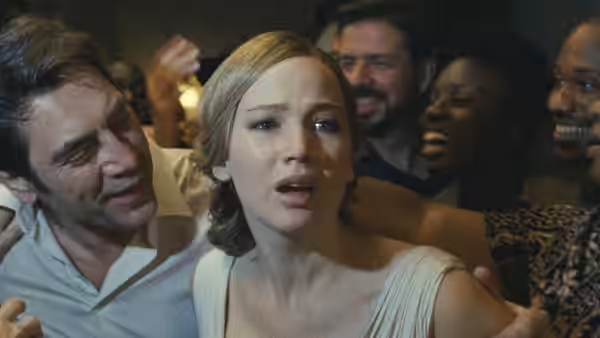
The guests make the first hour. Ed Harris arrives coughing, says he took the place for a bed and breakfast, and is smoking in the study by the end of the evening. Michelle Pfeiffer follows the next morning in dark glasses, finds the drinks, and asks Lawrence why she has not had children and whether the marriage is any good in bed. Pfeiffer plays her with a smile that never moves and a voice pitched just under rudeness, and every scene she is in improves. Danny Glicker puts her in clinging black and Lawrence in thin pale cotton. We laughed at Pfeiffer, and then stopped laughing, at about the point their sons (Domhnall Gleeson and Brian Gleeson) turned up shouting about a will.

We were frightened for a good hour, and we do not say that often. Nothing supernatural has happened; a woman is standing in her own kitchen while people she did not invite open her drawers and her husband tells her to be nicer. The third time the doorbell rang we felt the whole row stiffen. Lawrence does this with almost nothing: a set jaw, a hand flat on the wall, the same request to leave repeated more politely each time. It is a performance made of restraint, and the second half asks her to scream instead. She does that well too, but it is a smaller thing to watch.

The second half takes a turn we will not describe, except to say that the house fills up. Aronofsky, who also wrote it, has a meaning in mind, and from about the seventieth minute he is illustrating that meaning, scene by scene, instead of telling the story. Andrew Weisblum’s cutting, patient for an hour, goes to fragments. Things happen because the parable requires them to, not because anyone in that house would do them. Bardem, warm and vague and faintly pleased with himself throughout, dwindles into a mouthpiece. The scenes are staged with skill. They are also a checklist, and by the last half hour we had stopped being frightened and were ticking off the references, which is not what fear feels like.

This is Aronofsky’s pattern. Black Swan (2010) kept its metaphor inside a dancer’s body and was terrifying because of it. Noah (2014) started with an idea and built a flood around it. This film begins as the first kind and ends as the second, and you can see the join.

It runs 121 minutes and carries an 18, which the last act earns. See it for Pfeiffer, for the house, and for the hour in which nothing has happened and everything is wrong. Bring someone who does not mind being told what a film means, because this one will tell you, and then tell you again in case you missed it.

Critical consensus AI synthesised

70
Positive
20
Mixed
12
Negative
3

Most critics come out in favour, and their praise gathers around Jennifer Lawrence. Review after review calls her performance the thing that holds the film together, and several note that the camera scarcely leaves her face, which they count as Aronofsky’s best decision. The close handheld photography and the oppressive sound design are named repeatedly as the source of the dread. Michelle Pfeiffer’s cruel house guest gets a steady supply of admiring mentions, and most agree the controlled first half is the film at its best.

The reservations are about what comes after. A good number of the positive reviews concede that the second half tips into excess and that the allegory is too plainly signposted to reward decoding. The spread of opinion is wide. Variety finds the spectacle dazzling but empty, and Vulture objects that the film puts Lawrence through suffering that serves the director rather than the story. /Film goes further and thinks her miscast.

Evening Standard
15 November 2017 · ★★★★★ · David Sexton
100

Sexton finds the film scary and arty, with its oppressive style casting a spell. He especially praises Jennifer Lawrence’s emotional honesty and expressive face.

Read the full review →
The i Paper
14 September 2017 · ★★★★★ · Matthew Turner
100

Turner calls the film an unmissable, nightmarish experience that is both shocking and intense. He especially praises the technical direction and Jennifer Lawrence’s captivating performance.

Read the full review →
Time Out
5 September 2017 · ★★★★★ · Joshua Rothkopf
100

The critic calls the film bold, barmy and brilliant, an instant landmark of boundary-pushing cinema. The review singles out its in-your-face psychological horror as far more than a haunted-house movie.

Read the full review →
IndieWire
5 September 2017 · A- · Ben Croll
90

Croll finds the film daring and effective, building from a slow burn into an audacious cinematic blaze. He especially praises the close, handheld camerawork that keeps viewers with Jennifer Lawrence as the house and its horrors spiral out of control.

Read the full review →
Los Angeles Times
14 September 2017 · Justin Chang
90*

Chang finds the film feverishly inspired, experimentally ambitious, and beautifully coherent despite its escalating chaos. He especially praises Jennifer Lawrence’s extraordinary, expressive performance and the film’s commitment to her perspective.

Read the full review →
The Guardian
5 September 2017 · Peter Bradshaw
85*

Bradshaw finds the film an outrageous, exhilarating horror-comedy, though its chaos is deliberately excessive. He praises Jennifer Lawrence’s compelling central performance and Michelle Pfeiffer’s cruel supporting turn.

Read the full review →

Straight answers AI written, from our review

How long is mother!, and what is it rated?
mother! runs 2h 01m. It is a horror and drama film.
Where can I watch mother! in Serbia?
mother! is available to rent from Amazon Prime Video from din 2.99. Availability is checked daily; the links above go straight to each service.
What should I watch after mother!?
After mother!, try Rosemary's Baby (1968, Fi1m 92): The template: a wife, a flat, and neighbours who will not stop helping. Then The Exterminating Angel (1962, Fi1m 87): Buñuel’s dinner guests find they cannot leave; funnier, shorter and no less strange; and Repulsion (1965, Fi1m 88): Polanski shuts Catherine Deneuve in a London flat and lets the walls do the rest.

Cast

If you liked this, try…

  1. Rosemary's Baby (1968, Fi1m 92)The template: a wife, a flat, and neighbours who will not stop helping.

  2. The Exterminating Angel (1962, Fi1m 87)Buñuel’s dinner guests find they cannot leave; funnier, shorter and no less strange.

  3. Repulsion (1965, Fi1m 88)Polanski shuts Catherine Deneuve in a London flat and lets the walls do the rest.

  4. Funny Games (1997, Fi1m 74)Haneke’s polite young men at the door and a family too well mannered to refuse them.

  5. Black Swan (2010, Fi1m 82)Aronofsky’s other horror of a woman consumed, and the one where the metaphor stays put.