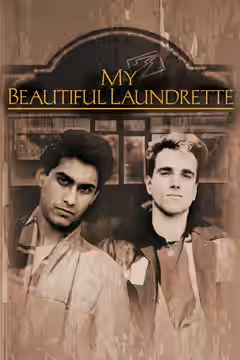
Johnny (Daniel Day-Lewis) held by two shirtless men at a bathroom sink
Film review

My Beautiful Laundrette

1985 · Directed by Stephen Frears · 1h 38m

In a sentenceWe came for the romance and left with an unreasonable interest in commercial laundry

In Thatcher-era South London, Omar Ali (Gordon Warnecke) and Johnny Burfoot (Daniel Day-Lewis) set about turning a rundown laundrette into a business. Their partnership also becomes a romance, conducted amid the tensions between London’s Pakistani community and working-class white youths. As the shop takes shape, questions of race, class, money and sexuality complicate the men’s attempt to make a life together. Saeed Jaffrey and Roshan Seth also star in Stephen Frears’s comedy-drama, written by Hanif Kureishi, about private desires and the pressure to get ahead.

Plays from YouTube when you press play; nothing loads from them until then.

Fi1m review

Stephen Frears and Hanif Kureishi make a funny, tender romance in which wanting money is as human as wanting love. The crowded subplots occasionally get in the way, but the performances keep the people worth caring about.

Stephen Frears makes a warm, prickly social comedy from an unlikely business proposition: two young men turning a rundown laundrette into somewhere people might want to spend time. My Beautiful Laundrette is funny, sexy and observant, with a crowded script that occasionally lets its characters talk longer than we want to listen. Hanif Kureishi puts a gay romance among the ambitions and resentments of London’s Pakistani community and working-class whites. Money matters here, and wanting it does not automatically make someone a fool or a villain.

Gordon Warnecke’s Omar Ali has to hold our attention beside Daniel Day-Lewis’s Johnny Burfoot, and the quieter performance is worth watching closely. Warnecke makes the wish to get ahead appealing enough for us to share it, without asking us to approve of everything that comes with it. Day-Lewis brings a restless physical presence, but his attention to Omar is what gives the romance its force. We were moved by their tenderness, because the racial resentment around them makes that affection feel precarious.

Kureishi also gives Saeed Jaffrey’s Nasser Ali room to be funny without reducing him to a joke about money. Jaffrey makes ambition sociable and persuasive, and his pleasure in the character is infectious. The comedy works because no one has to stand outside the story explaining what Thatcher’s Britain has done to the people in it. Frears allows us to enjoy their company while leaving plenty of room to question their behaviour.

Hugo Luczyc-Wyhowski’s production design gives the renovation a visible point: the laundrette becomes flashy enough for its owners’ pride to make sense. Oliver Stapleton’s cinematography makes the transformed shop inviting, helping us understand why improving it should become such an absorbing occupation. Its new flashiness can look faintly absurd, which is part of the pleasure. That touch of fantasy suits a film willing to let its characters enjoy themselves despite the hostility surrounding them.

Mick Audsley’s editing keeps the romance and the business scheme closely connected, giving the lovers practical concerns alongside their attraction. There is an appealing bustle to the changes of company and concern, though the competing relationships sometimes make the story feel hurried. Hans Zimmer and Stanley Myers’s music helps sustain the playful mood without making the surrounding hostility disappear. That lightness matters in a film dealing with racism and resentment, where an insistently grave accompaniment could have made the comedy feel unwelcome.

The weakness is Kureishi’s tendency to give several people something important to say at once. Some dialogue sounds written for our benefit, and the subsidiary stories do not all have enough space to develop before attention moves elsewhere. Frears usually gets away with that crowding because the cast give even awkward exchanges some warmth, but there are passages where we want fewer people and more time with them. The 98-minute running time leaves some of those relationships short of room.

As a romance, it is unusually comfortable letting desire exist alongside calculations about work, money and belonging. Omar and Johnny are not required to become exemplary citizens before we are allowed to care about them, and that makes the love story easier to believe. Their attraction remains interesting because the film has given them other things to want, including things we might distrust. See it for the lovers, and allow for a few conversations that could have ended sooner.


Critical consensus AI synthesised

83
Positive
10
Mixed
0
Negative
0

The consensus is firmly positive, with praise clustering around the performances and the film’s handling of race, class, sexuality and ambition in Thatcher-era Britain. Daniel Day-Lewis receives repeated attention, while Saeed Jaffrey and Gordon Warnecke also earn praise for keeping the characters human amid the satire. The reviews value Kureishi’s script for approaching politics through personal relationships rather than speeches. Frears’ direction is admired for its vitality and for allowing tenderness, resentment and comedy to coexist.

The differences concern emphasis more than verdict: some critics stress the romance’s sensuality, others the sharpness of the social comedy. Reservations are limited but specific, with The AV Club finding the narrative ungainly, the dialogue unnatural and the subplots overstuffed, despite admiring Day-Lewis. The spread remains broadly favourable; even the more qualified responses praise the acting and the vivid portrait of London’s Pakistani community.

Radio Times
★★★★★ · Sue Heal
100

This seminal 1980s movie is celebrated for launching major careers and cleverly turning Thatcherite values on their head without polemic, thanks to marvellous performances and its importance in British cinema.

Read the full review →
The New Yorker
3 March 1986 · Pauline Kael
90*

The film is a startlingly fresh, sensual portrait of South London life among Pakistani immigrants and resentful white youths, defined by a tender yet fraught gay romance. Frears and Kureishi capture the texture of the milieu with instinctive visual and rhythmic flair.

Read the full review →
Los Angeles Times
13 March 1986 · Sheila Benson
85*

Kureishi’s audacious script mixes race, class, sexuality, and politics into an irresistible satirical romance set among London’s Pakistani community. Frears directs with vitality and casts superbly, letting the film’s crisscrossing relationships and performances reverberate.

Read the full review →
The New York Times
7 March 1986 · Vincent Canby
85*

This rude, wise social comedy about Pakistani immigrants in London is the year's first real sleeper, full of vivid characters and eccentric energy. It succeeds through its personal, unforced take on race, class, and ambition in contemporary Britain.

Read the full review →
Empire
· William Thomas
80*

The critic finds the film a somber and complex take on cross-cultural romance and British racism in 1980s London, praising its superb acting by Daniel Day-Lewis and Saeed Jaffrey along with skillful direction by Frears.

Read the full review →
Time Out
7 January 2015 · RR
80*

The critic highlights the film's dual focus on London's Asian community and a gay love story, praising Daniel Day-Lewis's luminous performance and the compassionate, cutting vision of what it means to be Asian and British in Thatcher's Britain.

Read the full review →

Straight answers AI written, from our review

Is My Beautiful Laundrette worth watching?
My Beautiful Laundrette is worth watching for anyone who likes a romance where wanting money is treated as seriously as wanting love, and we scored it 85. Gordon Warnecke and Daniel Day-Lewis make the tenderness between Omar and Johnny worth caring about. The script crowds in more subplots than 98 minutes can hold, so allow for a few conversations that run long.
How long is My Beautiful Laundrette, and what is it rated?
My Beautiful Laundrette runs 1h 38m. It is a comedy and drama film.
Where can I watch My Beautiful Laundrette in Poland?
My Beautiful Laundrette is not on any streaming or rental service in Poland at the moment. It is available in 4 other countries; change your country at the top of the page to see where. Availability is checked daily.
How violent or frightening is My Beautiful Laundrette, and is it suitable for children?
My Beautiful Laundrette carries a 15 certificate in the UK and an R in the US, and it is not a film for children. It is a comedy-drama about a gay romance set amid racial resentment between London's Pakistani community and working-class white youths, with sex and hostility both part of the story. Older teenagers who can take that material will be fine; the squeamish need not worry about gore.
How does My Beautiful Laundrette compare to Beautiful Thing?
My Beautiful Laundrette is the busier and more ambitious of the two, putting its gay romance among arguments about money, race and class in Thatcher's Britain, while Beautiful Thing is a gentler teenage love story about affection surviving cramped surroundings. Frears's film is the richer and sharper; Beautiful Thing is the warmer and easier evening. Both leave their secondary characters short of room.
What should I watch after My Beautiful Laundrette?
After My Beautiful Laundrette, try Beautiful Thing (1996, Fi1m 80): A gentler British gay romance, with affection surviving cramped surroundings and difficult neighbours. Then The Wedding Banquet (1993, Fi1m 81): Family expectations complicate a gay relationship in another comedy generous towards imperfect people; and Ali: Fear Eats the Soul (1974, Fi1m 88): Another romance made difficult by racism, with less room for laughter.

Cast

Awards

Academy Awards, 1987

Nominated
Best Writing, Original Screenplay

If you liked this, try…

  1. Beautiful Thing (1996, Fi1m 80)A gentler British gay romance, with affection surviving cramped surroundings and difficult neighbours.

  2. The Wedding Banquet (1993, Fi1m 81)Family expectations complicate a gay relationship in another comedy generous towards imperfect people.

  3. Ali: Fear Eats the Soul (1974, Fi1m 88)Another romance made difficult by racism, with less room for laughter.

  4. A Taste of Honey (1961) · not reviewed yetWorking-class lives and unconventional affection, treated with humour and little patience for respectability.

  5. The Lunchbox (2013, Fi1m 75)Work and ordinary routines make room for affection, with quieter comic pleasures.

Free account

Know what to watch tonight

Two lists that know where things are streaming, collections you can share, your own score beside ours, and Discover that remembers what you have seen.

  • Want to see, sorted by what is streaming now
  • Seen, with your score out of ten
  • No adverts, ever