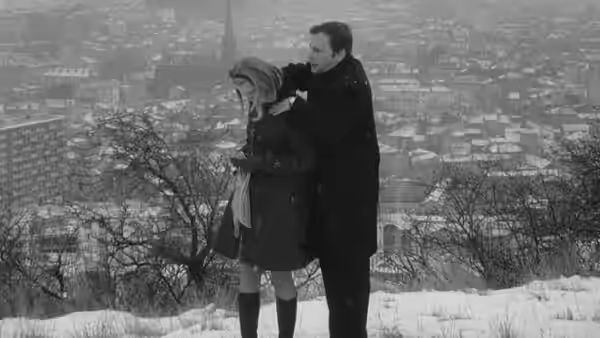
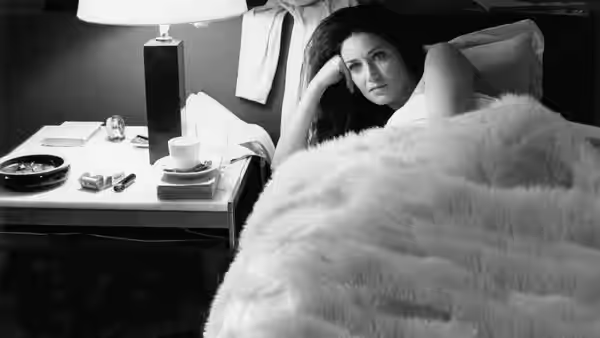
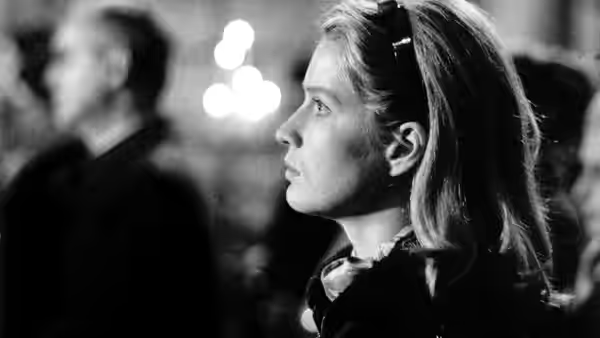
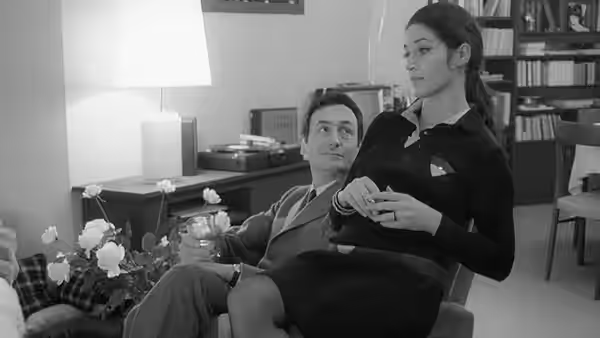
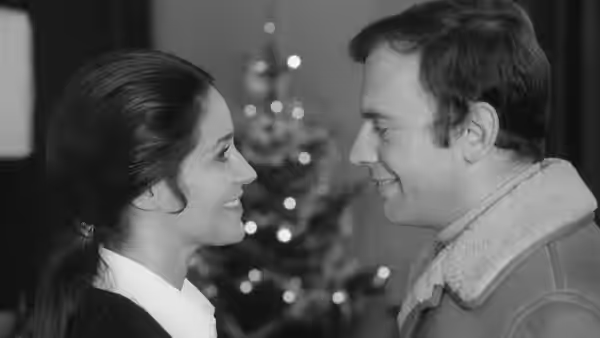
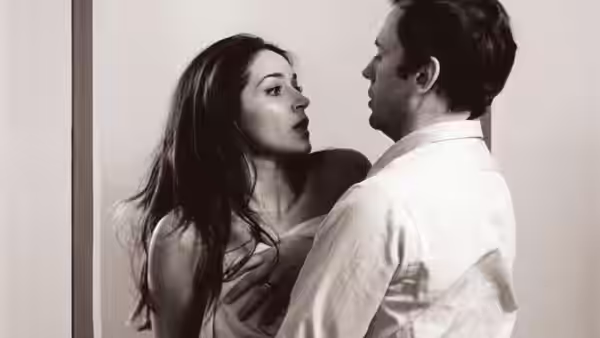
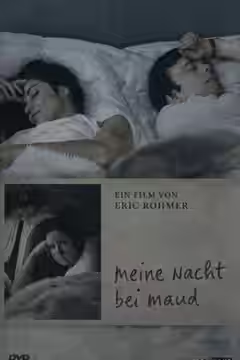
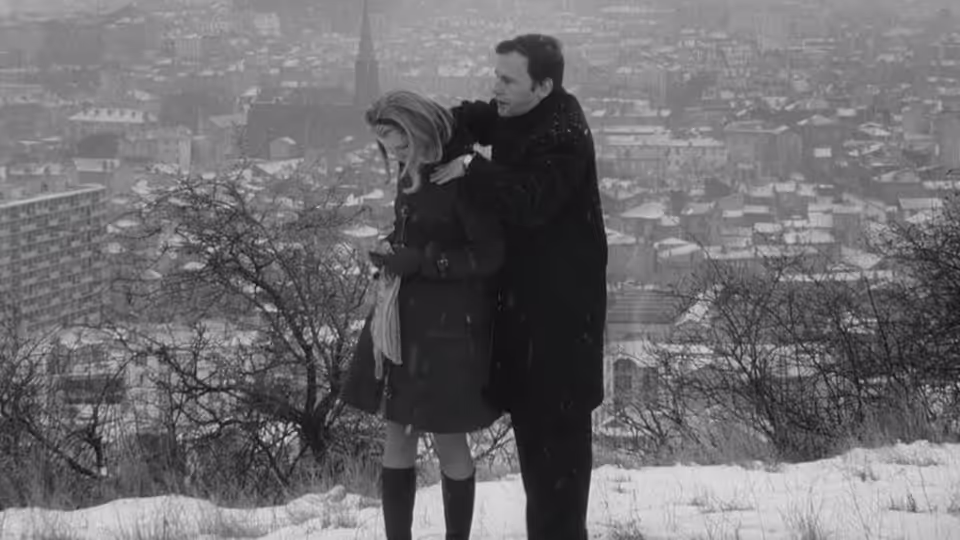
A man holds a woman close on a snowy street beneath bare trees
Film review

My Night at Maud's

1969 · Directed by Éric Rohmer · 1h 50m

In a sentenceA long conversation about sex, with Françoise Fabian making the case for a shorter one

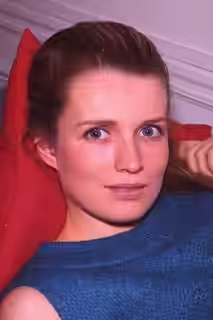
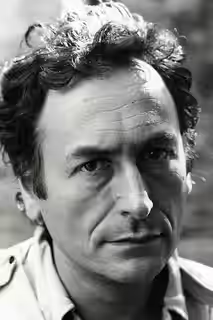
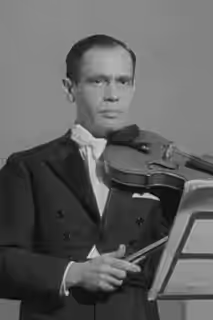
Jean-Louis (Jean-Louis Trintignant) is drawn towards Maud (Françoise Fabian), against a snowy setting. Philosophy and sexual attraction become subjects for discussion as he tries to make sense of what he wants. Françoise (Marie-Christine Barrault) and Vidal (Antoine Vitez) also figure in this story of people examining their attitudes towards desire. The conversations take their time, allowing opinions to be stated, challenged and reconsidered. Jean-Louis’s attraction to Maud keeps bringing the discussion back to the people involved, and to the difficulty of making what he thinks agree with what he feels.

Fi1m review

Éric Rohmer’s talkative romance is witty, intimate and carried by Françoise Fabian’s inviting performance. The conversations sometimes outstay their welcome, but watching intelligent people struggle with desire makes the patience worthwhile.

The pleasure of My Night at Maud’s is watching people take their own thoughts seriously enough to become funny. Éric Rohmer, who writes and directs, allows the discussion of sexual attraction to occupy time that another romance would spend getting its characters together. It is an absorbing, warm film, and we recommend it with one reservation: some of these conversations could finish sooner. Françoise Fabian supplies much of the warmth, making Maud someone whose company can survive a considerable amount of philosophy.

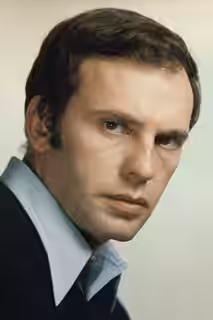
Jean-Louis Trintignant plays Jean-Louis with a reserve that makes the attention he gives Maud interesting in itself. He has to let us follow a man thinking without making every pause look significant, and his performance is patient enough to manage that. The talk gives him opportunities to sound certain; the attraction gives us reason to question that certainty. We can listen closely to what he says and still suspect that he has more thinking to do.

Françoise Fabian is more immediately engaging, and the film benefits from the difference. Her Maud makes the discussion of sex feel connected to an actual person, whose desires cannot be settled by finding a persuasive sentence. We laughed at the solemnity of the intellectual talk around her. Her ease in these exchanges makes all that verbal effort amusing while keeping the attraction credible, and gives us a reason to care about where the conversation might lead.

Néstor Almendros gives the snowy setting a welcome physical presence. Those views offer a chance to look without having to follow another line of reasoning, and their beauty makes the pauses worth taking. Nicole Rachline’s production design is discreet enough to keep our attention on the actors, which is a useful quality in a film that spends so much time in conversation. The surroundings never seem to be demanding an interpretation of their own.

Cécile Decugis’s editing accommodates the long takes and gives each exchange time to develop its own rhythm. Listening matters here, and cutting the dialogue more briskly would lose some of the pleasure of watching people consider what they have heard. Even so, 110 minutes is generous for material that sometimes revisits a point after its dramatic interest has faded. There are stretches when we understand the difficulty and are simply waiting for the speakers to catch up.

The film also asks something unusual of a romance: that we remain interested in the explanations people give for their attraction. It leaves enough room for us to question those explanations without dismissing the people offering them. The comedy depends on taking their concerns seriously, and the performances are sufficiently persuasive to make that possible. A less patient treatment would probably be funnier, but it would give us fewer reasons to care about Maud and Jean-Louis.

Choose it for an evening when conversation sounds like sufficient entertainment, and leave room for disagreement afterwards. Half-watching it while doing something else would make its slower stretches harder work, since so much depends on following an exchange from beginning to end. We would gladly spend the evening with Maud again, though we might occasionally ask to change the subject.
Critical consensus AI synthesised

74
Positive
4
Mixed
2
Negative
0

The reviews lean positive, with praise clustering around Rohmer’s wit, intelligence and finely tuned dialogue. Critics find the conversations revealing about sexual attitudes, and admire the space given to people speaking and listening. The performances also draw praise, particularly Françoise Fabian’s Maud, while the snowy setting attracts attention for its photography. The New Yorker is especially enthusiastic about the film’s gentle intelligence and the intimacy of its long takes.

The reservations concern length and the demands of the philosophical discussion rather than the acting. Empire finds the film overlong, though still charming, fascinating and amusing. The Guardian acknowledges that the discussions divide audiences, without treating that as a reason to dismiss them. The recorded scores range from mixed to strongly positive, with no negative entries, but two of the six lack accessible verdicts, so the precise grounds for those lower scores cannot be established.

The New Yorker
27 March 1970 · Penelope Gilliatt
95*

Gilliatt regards Rohmer’s film as a delicate triumph and praises its gentle, truthful intelligence. She singles out the intimate conversations and the way the film lets people speak and listen in long takes.

Read the full review →
Empire
1 January 2000 · David Parkinson
75*

Parkinson finds the film charming and intellectually engaging despite its excessive length. He particularly praises its finely tuned dialogue, which makes the film fascinating and amusing.

Read the full review →
Variety
31 December 1968 · Variety Staff
75*

The review finds the film refined, witty, and revealing in its exploration of intellectuals’ sexual attitudes. It praises the performances, especially Françoise Fabian’s portrayal of Maud.

Read the full review →
The Guardian
25 July 2010 · Philip French
70*

French gives a positive account of Rohmer’s film, while acknowledging that its philosophical discussions divided audiences. He singles out its wit, intelligence and physical beauty, as well as the snowy setting’s cinematography.

Read the full review →
The New York Times
24 September 1969
64*

The headline suggests a review, but the article text is inaccessible, so its verdict cannot be confirmed. No specific praise or complaint can be reliably identified from the available page.

Read the full review →
Time Out
15 March 2012
64*

The available page does not reveal the critic’s verdict. Its description singles out the intellectual’s attraction to earthy Françoise Fabian.

Read the full review →

Straight answers AI written, from our review

Is My Night at Maud's worth watching?
My Night at Maud's is worth watching if a romance built around conversation appeals: we scored it 81 for its warmth, wit and Françoise Fabian’s inviting performance. The philosophical exchanges sometimes run longer than their interest lasts, but the attraction between Maud and Jean-Louis gives the talk enough feeling to reward close attention.
How long is My Night at Maud's, and what is it rated?
My Night at Maud's runs 1h 50m. It is a romance and comedy film.
Where can I watch My Night at Maud's in New Zealand?
My Night at Maud's is not on any streaming or rental service in New Zealand at the moment. It is available in 8 other countries; change your country at the top of the page to see where. Availability is checked daily.
How does My Night at Maud's compare to Brief Encounter?
My Night at Maud's is the choice for philosophical conversation about desire, while Brief Encounter earns our stronger recommendation for making falling in love feel ordinary and frightening. Both examine attraction between people with reasons to resist it; we find warmth and humour in Maud’s exchanges with Jean-Louis, while Laura’s anxiety gives Brief Encounter its painful force.
What should I watch after My Night at Maud's?
After My Night at Maud's, try Brief Encounter (1945, Fi1m 90): Another careful examination of desire by people who have reasons to resist it. Then Before Sunrise (1995, Fi1m 89): Two people talk their way towards intimacy, with fewer philosophical detours; and Certified Copy (2010, Fi1m 84): Conversation becomes a dispute about how well two people can know each other.

Cast

Awards

Academy Awards, 1971

Nominated
Best Writing, Original Screenplay

Academy Awards, 1970

Nominated
Best International Feature Film

International Submission to the Academy Awards, 1970

Nominated
International Submission to the Academy Awards

If you liked this, try…

  1. Brief Encounter (1945, Fi1m 90)Another careful examination of desire by people who have reasons to resist it.

  2. Before Sunrise (1995, Fi1m 89)Two people talk their way towards intimacy, with fewer philosophical detours.

  3. Certified Copy (2010, Fi1m 84)Conversation becomes a dispute about how well two people can know each other.

  4. The Lunchbox (2013) · not on Fi1m yetA quieter romance in which carefully chosen words carry considerable risk.

  5. Claire's Knee (1970) · not on Fi1m yetÉric Rohmer gives another articulate man ample opportunity to explain himself badly.