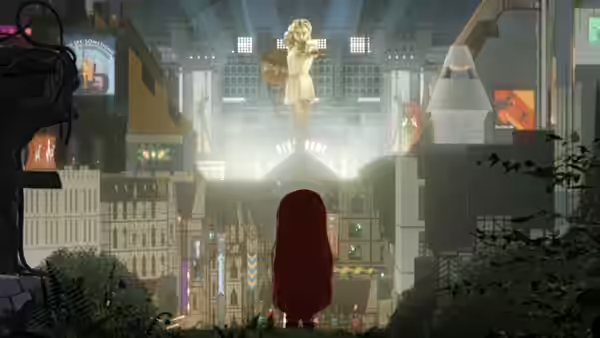
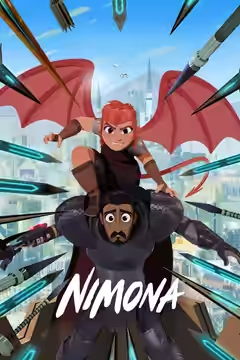
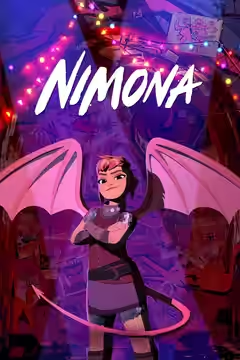
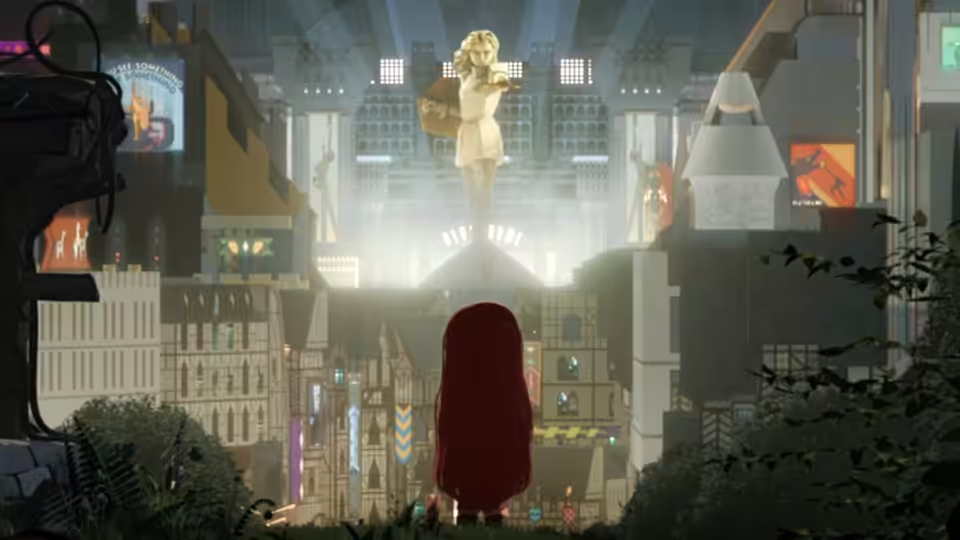
A red-haired figure looks up at a glowing statue above a crowded city square
Film review

Nimona

2023 · Directed by Nick Bruno, Troy Quane · 1h 39m

In a sentenceA shapeshifter who would rather be a shark, a knight who would rather be believed, and a city that wants neither

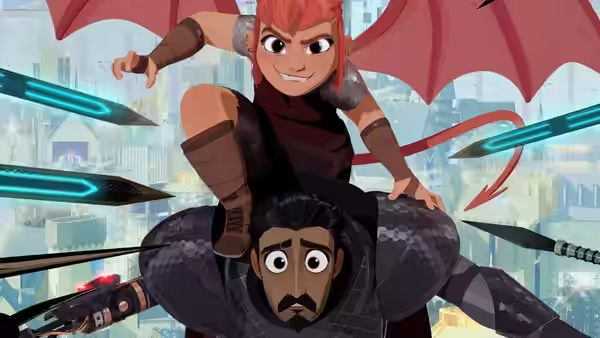
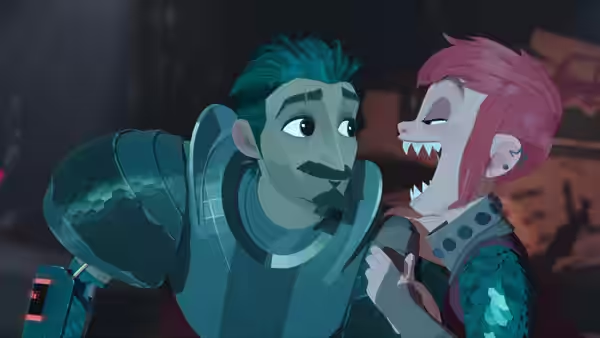
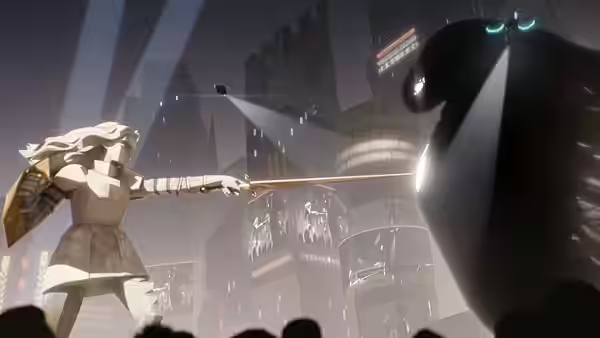
A thousand years after a hero called Gloreth drove a monster out of her city and walled it in, the kingdom still trains knights to keep watch. Ballister Boldheart (Riz Ahmed), a street kid turned squire, is about to become the first commoner knighted by Queen Valerin (Lorraine Toussaint), with his boyfriend Ambrosius Goldenloin (Eugene Lee Yang), a descendant of Gloreth, at his side. At the ceremony his sword fires on its own and kills the queen. Ambrosius takes off his arm, and Ballister flees into a city of laser lances, holographic billboards and a metro, the most wanted man in it. Into his hideout comes Nimona (Chloë Grace Moretz), a teenager who can turn into a shark, a gorilla or a small boy, and who wants to be a villain’s sidekick. He wants to clear his name. She wants to break things.

Plays from YouTube when you press play; nothing loads from them until then.

Fi1m review

Nick Bruno and Troy Quane’s animated fairytale about a framed knight and a shapeshifting teenager is funnier and better drawn than its plot, which you will see coming from the castle walls. Worth your evening, particularly with a child present.

Ballister Boldheart (Riz Ahmed) is minutes from being knighted when his sword fires by itself and kills the queen, and the city that raised him decides in the same instant that it always knew he was a villain. Nimona, which Nick Bruno and Troy Quane have directed from ND Stevenson’s graphic novel, is about what he does next, and about the shapeshifting teenager who turns up in his hideout and refuses to leave. It is a fairytale for children about the way a place decides who its monsters are. It is also funny, drawn with real care, and plotted so that you can see each turn arriving a full scene early. We enjoyed it and we were never once surprised by it.

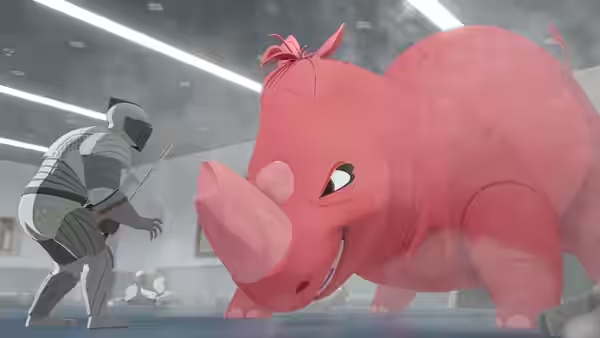
The look is the first thing. Jeff Turley and Aidan Sugano’s production design puts a medieval walled city under holographic billboards, gives the knights lances that fire like rifles, and runs a metro under the castle. It should be a mess and it is not, because everything is drawn in the same flat, inked style: block colours, thick outlines, characters who look like pages of a comic moving through a room with depth. When Nimona changes into a shark or a gorilla or an ostrich, the animators keep her eyes and her grin across every shape, so you never lose her. A chase through the metro, in which she changes four times before the train reaches the next stop, is the best sequence in the film.

Chloë Grace Moretz voices Nimona as a girl who talks faster than anyone can answer, and who greets bad news with the word “metal”. Her first scene with Ballister, in which she covers a wall of his hideout with plans that all end in murder while he tries to explain that he is innocent, is where we laughed hardest. Ahmed plays Ballister as a serious man trying to hold on to his dignity while a rhinoceros demolishes his kitchen, and he is a good straight man; he lets her have every scene and takes the film back in the quiet ones. There is an exchange, later, when he asks what changing shape feels like and she says it hurts more not to. It is written plainly and Moretz plays it plainly, and it got to us. We had not expected to be moved by a cartoon rhinoceros.

The people around them are thinner. Eugene Lee Yang’s Ambrosius Goldenloin, Ballister’s boyfriend and the man ordered to hunt him, is given a real dilemma and about three lines to feel it in. Frances Conroy’s Director runs the Institute with the voice of a woman who has already decided something, and you will guess what a scene or two before the film wants you to. Beck Bennett’s Sir Thoddeus Sureblade is a single joke, the jock knight with a helmet full of nothing, though the joke does land each time. Lorraine Toussaint’s Queen Valerin is warm for the few minutes she has.

Lloyd Taylor and Robert L. Baird’s screenplay has the shape of a dozen framed-hero films: one piece of evidence, one chase to get it, one public unmasking. The children in the audience will not mind. The adults will spend the middle stretch waiting for the film to catch up with what they worked out at the knighting. What the writers do well is the argument underneath, that a city can be wrong for a thousand years and call it tradition, and they mostly trust the pictures to carry it, until a late scene where a character says the moral aloud, twice. Christophe Beck’s score keeps the action clear and never pushes for tears, and Randy Trager and Erin Crackel cut it at 99 minutes, which is the right length.

As a revisionist fairytale it sits a fair way below Shrek, which was crueller and funnier, and as comic-book animation it is not as inventive as Spider-Man: Into the Spider-Verse, which it has clearly looked at. It is better than most of what passes for family animation now. Most critics have put it a little higher than we have; we think they have given it credit for its heart and let the plot off. Near the end the film changes visual style for a stretch we will not describe, and it is the boldest thing in it.

Watch it with a child who has recently been told they are too much. They will know who Nimona is before the adults do.

Critical consensus AI synthesised

75
Positive
12
Mixed
4
Negative
1

Most critics like Nimona, and the praise gathers in two places: the animation and the title character. The hybrid, comic-book-derived look and the medieval-futurist setting are singled out again and again, and several reviews credit Chloë Grace Moretz’s voice performance with carrying the character’s mischief and hurt. The film’s treatment of queer identity and belonging is widely judged sincere rather than preachy, and the relationship between Nimona and Ballister is called nuanced more than once.

The reservations are mild and cluster around the story. Several critics find the plot predictable even as they enjoy it, and admirers of the source comic regret how much has been changed; Polygon in particular mourns the lost complexity of Ballister and Ambrosius’s relationship. Vulture thinks the ending settles for hope where it might have asked harder questions. The spread is narrow, with one clear dissenter: Eye for Film finds the film overfamiliar and short on a personality of its own.

Empire
21 June 2023 · Ben Travis
90*

Travis finds Nimona an irreverent, sincere revisionist fairytale that succeeds both visually and narratively. He particularly praises its distinctive hybrid animation and Nimona’s rebellious, funny energy.

Read the full review →
The Hollywood Reporter
14 June 2023 · Frank Scheck
90*

The critic finds the film a consistently delightful, subversive animation and wants a sequel. They especially praise Chloe Grace Moretz’s uproarious voice performance and the character design that brings Nimona’s emotions to life.

Read the full review →
The Guardian
24 June 2023 · ★★★★ · Wendy Ide
80

Ide finds the film a rambunctious, engaging adventure with a serious message about tolerance and LGBTQ+ acceptance. She singles out its distinctive animation and striking medieval-futurist setting for praise.

Read the full review →
IndieWire
30 June 2023 · B · Christian Zilko
77

The critic finds Nimona a nuanced, bittersweet story of belonging that challenges authoritarianism. They praise its openly portrayed gay romance and storybook animation style.

Read the full review →
Los Angeles Times
30 June 2023 · Noel Murray
75*

Murray finds Nimona imaginative, boisterous and politically pointed without becoming preachy. He praises its puckish wit, adventurous pace and celebration of living freely at the margins.

Read the full review →
Vulture
30 June 2023 · Alison Willmore
75*

Willmore finds the film refreshing and worthwhile, though its ending clings to the hope of belonging rather than confronting the work of changing society. She praises the nuanced relationship between Nimona and Ballister and the film’s clear-eyed treatment of queer identity and the status quo.

Read the full review →

Straight answers AI written, from our review

How long is Nimona, and what is it rated?
Nimona runs 1h 39m. It is an animation and family film.
Where can I watch Nimona in Hungary?
Nimona is streaming on Netflix in Hungary. Availability is checked daily; the links above go straight to each service.
What should I watch after Nimona?
After Nimona, try Wolfwalkers (2020, Fi1m 84): Irish hand-drawn tale of a girl who turns wolf and a town that hunts her. Then The Iron Giant (1999, Fi1m 88): A misunderstood creature, a frightened town, and a boy who knows better; and Spider-Man: Into the Spider-Verse (2018, Fi1m 87): The comic-page animation style Nimona borrows, done with more nerve.

Cast

Awards

Academy Awards, 2023

Nominated
Best Animated Feature

Annie Award for Best Animated Feature, 2023

Nominated
Annie Award for Best Animated Feature

Critics' Choice Awards, 2023

Nominated
Best Animated Feature

If you liked this, try…

  1. Wolfwalkers (2020, Fi1m 84)Irish hand-drawn tale of a girl who turns wolf and a town that hunts her.

  2. The Iron Giant (1999, Fi1m 88)A misunderstood creature, a frightened town, and a boy who knows better.

  3. Spider-Man: Into the Spider-Verse (2018, Fi1m 87)The comic-page animation style Nimona borrows, done with more nerve.

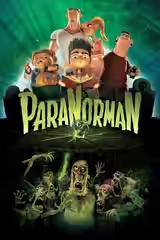
  4. ParaNorman (2012, Fi1m 76)Stop-motion about an odd child and the witch-hunt his town never quite ended.

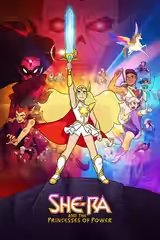
  5. She-Ra and the Princesses of Power (2018) · not on Fi1m yetND Stevenson’s series: found families, shifting loyalties, and a sharper villain.

Nimona (2023) review: funny, well drawn, and entirely predictable (Hungary) | Fi1m