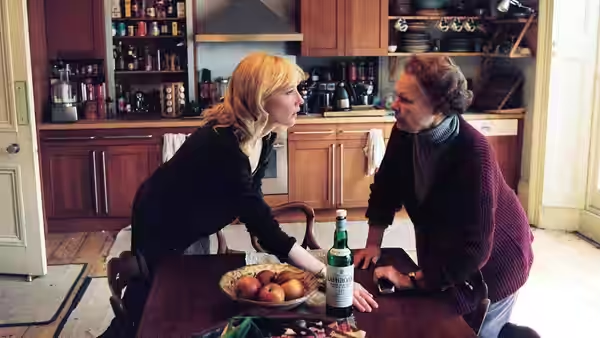
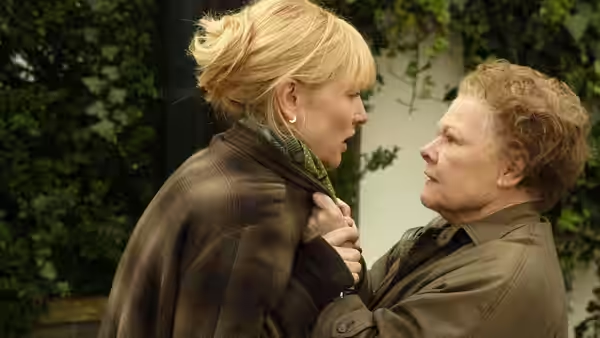
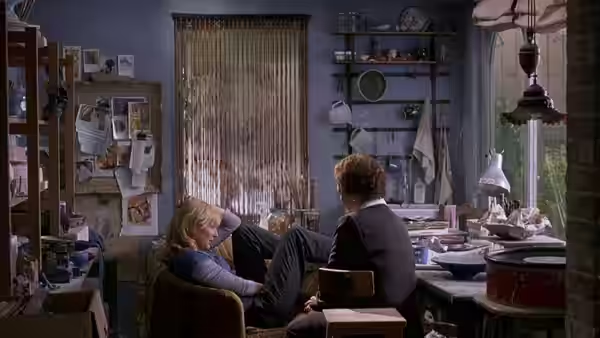
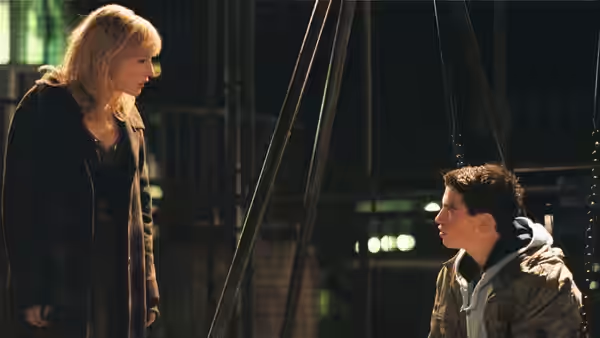
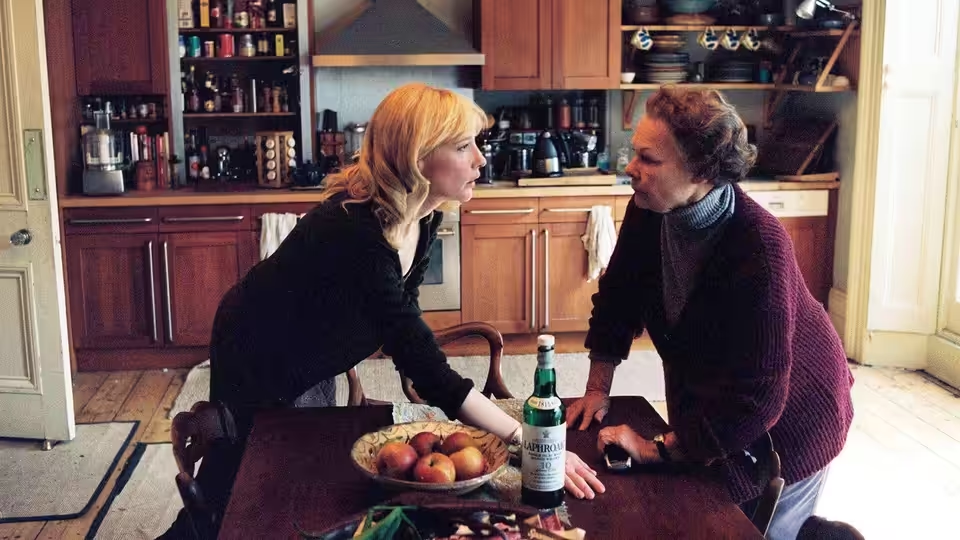
Sheba Hart (Cate Blanchett) and Barbara Covett (Judi Dench) lean across a kitchen table
Film review

Notes on a Scandal

2006 · Directed by Richard Eyre · 1h 32m

In a sentenceJudi Dench, a fountain pen and a diary full of gold stars; lock your doors

Barbara Covett (Judi Dench) is a history teacher nearing the end of a long career at a north London comprehensive. She lives alone with her cat and a diary in which good days get a gold star and colleagues get a sharp sentence each. A new art teacher arrives: Sheba Hart (Cate Blanchett), younger, vaguely bohemian, married to the much older Richard (Bill Nighy), with a sullen teenage daughter, Polly (Juno Temple), and a young son, Ben (Max Lewis). Barbara decides Sheba is the friend she has waited years for and sets about becoming indispensable, from a playground fight to Sunday lunch at the Harts’ house. Sheba, meanwhile, is drawn into something with a fifteen-year-old pupil, Steven Connolly (Andrew Simpson), and one evening after a school performance Barbara sees what she should not.

Plays from YouTube when you press play; nothing loads from them until then.

Fi1m review

Richard Eyre’s adaptation of Zoë Heller’s novel is a tight, unkind, superbly acted 92 minutes, with Judi Dench giving one of her best screen performances. Philip Glass’s score shouts over it and the last stretch tips into melodrama, but it grips.

Barbara Covett (Judi Dench) has taught history at a north London comprehensive for longer than anyone on the staff can remember, and she keeps a diary in which good days get a gold star and colleagues get a sentence they would not survive. When Sheba Hart (Cate Blanchett) arrives to teach art, Barbara decides she has found a friend. Sheba has found something else: a fifteen-year-old pupil, Steven Connolly (Andrew Simpson). Richard Eyre’s film, adapted by Patrick Marber from Zoë Heller’s novel, is about what Barbara does once she knows. It is a sharp, unkind, well-made 92 minutes, worth your evening, with one loud reservation.

The narration is the film. Marber gives Barbara a diary voice of patient, precise spite, and Dench reads it as if dictating to a secretary she does not trust. Sue Hodge (Joanna Scanlan) is dismissed in a clause; the headmaster, Sandy Pabblem (Michael Maloney), gets a paragraph. We laughed at nearly all of it, and then noticed we had been agreeing with Barbara for twenty minutes, and that the film had meant us to. On screen Dench does less and it carries further: a hand laid on Sheba’s arm and left there a beat too long, the sag in her shoulders when she gets home to the cat.

Blanchett has the harder job, because Sheba must be a fool without being a cartoon. She plays her as a woman who drifted: married young to Richard (Bill Nighy), a good deal older, mother to a furious teenager, Polly (Juno Temple), and a son, Ben (Max Lewis), who has Down’s syndrome, and now back at work and mistaking a boy’s attention for being seen. Simpson’s Connolly is cocky on the football pitch, needy in the art room, a child whenever it suits him. The film does not excuse Sheba. It lets Barbara judge her in voice-over and then spends an hour showing us what Barbara’s judgment is worth.

Nighy is the quiet surprise. For most of the film Richard is fond, faintly patronising and funny, a man used to being the clever one in the house. Then, in the second half, he has a scene we will not describe, except to say that we flinched, and that we had not known he had it in him. Tim Hatley designs the two homes so that each tells you about its owner before anyone speaks: the Harts’ house is books, rugs, clutter and a pottery studio down the garden; Barbara’s flat is beige, tidy and full of nothing. Hatley also dresses them, Barbara in brown and grey, Sheba in long skirts and loose jumpers.

Chris Menges shoots a London of low winter light, grey skies over the playground and strip lighting in the corridors, and keeps the camera close on Dench so that we watch her watching Sheba. Then there is the score. Philip Glass has written churning, repeating strings that treat a cup of tea in the staff room as if it were a bank raid. For half an hour this works, because it tells us Barbara’s mind never stops. After that it keeps going at the same pitch through scenes that needed quiet, and we started hearing the music instead of the people. John Bloom and Antonia Van Drimmelen cut briskly, a virtue for an hour and a problem in the last twenty minutes, when events the novel let breathe arrive one on top of another.

Heller’s book was a comedy about loneliness with a thriller underneath. Marber has turned it the other way up, and mostly the trade pays: the film is tighter and more frightening than the novel. The cost comes at the end, where a story about small daily cruelties, the kind that happen in any staff room, becomes a story about a monster, complete with a confrontation shot and scored like the close of an opera. Dench keeps Barbara a person through all of it, lonely and ashamed and still hoping to be liked. The film around her is less careful.

It carries a 15 and runs an hour and a half, which makes it a good film for a weeknight: on before the news and done before you are tired. See it for Dench, who is as good here as we have seen her, and for Nighy’s one scene. Turn the strings down a notch if you can. The people are saying things worth hearing underneath them.

Critical consensus AI synthesised

72
Positive
7
Mixed
5
Negative
1

Most critics like Notes on a Scandal, and nearly all of them like it for the same reason. Judi Dench’s Barbara is praised in almost every review, as chilling, imperious, spiteful and grotesquely comic, and several critics pair her with Cate Blanchett and find the scenes between the two women the film’s best. The warmer notices call it a gripping, deviously entertaining thriller that stays absorbing even though neither woman is easy to like.

The reservations gather around the writing rather than the acting. The mixed reviews find the characters thin and the drama brittle; Slant Magazine thinks the third act is rushed, and The AV Club objects to the score as well as the shallow characterisation. The one outright dissent comes from the Los Angeles Times, which finds the adaptation bombastic and less psychologically complex than the novel. The spread is moderate: a cluster of strong recommendations, a block of three-star shrugs, and a single refusal.

The New Yorker
7 January 2007 · David Denby
90*

Denby finds the film wonderfully entertaining and brilliant. He especially praises Judi Dench’s nuanced performance and Cate Blanchett’s portrayal of Sheba.

Read the full review →
Empire
1 January 2000 · Olly Richards
85*

The critic calls the film intelligent, classy and skin-crawling, with only a few moments that feel too explicit or emotionally false. Judi Dench’s chilling, nuanced performance is singled out as the film’s masterclass.

Read the full review →
The Guardian
4 June 2007 · Rob Mackie
85*

Mackie finds the film absorbing, gripping, and emotionally compelling despite its deeply flawed characters. He especially praises the subtle performances, led by Judi Dench and Cate Blanchett.

Read the full review →
Variety
8 December 2006 · Justin Chang
85*

Chang finds the film a deviously entertaining, superbly executed thriller. He especially praises the riveting interplay between Judi Dench and Cate Blanchett.

Read the full review →
Radio Times
★★★★ · Sloan Freer
80

The critic praises the film as an intense, gritty drama. Judi Dench’s performance is singled out for its malignant spite and intensity.

Read the full review →
Screen Daily
11 December 2006 · Geoffrey Macnab
64*

The accessible page does not reveal the critic’s verdict. It provides no readable praise or complaint about the film.

Read the full review →

Straight answers AI written, from our review

Is Notes on a Scandal worth watching?
Notes on a Scandal is worth watching for anyone who likes a tight, unkind drama built on two strong performances, and we scored it 75. Judi Dench is as good here as we have seen her, and Bill Nighy has one scene that took us by surprise. Philip Glass's score shouts over too much of it and the last twenty minutes tip into melodrama.
How long is Notes on a Scandal, and what is it rated?
Notes on a Scandal runs 1h 32m. It is a drama and romance film.
Where can I watch Notes on a Scandal in Italy?
Notes on a Scandal is streaming on Disney+ in Italy, and it is also available to rent from Apple TV from €3.99. Availability is checked daily; the links above go straight to each service.
How violent or frightening is Notes on a Scandal, and is it suitable for children?
Notes on a Scandal carries a UK 15 certificate and is not for children: its story turns on an art teacher's relationship with a fifteen-year-old pupil, and the whole film is about spite, loneliness and cruelty in a staff room. There is little in the way of physical violence as far as we saw. It is frightening in the way a diary read over your shoulder is frightening rather than in any jump-scare sense.
How does Notes on a Scandal compare to The Servant?
Notes on a Scandal and The Servant are both about one person taking over another's life politely, from the inside, but The Servant is the colder and the better film. Joseph Losey's picture works room by room and keeps its nerve longer, though it too turns the screw too hard at the close. Watch Notes on a Scandal for Dench's narration and a brisk 92 minutes; watch The Servant if you want the same idea done with more ice.
Is Notes on a Scandal based on a true story or a book?
Notes on a Scandal is based on Zoë Heller's novel of the same name, adapted by Patrick Marber, and is not a true story. Heller's book was a comedy about loneliness with a thriller underneath; the film turns that the other way up, becoming tighter and more frightening but rushing the ending the novel let breathe. You do not need to have read it.
What should I watch after Notes on a Scandal?
After Notes on a Scandal, try The Servant (1963, Fi1m 89): Dirk Bogarde takes a household apart from the inside, politely, one evening at a time. Then Persona (1966, Fi1m 89): Two women, one island, and a fixation that eats the quieter of them alive; and Closer (2004, Fi1m 63): Patrick Marber’s own play filmed; four people lying to each other with great precision.

Cast

Awards

Academy Awards, 2007

Nominated
Best Actress
Nominated
Best Original Score
Nominated
Best Supporting Actress
Nominated
Best Writing, Adapted Screenplay

If you liked this, try…

  1. The Servant (1963, Fi1m 89)Dirk Bogarde takes a household apart from the inside, politely, one evening at a time.

  2. Persona (1966, Fi1m 89)Two women, one island, and a fixation that eats the quieter of them alive.

  3. Single White Female (1992) · not on Fi1m yetThe lurid American cousin: a flatmate who wants your life and starts with your haircut.

  4. Closer (2004, Fi1m 63)Patrick Marber’s own play filmed; four people lying to each other with great precision.

  5. Tár (2022, Fi1m 84)Blanchett again, this time holding the power, in an institution that protects her until it does not.