Film review

TÁR

2022 · Directed by Todd Field · 2h 38m · MPA R

In a sentenceTwo and a half hours with a woman who can control every sound in a concert hall and none of the ones in her flat

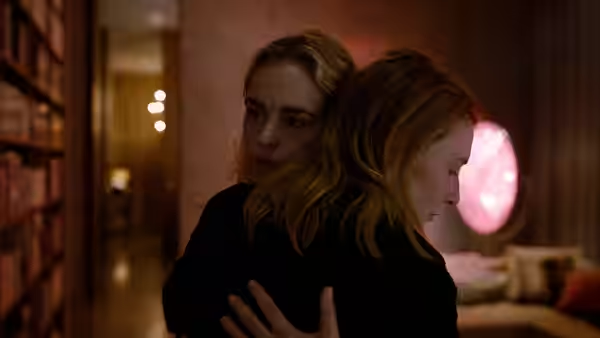
Lydia Tár (Cate Blanchett) is the chief conductor of a major Berlin orchestra, the first woman to have the job, and she is at the top. On a New York stage she is interviewed about her record by Adam Gopnik, playing himself, and at Juilliard she takes a masterclass in which she dismantles a student who will not study Bach. Back in Berlin she is preparing a live recording of Mahler’s Fifth Symphony, with her assistant Francesca (Noémie Merlant) at her elbow and her partner Sharon (Nina Hoss), the orchestra’s first violin, at home with their daughter Petra (Mila Bogojevic). Emails keep arriving concerning Krista Taylor (Sylvia Flote), a former student. Then a young Russian cellist, Olga (Sophie Kauer), joins the orchestra, and Lydia notices her.

Plays from YouTube when you press play; nothing loads from them until then.

Fi1m review

Todd Field’s first film in sixteen years is a long, cold, exact portrait of a conductor whose power is running out, and Cate Blanchett fills every frame of it. It runs twenty minutes too long and refuses to say what it thinks. We recommend it warmly.

Todd Field has not made a film since Little Children in 2006, and he has come back with a portrait of a woman used to being the most important person in any room. Lydia Tár (Cate Blanchett) conducts a major Berlin orchestra, and the film opens with Adam Gopnik, playing himself, reading her achievements to a New York audience for what feels like several minutes while she sits and lets him. Field then spends 158 minutes watching what she does with all that. It is cold, exact and good, and it asks for more patience than it always repays.

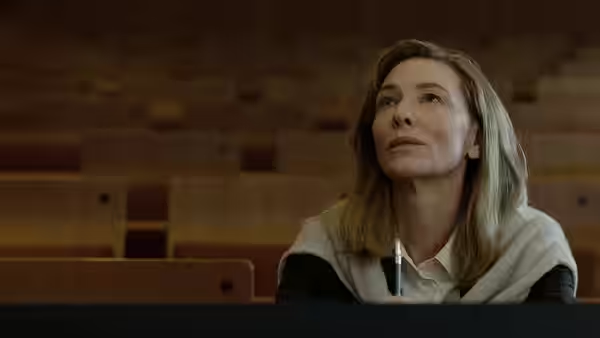
The scene that tells you what you are in for comes early. Lydia takes a masterclass at Juilliard, a student says he cannot get on with Bach because of how Bach lived, and she takes him apart. Florian Hoffmeister films it in a single take that follows her round the classroom, so there is no cut to hide behind and no reaction shot to tell us what to think. Blanchett does it at conversational volume, sitting at the piano, tapping out a few bars. We laughed at nearly every line, and about halfway through we noticed we were enjoying watching a powerful woman humiliate a twenty-year-old, and the laugh curdled. That is the film’s method: it lets you like her and then sends you the bill.

Back in Berlin the film goes quiet. Marco Bittner Rosser gives Lydia and her partner Sharon a flat of bare concrete and long corridors, where a footstep carries, and Hoffmeister lights it in flat grey so the rooms look like the inside of a recording studio. Bina Daigeler puts Lydia in dark tailored suits, and a scene of two tailors fitting her for one tells you how much of this woman is cut and pressed. Hildur Guðnadóttir has written almost no score. What we hear is Mahler’s Fifth in rehearsal and then, in the flat at night, a metronome ticking in a drawer, a doorbell, a woman screaming somewhere in a park while Lydia is out running. We spent the middle hour listening for the next small wrong noise, and those unnerved us more than anything in the plot.

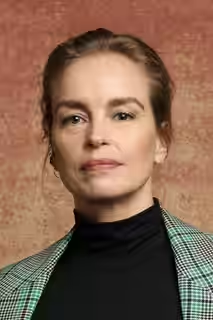
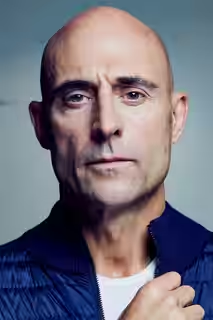
Nina Hoss plays Sharon, the orchestra’s first violin, and does most of her acting by watching: from the strings, from the bed, from a doorway when Lydia comes home late. She is the one person who knows exactly what Lydia is, and Hoss lets us see her deciding how much of it she can afford to know. Noémie Merlant’s Francesca, the assistant, has learned to keep her face still. Sophie Kauer’s Olga, the new cellist, is not afraid of Lydia, and the film wisely never explains why. Mark Strong is Eliot Kaplan, a banker who conducts on the side and wants to be told he is good.

Monika Willi cuts the film in ellipses. Conversations begin halfway through, scenes end a beat before their point lands, and much of what matters happens off screen, in emails Lydia deletes and in the name of a former student, Krista Taylor, that people keep not saying. Field never shows us what Lydia did. He shows the aftermath and the faces of the people managing it, and leaves us to decide how bad it was. A few critics have called this cowardice, or the film siding with her against her accusers. We do not read it that way. It is on nobody’s side, and it does not need to make her stupid to make its point.

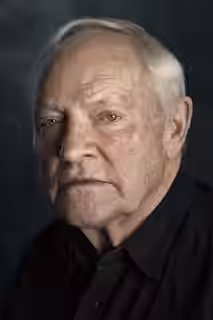
It is too long. The second hour circles the same three rooms for a stretch where nothing tightens, and Julian Glover’s retired conductor, Andris, exists to give Lydia someone to be nostalgic with and not much else. Then the last twenty minutes take the film somewhere we will not describe. The tone shifts hard, some of the audience we saw it with laughed, and we still cannot say whether Field means it as punishment, joke or release. We have come round to thinking he does not mind which we pick.

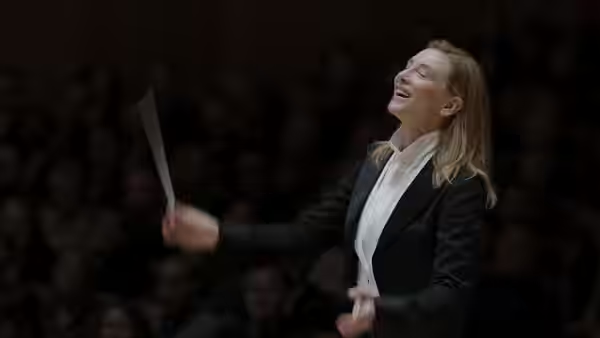
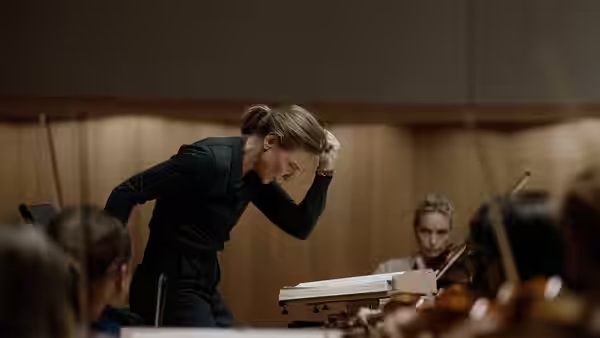
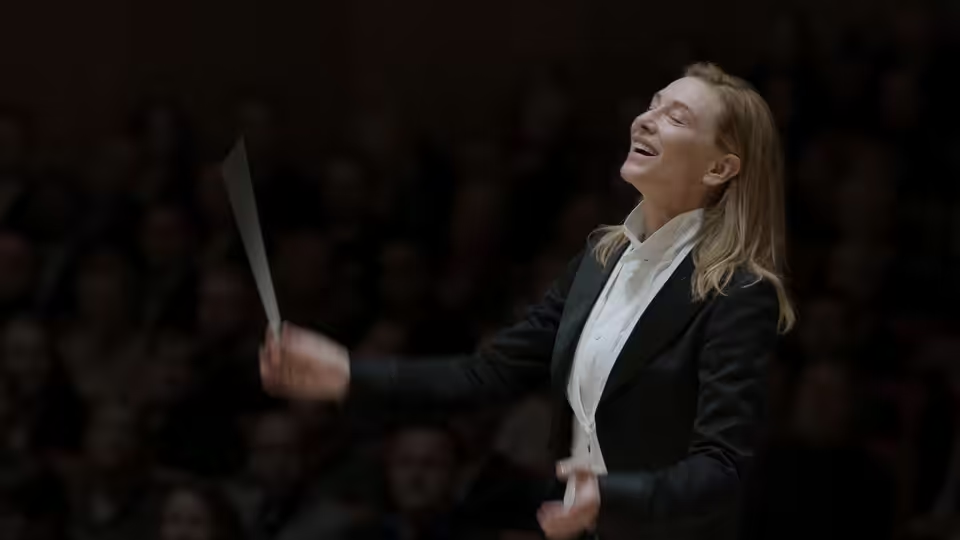
Blanchett is the reason to see it, and it is not a small reason. She conducts, speaks German and plays the piano on screen, none of it looks like a stunt, and the film’s best passages are simply her in a black shirt in front of an orchestra, working. See it in a cinema if you can, for the Mahler and for the silences, which are doing as much as the music. It runs 158 minutes. You will feel about twenty of them.

Critical consensus AI synthesised

83
Positive
30
Mixed
0
Negative
2

Most critics rate TÁR highly: thirty of the thirty-two reviews are positive, and the praise lands in the same place almost every time. Cate Blanchett’s performance as the conductor Lydia Tár is the first thing nearly everyone mentions, described as commanding, ferocious and finely controlled. Todd Field’s direction is credited close behind, for the detail with which it builds the orchestra’s world, for its patience and precision, and for the way it moves from dry comedy towards something closer to horror.

The reservations are few and mostly mild. Some find the film unsure whether Tár’s fall is tragedy or joke, several doubt it says anything new about cancel culture, and one or two find the long Juilliard scene grating. The two outright dissenters go further. The New Yorker calls the film regressive and disjointed, arguing it treats its protagonist as the victim of false attacks, while Eye for Film finds Tár a construct that never gets under the skin.

Time Out
22 December 2022 · ★★★★★ · Phil de Semlyen
100

The critic hails the film as chilly, severe, distancing yet utterly captivating, with formidable filmmaking intelligence. Blanchett’s spellbinding, Oscar-worthy turn as the sociopathic conductor is the standout element.

Read the full review →
IndieWire
1 September 2022 · A · David Ehrlich
95

The critic calls it a thrilling, dense portrait that goes far beyond a simple take on cancel culture. Blanchett's commanding performance as the spiraling conductor is highlighted for its gravitas and control.

Read the full review →
The AV Club
6 October 2022 · A · Murtada Elfadl
95

The critic hails the film as an immersive event and indelible portrait of intellect waylaid by privilege. Blanchett's bewitching performance as the cruel narcissist conductor is singled out for its depth and intuition.

Read the full review →
Empire
11 January 2023 · Ian Freer
90*

The critic deems it a masterwork and essential granular character study of a complex powerhouse, singling out Blanchett's career-best, perfectly modulated performance that commands respect without judgment.

Read the full review →
Evening Standard
11 January 2023 · Charlotte O'Sullivan
90*

The critic calls it the bleakest and funniest film about systemic sleaze since Promising Young Woman, praising Blanchett's outdoing performance as the flawed maestro and the film's nuanced take on power and abuse.

Read the full review →
Los Angeles Times
6 October 2022 · Justin Chang
90*

The critic hails Cate Blanchett at the peak of her powers in a magnificent cinematic symphony that respects audience intelligence. Field's clarity and rigor in imagining the character's inner and outer worlds, along with his mastery of cinematic time, are singled out for praise.

Read the full review →

Cast

Awards

Academy Awards, 2023

Nominated
Best Picture
Nominated
Best Writing, Original Screenplay

Golden Globes, 2023

Nominated
Best Motion Picture – Drama

If you liked this, try…

Amadeus poster91

Amadeus

1984 · Genius, envy and a court that applauds; the noisier, warmer ancestor of this one.

The Piano Teacher poster

The Piano Teacher

2001 · Haneke’s conservatoire is colder still, and Huppert makes Tár look approachable.

In the Bedroom poster84

In the Bedroom

2001 · Field’s first film: the same patience, the same refusal to tell you how to feel.

Whiplash poster84

Whiplash

2014 · Musical tyranny from the student’s side of the stand, at twice the tempo.

The Assistant poster

The Assistant

2019 · A day in the life of the person who keeps her face still; Francesca’s story, elsewhere.