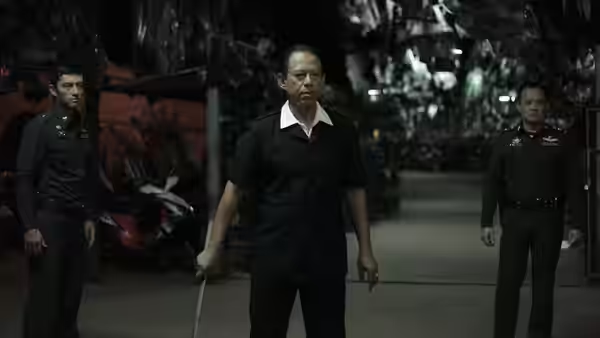
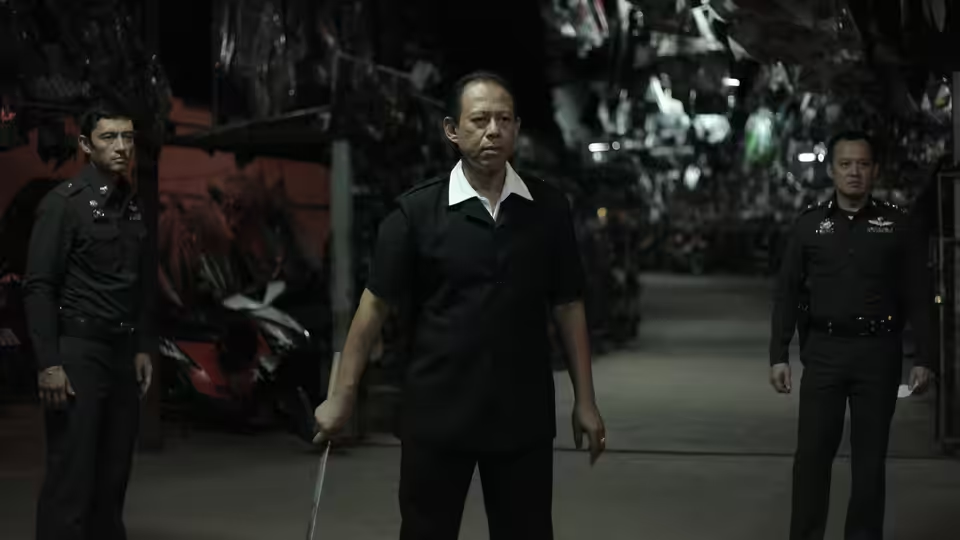
Chang (Vithaya Pansringarm) stands holding a sword between two uniformed men in a garage
Film review

Only God Forgives

2013 · Directed by Nicolas Winding Refn · 1h 29m

In a sentenceKristin Scott Thomas is rude enough to make us grateful for the interruption

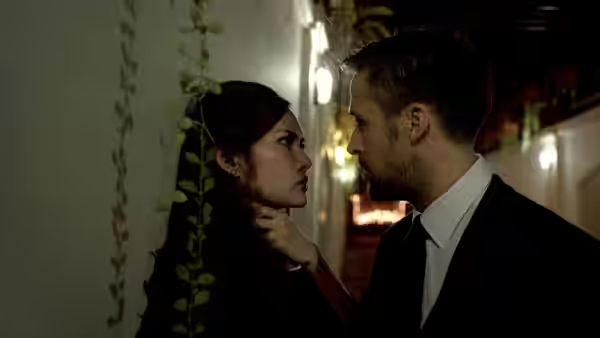
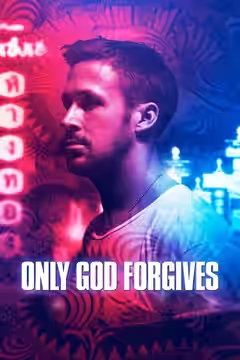
In Bangkok, Julian (Ryan Gosling) is drawn into a revenge story in which violence and guilt govern the encounters. He remains withdrawn, speaking little, while Crystal (Kristin Scott Thomas) cuts through the silences with blunt speech. Chang (Vithaya Pansringarm) and Mai (Rhatha Phongam) also inhabit this criminal world. Confrontations develop slowly beneath neon light, with little conversation to explain the people involved or what they intend. Violence interrupts the stillness, and Julian’s reserve offers few clues to how he will respond.

Plays from YouTube when you press play; nothing loads from them until then.

Fi1m review

Nicolas Winding Refn gives this revenge thriller precise images and an unsettling score, but too few reasons to care about its people. Kristin Scott Thomas supplies welcome comic spite; the slow, punishing stretches remain hard to justify.

Nicolas Winding Refn’s Only God Forgives has enough fine work in its images and music to make its thin drama frustrating. This is a revenge thriller slowed almost to a standstill, with guilt weighing on people who seldom explain themselves. There is nothing wrong with asking us to watch faces, listen and wait for a movement. The difficulty is that, across 89 minutes, the film gives us too few changes in those faces to keep the waiting tense.

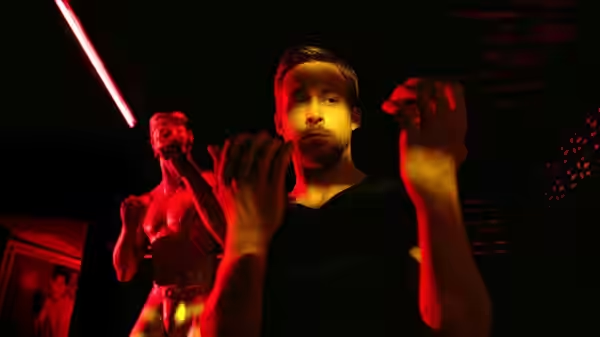
Larry Smith’s cinematography provides the clearest reason to persevere: saturated colour and exact framing make Bangkok feel threatening before anyone acts. The neon is oppressive, and the carefully arranged compositions give the eye plenty to examine during the pauses. Beth Mickle’s production design sustains that artificial city, where ordinary life barely seems to exist beyond the frame. The trouble begins when another carefully composed image is expected to carry a scene without much help from the characters.

Cliff Martinez’s electronic score does useful work here, making the quiet stretches uneasy without demanding a burst of action to justify them. Its eerie sounds suggest danger even when the drama has stopped supplying reasons to anticipate it. Matthew Newman’s editing preserves the slow pace, but the extended pauses too often feel interchangeable. The music keeps suggesting that something terrible is near, even when our interest in what that might be has faded.

Ryan Gosling plays Julian with such restraint that it becomes difficult to distinguish one state of mind from another. We were bored by his prolonged stillness, because the film gives us so little change in expression or behaviour to follow. It is a committed performance, and the lack of easy charm fits this hostile setting. After a while, though, another pause with Julian tells us little we have not already gathered.

Kristin Scott Thomas has more to work with as Crystal, whose bluntness cuts through the solemnity. Her comic nastiness is welcome because it gives a scene an immediate, recognisable tension: someone is being unpleasant, and we want to see what happens when she finishes. That is a modest pleasure, but an important one in a film so reluctant to let people speak plainly. Even this performance cannot turn a thinly written character into a fully convincing person.

The violence is difficult to dismiss, and the controlled presentation can make it ugly in a way that feels deliberate. The problem is repetition: brutality keeps demanding a response without giving us much more to understand about the people responsible. A revenge thriller needs a clear sense that a decision will cost somebody something, even when everybody involved is hateful. Here, the lengthy preparation for each eruption becomes as wearing as the violence itself.

There is enough control of colour, sound and pace here to explain why the film has admirers. We cannot recommend it on those strengths alone, because too much of the evening is spent waiting for the people to become interesting. If sparse dialogue and prolonged brutality already sound tiring, this is a safe one to leave unwatched.

Critical consensus AI synthesised

47
Positive
6
Mixed
8
Negative
13

The consensus on Only God Forgives leans negative, though even many detractors admire its carefully composed images and oppressive Bangkok atmosphere. Praise clusters around the cinematography, production design and Cliff Martinez’s eerie score. Kristin Scott Thomas’s darkly comic performance also earns approval across the divide, with several critics finding her a welcome interruption to the solemnity. For many, however, these pleasures do not compensate for thin characters, awkward dialogue and violence that becomes numbing rather than disturbing.

The spread is wide, and the disagreement concerns more than tolerance for brutality. The Guardian finds the film gripping and formally brilliant. Radio Times argues that its slow, alienating approach rewards patience. Less persuaded critics find little beneath the stylisation, while mixed reviews often enjoy the atmosphere without finding enough story or feeling to sustain it. Gosling’s restraint is another dividing point: some admire it, but others see an inert central performance that makes involvement difficult.

Radio Times
★★★★ · Damon Wise
80

Wise describes the film as an alienating, slow and intensely violent drama that rewards viewers willing to stay with it. He singles out its fractured, psychedelic style and Refn’s enduring fascination with violence.

Read the full review →
The Guardian
22 May 2013 · festival review · Peter Bradshaw
75*

Bradshaw finds the film gripping and formally brilliant, despite its extreme violence and likely walkouts. He especially praises the cinematography, production design and art direction for creating its eerie, vivid world.

Read the full review →
Empire
28 May 2012 · Damon Wise
70*

Wise finds the film a hallucinatory, uncompromising study of guilt, though its slow and mannered style may frustrate viewers. He particularly praises Cliff Martinez’s score for its eerie sounds and how it deepens the Bangkok setting.

Read the full review →
Screen Daily
22 May 2013 · festival review · Mark Adams
70*

The visible headline suggests a positive but atmospheric verdict. It singles out the film’s mesmerising, moody, and violent qualities.

Read the full review →
RogerEbert.com
65*

The page is identified as a review of the 2013 film, but its contents are inaccessible. The critic’s verdict and specific praise or complaint cannot be verified.

Read the full review →
Little White Lies
2 August 2013 · 5/3/5 · Adam Woodward
60

The critic finds the film self-indulgent but engrossing, calling it Refn’s most complete work and possibly his masterpiece. They praise its hypnotic visual style and visceral atmosphere.

Read the full review →

Straight answers AI written, from our review

Is Only God Forgives worth watching?
Only God Forgives is difficult to recommend beyond viewers drawn to precise images and unsettling music; we score it 48/100. We welcome Kristin Scott Thomas’s comic spite, but the sparse dialogue, prolonged stillness and repetitive brutality leave too little reason to care about the people involved.
How long is Only God Forgives, and what is it rated?
Only God Forgives runs 1h 29m. It is a drama and thriller film.
Where can I watch Only God Forgives in Iceland?
Only God Forgives is not on any streaming or rental service in Iceland at the moment. It is available in 21 other countries; change your country at the top of the page to see where. Availability is checked daily.
How violent or frightening is Only God Forgives, and is it suitable for children?
Only God Forgives carries a UK 18 certificate and is unsuitable for children, with prolonged, ugly violence that also makes it a poor choice for squeamish adults. Its oppressive neon lighting and eerie electronic score create unease between the confrontations, though we find the repeated brutality and slow preparation increasingly wearing.
How does Only God Forgives compare to The Neon Demon?
Only God Forgives is the less rewarding choice beside The Neon Demon, which we recommend with reservations for patient horror viewers. Both use colour and music to support studies of cruelty, but the fashion-world horror offers more feeling and sustains our interest better than the revenge thriller, despite its own thin dialogue and sluggish scenes.

Cast

Awards

Sitges Film Festival Best cinematography, 2013

Won
Sitges Film Festival Best cinematography

If you liked this, try…

  1. Le Samouraï (1967) · not on Fi1m yetControlled performances and spare spaces make criminal routine feel quietly threatening.

  2. Suspiria (1977) · not on Fi1m yetColour and sound make its hostile interiors worth getting lost in.

  3. Sonatine (1993) · not on Fi1m yetLong stretches of waiting make the abrupt violence harder to dismiss.

  4. A Bittersweet Life (2005) · not on Fi1m yetFormal precision and wounded pride give its violence a stronger emotional charge.

  5. The Neon Demon (2016, Fi1m 61)Another study of cruelty whose colour and sound can sustain our interest.