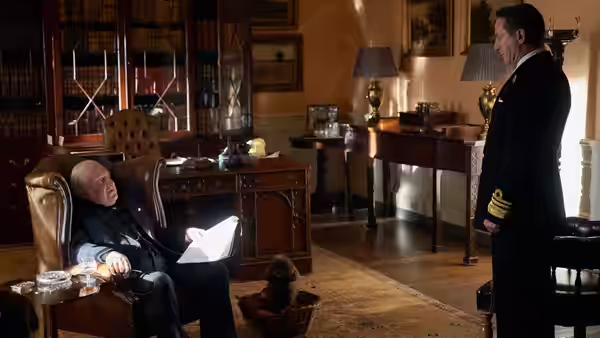
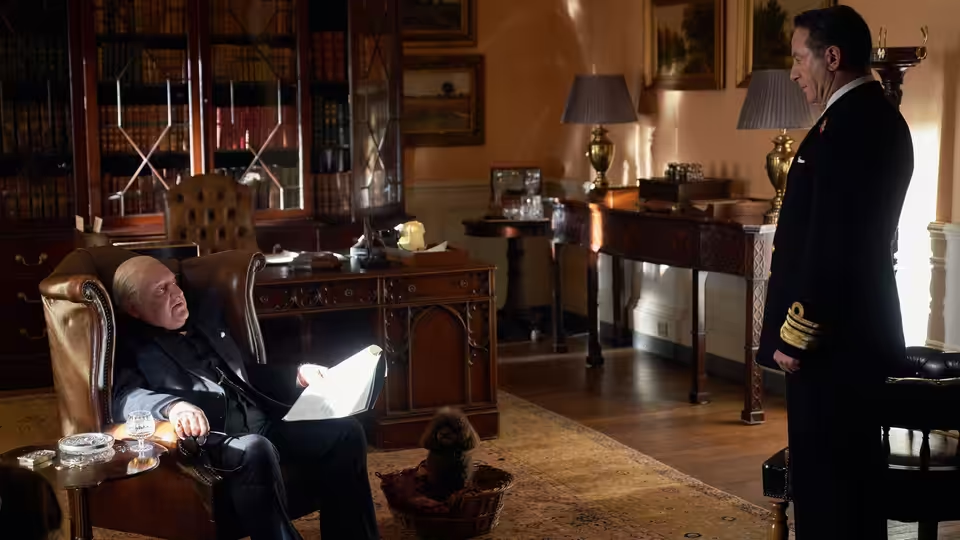
Winston Churchill (Simon Russell Beale) sits with papers as a naval officer stands before him
Film review

Operation Mincemeat

2022 · Directed by John Madden · 2h 08m

In a sentenceThe corpse is the only man in the Admiralty who gets a proper love letter, and he never reads it

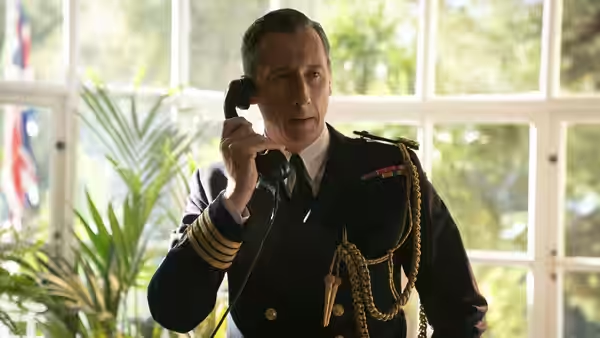
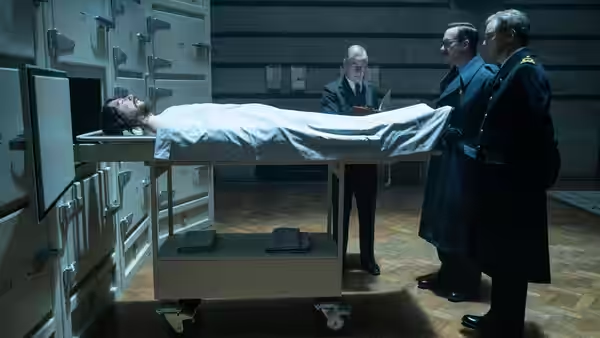
London, 1943. The Allies intend to invade Sicily and the Germans expect them to, so naval intelligence officer Ewen Montagu (Colin Firth) and the quieter Charles Cholmondeley (Matthew Macfadyen) propose a trick: dress a dead man as a Royal Marines officer, fill his pockets with forged letters pointing to Greece, and drop him in the sea off Spain where German agents will find him. Admiral John Godfrey (Jason Isaacs) thinks it absurd; Winston Churchill (Simon Russell Beale) approves it. The coroner Bentley Purchase (Paul Ritter) is asked to find a body. In a smoky basement, clerk Jean Leslie (Kelly Macdonald) and secretary Hester Leggett (Penelope Wilton) invent the dead man a life, a fiancée named Pam, a photograph and a letter, while Ian Fleming (Johnny Flynn) types the whole thing up.

Plays from YouTube when you press play; nothing loads from them until then.

Fi1m review

John Madden’s telling of the 1943 deception is well cast, nicely tailored and too gentle for its own good. Matthew Macfadyen and a single scene of Penelope Wilton writing a letter are worth the evening; the love triangle built around them is not.

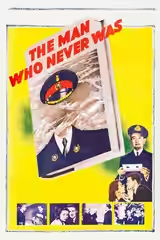
John Madden’s film tells one of the better stories of the war: in 1943 British intelligence dressed a corpse as an officer, filled his pockets with invented letters, and dropped him in the sea off Spain so the Germans would find him and believe the Allies were bound for Greece rather than Sicily. It was filmed before, as The Man Who Never Was in 1956. Madden’s version is longer, kinder and busier, and it is a decent evening that keeps getting in its own way. It runs 128 minutes and could lose twenty without harm.

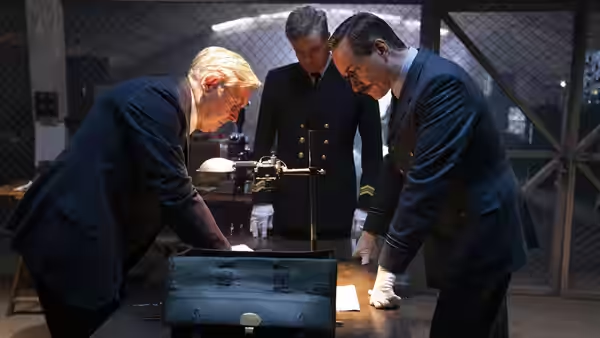
The pleasure is in the paperwork. Michelle Ashford’s script is at its best when the plan is a list of problems: where to find a body, how to keep it fresh, what a Marines officer carries in his wallet, what he writes to his girl. Matthew Macfadyen plays Charles Cholmondeley as a man who has never been the most interesting person in any room and has stopped minding, and he is the film’s heart. Colin Firth’s Ewen Montagu is the one who talks; Cholmondeley is the one who thought of it. Paul Ritter, as the coroner Bentley Purchase, treats the whole business as an administrative nuisance and gets the biggest laughs for it.

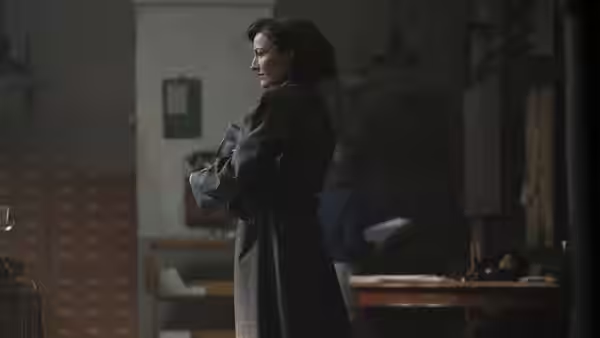
The scene we did not expect is a short one. Penelope Wilton’s Hester Leggett, the senior secretary who runs the office, is asked to write the letter the dead man will carry from his fiancée, and she reads it aloud as she goes. It is the letter of a woman who had a man to write to once and has not since. We were moved more than we thought a spy film could manage, and it was Wilton’s voice doing it, flat and careful and declining to break. For two minutes the invented man is the most alive person on screen. The film never quite gets back there.

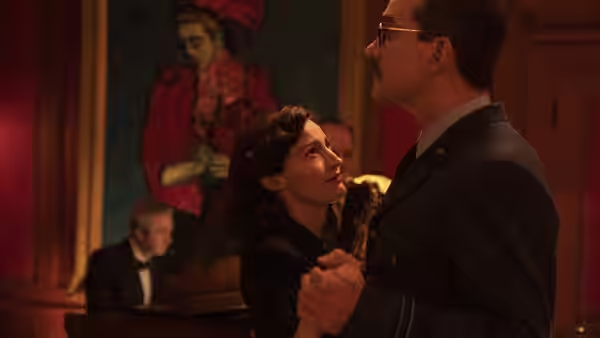
Around that, Ashford and Madden have built a love triangle. Montagu is married, his wife and children gone to America; Jean Leslie (Kelly Macdonald), the clerk who lends the dead man’s girl her photograph, is a widow; Cholmondeley is in love with her and watches Montagu get there first. Macdonald does a great deal with it, but the triangle is written in the key of Hester’s letter and played in the key of a Sunday evening serial, and every cut from the plan to the pining lets a little pressure out. Johnny Flynn’s Ian Fleming narrates from a typewriter, and the film cannot resist reminding us what he will go on to type. Once is a joke. By the fourth time it is a nudge in the ribs.

Sebastian Blenkov shoots the Admiralty basement in brown and amber, desk lamps doing most of the work and smoke in every room, and gives the mortuary a colder grey. It is handsome and it is also the look every British wartime film has worn for thirty years. John Paul Kelly’s rooms are properly cramped, files on every surface and one map taking up a wall. Andrea Flesch puts Firth in a three-piece suit that fits and Macfadyen in one that does not, which is characterisation done cheaply and well. Thomas Newman’s score is strings and soft piano, and it reassures us at moments when the film should be frightening us. Victoria Boydell cuts briskly between London and the sea in the middle stretch, and that is where the film is tightest.

Simon Russell Beale’s Churchill is a growl and a cigar and little more, and Jason Isaacs’s Godfrey is written as the man who says no so that somebody else can be right. A subplot about Montagu’s own household and where its loyalties lie, with Mark Gatiss, could go entirely. By the final third we were aware of the runtime, and aware that the film cared more about who would end up with whom than about whether the trick would work, which is the wrong way round.

Madden made Shakespeare in Love (1998) and Mrs Brown (1997), and he still handles a roomful of good actors with ease; nobody here is bad and several are better than what they are given. What he has not made is a thriller. The Man Who Never Was kept to the procedure and did not stop to fall in love. This one stops often. Watch it for Macfadyen, for Wilton’s two minutes and for Ritter. It carries a 12A, and a parent and a teenager could sit through it together without either one suffering.

Critical consensus AI synthesised

69
Positive
5
Mixed
8
Negative
0

Most critics like Operation Mincemeat without being greatly stirred by it. The reviews lean warm and none is hostile, but more than half stop short of a full recommendation. The praise gathers around Matthew Macfadyen, whose quiet, faintly comic turn as Charles is picked out again and again as the film’s most affecting element, and around the mechanics of the deception itself, which several reviews find tense and intricately assembled. Colin Firth, Kelly Macdonald and Johnny Flynn’s tongue-in-cheek Ian Fleming also draw notice.

The reservations are about manners rather than competence. The film is called conventional, genteel and decorous; the love triangle is found soapy or underheated; the ending is thought subdued. The spread is fairly narrow. The Guardian goes furthest, arguing that the film never makes the scheme’s extraordinary true story work as fiction, and IndieWire parts from the majority on tension, finding the spycraft short of suspense.

The AV Club
6 May 2022 · B+ · Brent Simon
83

The critic finds the film an engaging, rewarding espionage drama, praising its balance of procedural intrigue and human complexity. They single out the character work around the fabricated love story as especially affecting.

Read the full review →
Radio Times
★★★★ · Trevor Johnston
80

The review finds the film unconventional and entertaining, with tension taking precedence over action. It praises Colin Firth and Matthew Macfadyen for combining gravitas with comedic bemusement.

Read the full review →
The Hollywood Reporter
16 April 2022 · David Rooney
78*

Rooney finds the film gripping, classy, and satisfying, though one subplot feels excessive. He especially praises Matthew Macfadyen’s quietly affecting performance as Charles.

Read the full review →
Empire
14 April 2022 · John Nugent
75*

The review finds the film spirited and gently entertaining, though its soapy love triangle and restrained style limit its ambition. It praises the dry ensemble performances and the film’s balance of wartime trauma with morbid humor.

Read the full review →
The i Paper
14 April 2022 · Geoffrey Macnab
65*

Macnab finds the film an absorbing, well-crafted wartime thriller, though its story feels predictable. He praises the strong performances and painstaking period recreation, but says the ending is subdued and anticlimactic.

Read the full review →
Variety
11 April 2022 · Guy Lodge
65*

Lodge finds the film diverting and competently made, but too conventional and stiffly decorous. He praises the intricate mechanics of the deception and singles out Matthew Macfadyen’s performance as the film’s most poignant comic presence.

Read the full review →

Straight answers AI written, from our review

Is Operation Mincemeat worth watching?
Operation Mincemeat is worth an evening for anyone who enjoys the paperwork of a wartime deception, and we scored it 66. Matthew Macfadyen, Paul Ritter and a short scene of Penelope Wilton reading a letter aloud are the reasons to watch. The love triangle wrapped around them is not, and at 128 minutes the film could lose twenty without harm.
How long is Operation Mincemeat, and what is it rated?
Operation Mincemeat runs 2h 08m. It is a war and history film.
Where can I watch Operation Mincemeat in Saudi Arabia?
Operation Mincemeat is not on any streaming or rental service in Saudi Arabia at the moment. It is available in 34 other countries; change your country at the top of the page to see where. Availability is checked daily.
How violent or frightening is Operation Mincemeat, and is it suitable for children?
Operation Mincemeat carries a 12A and is a mild, talkative war film with little on screen to upset anyone. The corpse at the centre of the plot is treated as an administrative problem rather than a horror, and the mortuary scenes are cold rather than gory. A parent and a teenager could sit through it together without either one suffering; younger children would simply be bored.
How does Operation Mincemeat compare to Tinker Tailor Soldier Spy?
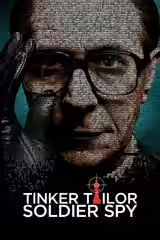
Operation Mincemeat and Tinker Tailor Soldier Spy share the brown rooms, the smoke and the tired men, but the earlier film is the tighter and the better of the two. Tomas Alfredson keeps to the procedure and makes you lean into it; John Madden keeps stopping to let his characters fall in love. Choose Tinker Tailor if you want tension and concentration, Mincemeat if you want something gentler to watch with a teenager.
What should I watch after Operation Mincemeat?
After Operation Mincemeat, try Tinker Tailor Soldier Spy (2011, Fi1m 84): Brown rooms, tired men and a plot you must lean into; the model for this sort of thing. Then The Imitation Game (2014, Fi1m 73): Another wartime secret told as prestige drama, with a better sense of what it cost; and Black Book (2006, Fi1m 80): Verhoeven’s occupation thriller: pulpier, faster and far less polite about betrayal.

Cast

If you liked this, try…

  1. The Man Who Never Was (1956) · not reviewed yetThe same corpse, the same trick, told in half the time and without the pining.

  2. Army of Shadows (1969) · not reviewed yetMelville’s French Resistance film, where deception costs people and the cold never lifts.

  3. Tinker Tailor Soldier Spy (2011, Fi1m 84)Brown rooms, tired men and a plot you must lean into; the model for this sort of thing.

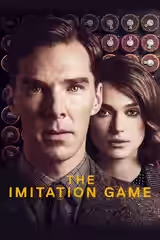
  4. The Imitation Game (2014, Fi1m 73)Another wartime secret told as prestige drama, with a better sense of what it cost.

  5. Black Book (2006, Fi1m 80)Verhoeven’s occupation thriller: pulpier, faster and far less polite about betrayal.