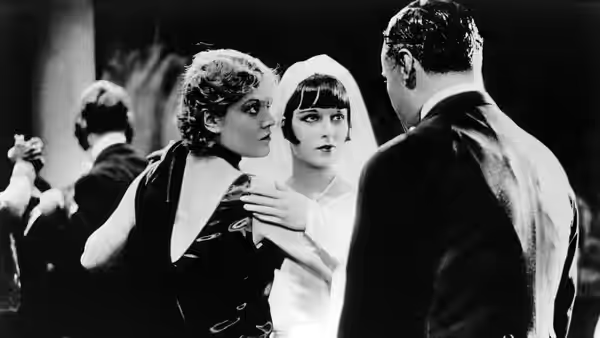
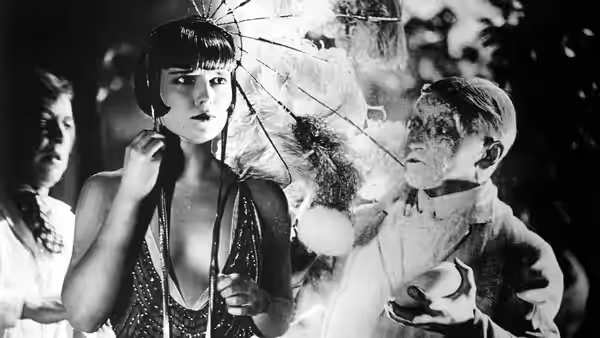
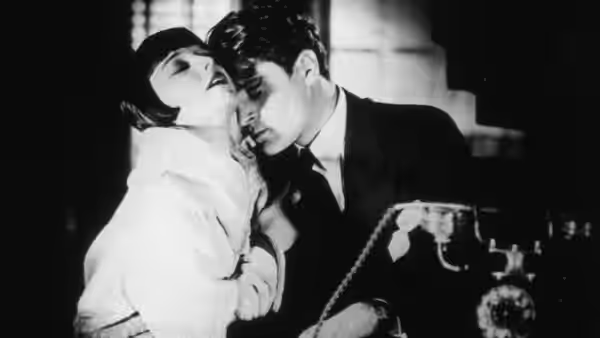
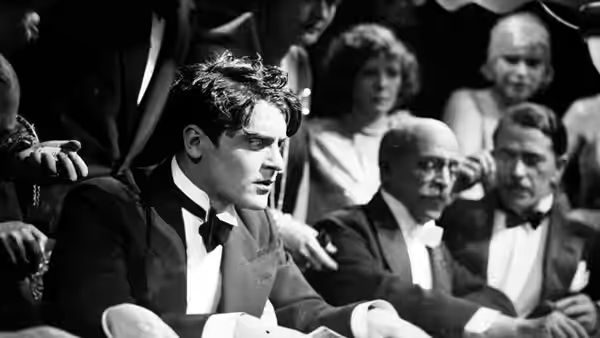
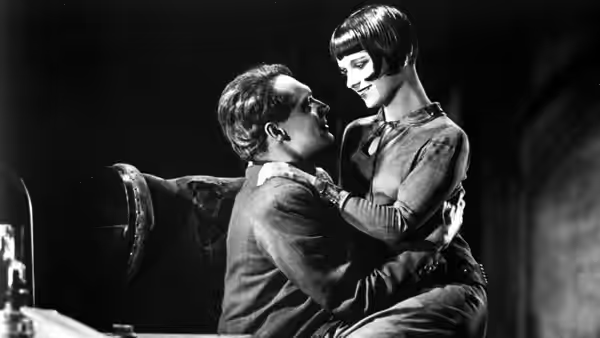
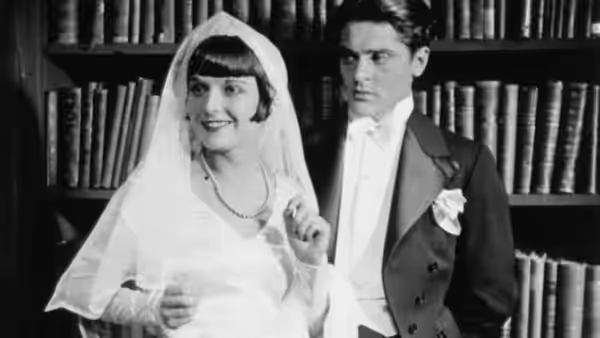
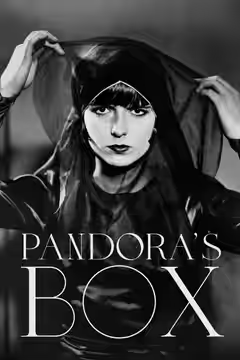
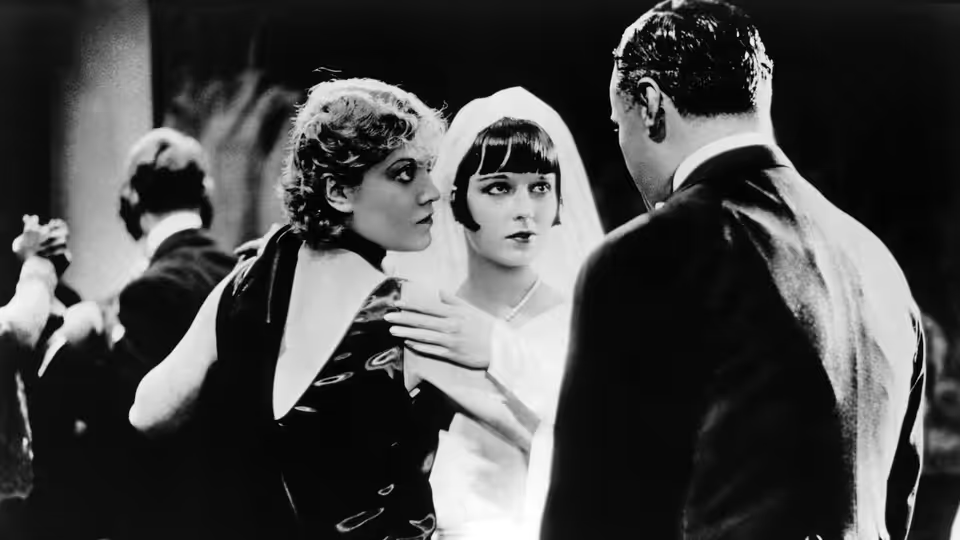
Lulu (Louise Brooks) stands between a woman and a man in formal dress
Film review

Pandora's Box

1929 · Directed by Georg Wilhelm Pabst · 2h 21m

In a sentenceHalf of Berlin queues up to tell Lulu what she means; she just keeps dancing

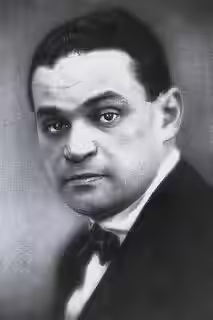
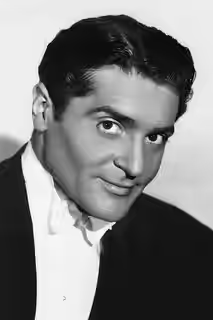
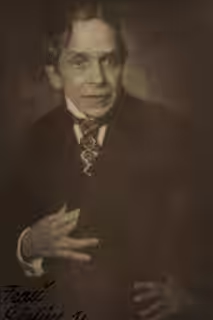
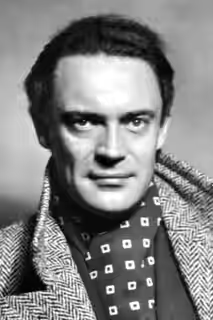
Berlin, the late 1920s. Lulu (Louise Brooks) is a dancer kept in a comfortable flat by Dr Ludwig Schön (Fritz Kortner), a newspaper publisher who has just become engaged to Charlotte von Zarnikow (Daisy D’Ora). Lulu is not told to move out, she is asked to be discreet, and she has never been discreet in her life. Schigolch (Carl Goetz), a shabby old man she calls her first patron, turns up with the strongman Rodrigo Quast (Krafft-Raschig) and a plan to put her in a trapeze act. Schön’s son Alwa (Francis Lederer) writes her into his revue instead, with Countess Geschwitz (Alice Roberts) designing the costumes and watching Lulu rather more closely than the sketches. On opening night Lulu spots Schön in the wings with his fiancée, and refuses to go on.

Plays from YouTube when you press play; nothing loads from them until then.

Fi1m review

Pabst’s silent film about a dancer and the men who ruin themselves over her is carried by Louise Brooks, who acts as if the rest of 1929 had not been invited. It sags in the middle and it moralises, and we would still send you to it.

Georg Wilhelm Pabst directed Pandora’s Box and wrote it with Ladislaus Vajda, with the editor Joseph Fleisler also credited as a writer. The material is a fable: Lulu, a dancer with no visible past and no plans, passes through the lives of a publisher, his son, a countess, a strongman and a scavenging old man, and each of them comes out worse. At 141 minutes it is long for a silent film and it feels long in one stretch, which we will come to. It is also one of the few films of its period we would put in front of someone who thinks they do not like silent films, because the woman at the centre of it does not seem to know she is in one.

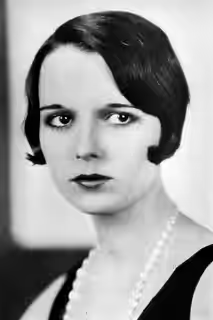
That is Louise Brooks. Everyone else in the cast acts in the manner of the day, with the hand to the brow and the slow turn to camera, and Brooks simply stands there with her black helmet of hair and looks at people. In the dressing-room scene, where Lulu has refused to perform and Dr Schön (Fritz Kortner) comes to shout her onto the stage, her face goes from fury to delight to something like pity in the space of a few cuts, and none of it is signalled. We felt caught, as though we had been watching a real person through a door. When the door does open, and it does, we understood the whole film in her expression before the intertitle arrived to explain it.

Günther Krampf shoots her in close-up more than anyone else in the picture, and lights her from the side so the hair is a hard black shape and the face is almost white. The backstage sequence is the best-made thing in the film: Fleisler cuts among stagehands, dancers in feathers, a drum, Sig Arno’s stage manager waving both arms, and Lulu sulking in a corner, and the rhythm gets faster as the curtain gets closer. Bohumil Heš puts Lulu in pale satin and the Countess Geschwitz (Alice Roberts) in a tailored dark jacket and tie, so that when they stand together you can read the whole relationship from the clothes.

The men are drawn in a thicker line. Kortner plays Schön with his jaw locked and his hands working, and it is effective without being subtle. Carl Goetz’s Schigolch is the film’s sly comic turn, a man who can find a drink in any room and asks nothing of Lulu except that she keep him. Krafft-Raschig’s Rodrigo is all chest. Francis Lederer’s Alwa is the weakest of them, a boy who loves Lulu the way a boy loves a poster, and the film knows it. Alice Roberts gets less than she deserves; Geschwitz is the only character who wants nothing from Lulu but Lulu, and Pabst keeps her on the edge of the frame.

The second half travels, and it slows. There is a trial, with Karl Etlinger’s defence attorney pleading against a prosecutor who compares Lulu to Pandora, and then a stretch on a gambling ship where the Marquis Casti-Piani (Michael von Newlinsky) trades in her as if she were cargo. We were bored on the ship, and then irritated, because the film had stopped watching Lulu and started explaining her. The script wants her to be a force of nature that men bring ruin upon themselves by touching, and the intertitles keep saying so. Brooks keeps quietly disagreeing. She plays a woman who likes people and does not think ahead, and that is a good deal more frightening than a myth.

The last reels are set in London fog, and Gustav Diessl appears as a stranger who befriends Lulu. We will say nothing about what happens except that Krampf lights it with a single candle and that it is tender for far longer than we were braced for, and the tenderness is what horrified us.

It is a silent film, so it is only as good as whoever is playing under it. Give it a decent accompaniment and one sitting. The first ten minutes, Lulu in her flat teasing the meter reader, will tell you whether Brooks has you. In our experience she does.
Critical consensus AI synthesised

82
Positive
8
Mixed
1
Negative
0

Most critics treat Pandora’s Box as a classic, and the reviews are close to unanimous. Nearly every one comes back to Louise Brooks as Lulu: expressive, commanding, and the main reason the film still holds. Pabst’s direction gets almost as much credit, in particular the close-ups, the fluid camera and the lighting, which several critics describe as unusually modern for 1929. The film’s erotic charge and its moral unease come up repeatedly, as does the final sequence.

The spread is narrow and there is no outright dissent. The one clear reservation comes from Empire, which finds the restored, uncut version slow in places while still calling it bold and compelling. A few of the later reviews, written around reissues, spend as much time on the restoration’s contrast and sharpness as on the film itself, which suggests critics now take its standing as settled and are arguing about the print.

Little White Lies
31 May 2018 · 5/5/5 · Caroline Golum
100

The critic says the reissue reaffirms the film’s classic status. She particularly praises Louise Brooks’s iconic performance and Pabst’s intimate close-ups.

Read the full review →
Time Out
5 December 2006 · Wally Hammond
90*

Hammond presents Pabst’s film as an extraordinary, tragic masterpiece. He singles out its erotic force and its adaptation of two works.

Read the full review →
Los Angeles Times
14 October 1993 · Mark Chalon Smith
85*

Smith regards the film as a subtle, impressively crafted silent classic. He especially praises Louise Brooks’s vivid, captivating performance and the film’s striking final sequence.

Read the full review →
Sight and Sound
85*

The critic praises the film as a classic, highlighting Louise Brooks’s captivating performance as Lulu. They also single out Pabst’s meticulous direction and the fluid camera work and expressive lighting.

Read the full review →
Slant Magazine
10 October 2024 · ★★★★ · Ed Gonzalez
80

Gonzalez praises the film as a modern, morally unsettling masterpiece. He singles out its visionary chiaroscuro and the Criterion transfer’s improved contrast and sharpness.

Read the full review →
The Guardian
20 May 2007 · Philip French
80*

French regards Pandora’s Box as the better of two great silent films. He praises Brooks’s expressive performance and the films’ subtle, fluent maturity.

Read the full review →

Straight answers AI written, from our review

Is Pandora's Box worth watching?
Pandora's Box is worth watching, and we scored it 88, chiefly for Louise Brooks, who plays Lulu as if nobody had told her silent films were meant to be acted broadly. It runs 141 minutes and sags badly in the gambling-ship stretch, and the intertitles moralise where Brooks does not. Give it one sitting and a decent musical accompaniment, and the first ten minutes will tell you whether she has you.
How long is Pandora's Box, and what is it rated?
Pandora's Box runs 2h 21m. It is a drama and crime film.
Where can I watch Pandora's Box in Ireland?
Pandora's Box is not on any streaming or rental service in Ireland at the moment. It is available in 4 other countries; change your country at the top of the page to see where. Availability is checked daily.
How violent or frightening is Pandora's Box, and is it suitable for children?
Pandora's Box has no UK certificate and is unrated in the US, and it is an adult drama rather than a violent one: a kept woman, a publisher's jealousy, a countess who watches her too closely, and a run of men who ruin themselves over her. Very little is shown, but the subject matter and the late-film tenderness that turns to horror are not for children. Older teenagers with patience for a silent film will be fine.
How does Pandora's Box compare to Sunrise: A Song of Two Humans?
Pandora's Box and Sunrise: A Song of Two Humans are both late-1920s silents lit for the night, and Murnau's is the tighter and gentler of the two, a marriage told with a moving camera and a small cast. Pabst's film is longer, colder and uneven, but it has Louise Brooks, and no performance in Sunrise matches her. Start with Sunrise if you are new to silents; come to Pandora's Box for the woman at its centre.
What should I watch after Pandora's Box?
After Pandora's Box, try Sunrise: A Song of Two Humans (1927, Fi1m 88): Murnau’s silent about a marriage and a city, for anyone who liked Krampf’s night light. Then Mulholland Drive (2001, Fi1m 92): Lynch’s Hollywood dream of a girl who arrives from nowhere and undoes everyone.

Cast

If you liked this, try…

  1. Diary of a Lost Girl (1929) · not on Fi1m yetPabst and Brooks again, the same year, with the fable swapped for a reformatory.

  2. Sunrise: A Song of Two Humans (1927, Fi1m 88)Murnau’s silent about a marriage and a city, for anyone who liked Krampf’s night light.

  3. The Earrings of Madame de... (1953) · not on Fi1m yetOphüls follows a woman through the men who misunderstand her, with a better ending.

  4. Belle de Jour (1967) · not on Fi1m yetDeneuve as another woman everyone insists on explaining, and Buñuel refusing to help.

  5. Mulholland Drive (2001, Fi1m 92)Lynch’s Hollywood dream of a girl who arrives from nowhere and undoes everyone.