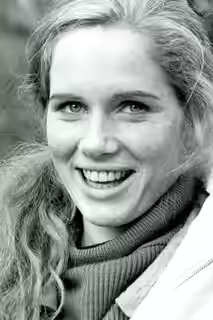
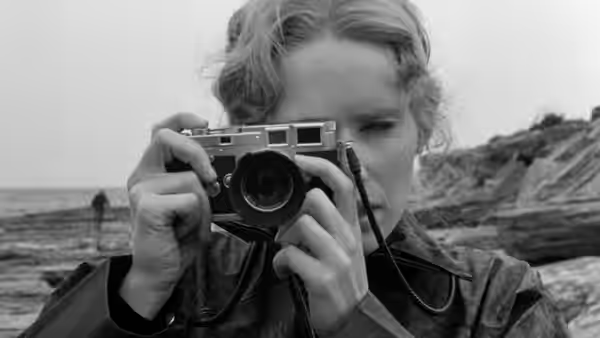
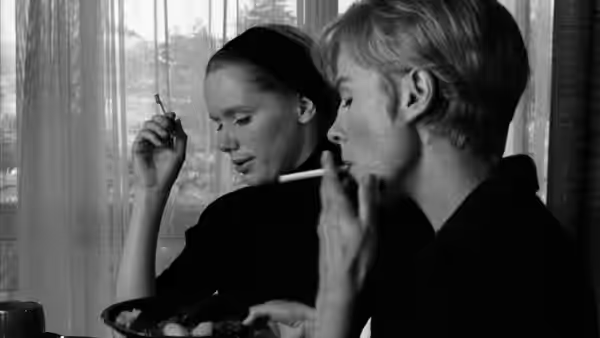
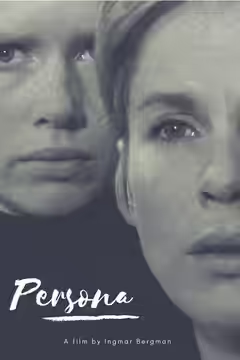
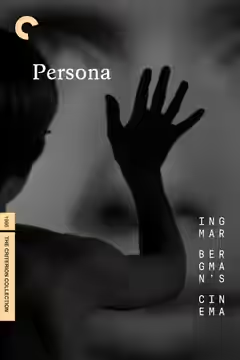
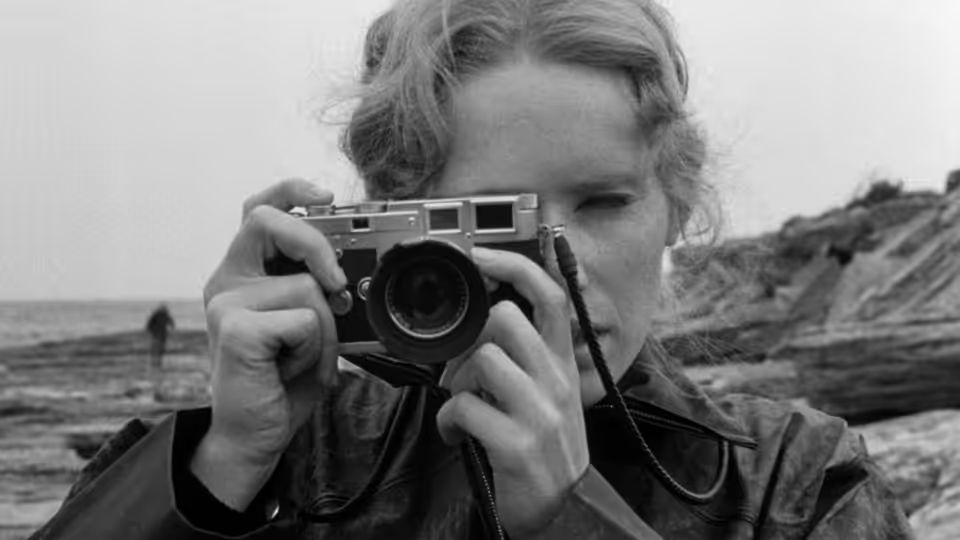
Elisabet Vogler (Liv Ullmann) raises a camera beside the sea
Film review

Persona

1966 · Directed by Ingmar Bergman · 1h 25m

In a sentenceEighty-five minutes in which the woman who says nothing wins every argument

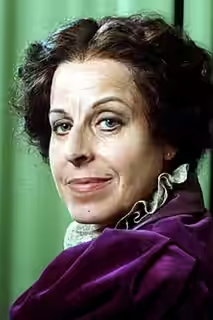
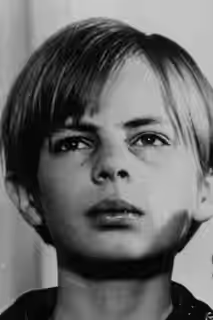
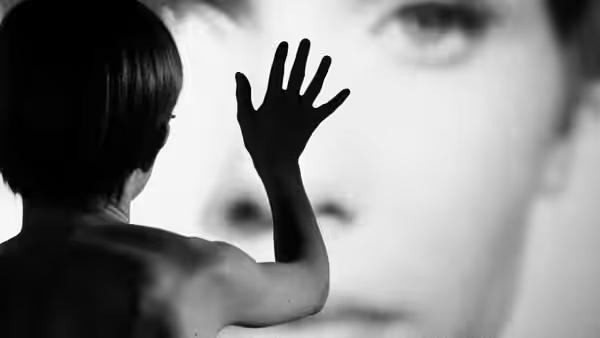
Elisabet Vogler (Liv Ullmann), a stage actress, stops speaking in the middle of a performance of Electra and has not said a word since. In hospital her doctor (Margaretha Krook) finds nothing physically wrong and puts her in the care of Alma (Bibi Andersson), a young nurse who is engaged to be married and a little afraid of the job. When the ward does nothing for her, the doctor lends the two women her summer house by the sea. There Alma talks, about her fiancé, her patients and a summer afternoon she has never told anyone about, and Elisabet listens. Before any of this, the film opens on a projector’s arc lamp, a run of fragments, and a boy (Jörgen Lindström) reaching for a woman’s blurred face on a wall.

Plays from YouTube when you press play; nothing loads from them until then.

Fi1m review

Bergman’s film about a nurse and the actress who has stopped speaking is 85 minutes long, in black and white, and among the most exposed things he made. It never says what happened between them, and we did not mind. You might.

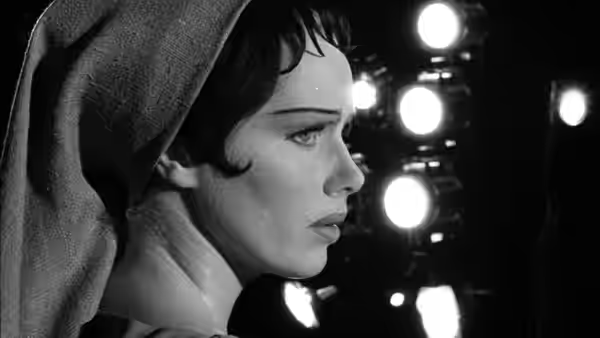
Ingmar Bergman starts with the machine. A projector’s arc lamp sparks, leader runs through the gate, and we get fragments: a cartoon, a spider, a nail hammered through a palm, and then a thin boy (Jörgen Lindström) waking in a white room among bodies under sheets, who turns and puts his hand up to an enormous, blurred woman’s face on the wall. Only then does the story begin. Elisabet Vogler (Liv Ullmann), a stage actress, has stopped speaking in the middle of a performance of Electra and has not said a word since. Her doctor (Margaretha Krook) can find nothing wrong, hands her to a young nurse, Alma (Bibi Andersson), and lends the pair her house by the sea for the summer.

That is the setup, and it is nearly the whole plot. Persona runs 85 minutes and it is one of the best things Bergman made, and we say that knowing it is also one of the hardest. It does not explain what happens between the two women. It barely agrees that anything happened at all. If you need a film to tell you what it was about, this is not your evening.

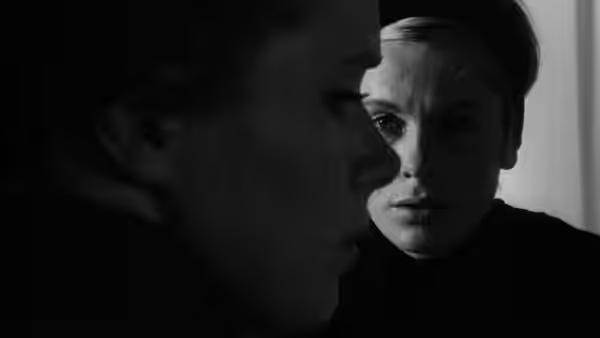
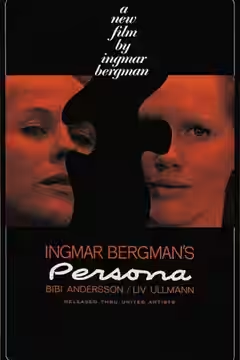
Sven Nykvist shoots it in black and white with almost no grey in it. Faces come out of dark rooms half-lit, one eye in light and one gone; the hospital and the house are white walls, white sheets and white light off the water. The famous image, two half-faces joined into one that belongs to neither woman, is on every poster and still works, because by then we have spent an hour with nothing to look at but these two faces. Ulla Ryghe cuts to match: long holds, then a jolt. Halfway through, the picture judders, catches and appears to burn, as if the projector from the opening had failed, and we will say no more about it.

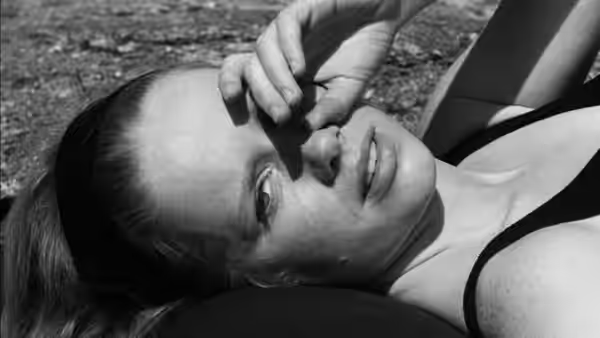
Bibi Andersson has the talking part, which is the showier one and not the easier. Alma fills the silence: her fiancé, her patients, whether she is a good person. One evening, over wine, she tells Elisabet about an afternoon on a beach with another woman and two boys, and Bergman gives her the whole story in a handful of unbroken takes, sat on a bed, in flat light, with nothing on the soundtrack. It is only talk, and it held us harder than any image in the film. We were embarrassed, and then something worse than embarrassed, because Alma is plainly enjoying being listened to and we could see what that was going to cost her.

Liv Ullmann says almost nothing for 85 minutes and hers is the harder job. She has to make listening look like a decision rather than a symptom. Watch her when the hospital television shows a monk (Thích Quảng Đức) setting himself on fire and she backs into the corner: it is the one time Elisabet’s face moves before she can stop it. Max Goldstein puts Alma in a starched uniform and then, at the house, dresses both women in the same dark jumpers and wide sunhats, so from behind we cannot tell which is which. Bibi Lindström’s rooms are bare. Lars Johan Werle’s score is a scrape of strings and something struck, used perhaps four times.

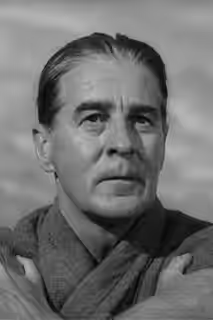
Early on, the doctor sits Elisabet down and tells her exactly why she has stopped speaking, and it is the one scene in which Bergman writes out what the rest of the film is content to show. We would rather not have heard it. The prologue is a director showing off, and one or two of its images, the nail above all, are there to make us flinch, which they did. And there is a passage in the second half involving Gunnar Björnstrand as Elisabet’s husband that we will not describe, except to say it is played as a dream and never quite decides whether it is one. It is the one stretch that felt slack to us.

It opened in British cinemas on 31 May 1967, and a good deal of the art cinema of the next twenty years, the films in which two women trade selves, took something from it. None of them has these two faces. Give it a quiet room, no phone and the 85 minutes it asks for. Do not expect to be told what happened. Bergman knows, and he is not saying.
Critical consensus AI synthesised

84
Positive
12
Mixed
0
Negative
0

Nobody has a bad word for it. Twelve reviews, all positive, and the praise gathers on the same spot: the images. Critics return to the high-contrast photography, the compositions that lay one woman’s face over the other’s, and Bergman’s willingness to tear at the surface of his own film. Most call it one of his best. Bibi Andersson’s performance as the nurse draws particular notice, and more than one reviewer finds the film warmer and more intimate than its formal games suggest.

The reservations are about difficulty, not quality. Variety finds it hard going even while admiring the technique, and the Los Angeles Times suggests the tricks that once shocked have lost some of their force. Sight and Sound spends part of its notice defending the film against the charge of self-indulgence, which tells you the charge is still made. The spread is narrow, and the lowest scores come from retrospective pieces that describe the film’s influence more than they judge it.

Little White Lies
2 January 2018 · 5/5/5 · David Jenkins
100

Jenkins considers Persona one of Bergman’s greatest films and an enduring cinematic achievement. He praises its striking high-contrast cinematography and surreal experimentation, which make its mysteries compelling rather than alienating.

Read the full review →
Slant Magazine
21 March 2014 · ★★★★½ · Chuck Bowen
90

Bowen finds the film vital, mysterious, and emotionally intimate despite its elaborate formal games. He particularly praises the Criterion transfer’s clarity and detail, especially in the close-ups.

Read the full review →
The AV Club
9 April 2014 · A- · Mike D'Angelo
90

D’Angelo regards Persona as a radical, visceral achievement that remains influential and rewarding. He especially praises Bergman’s visionary images of the two women’s faces and the film’s bold visual experimentation.

Read the full review →
The Guardian
29 December 2017 · Peter Bradshaw
90*

Bradshaw finds the film uniquely enigmatic, fascinating and still captivating. He particularly praises the haunting visual compositions that merge the two women’s faces to explore identity.

Read the full review →
Time Out
· TM
90*

The review describes Bergman’s film as brilliant. It singles out the symbiotic relationship between an actress in crisis and the nurse who cares for her.

Read the full review →
Empire
1 January 2000 · David Parkinson
85*

Parkinson calls the film wonderfully complex, warmly human, and one of Bergman’s very best. He singles out its technically audacious play with cinematic artifice and its ambiguity about the characters’ identities.

Read the full review →

Straight answers AI written, from our review

Is Persona worth watching?
Persona is worth watching for anyone who can sit with 85 minutes of two faces and no explanation, and we scored it 89. Bibi Andersson's long spoken confession on a bed held us harder than any image in it. If you need a film to tell you what it was about, this is not your evening.
How long is Persona, and what is it rated?
Persona runs 1h 25m. It is a drama film.
Where can I watch Persona in Iceland?
Persona is not on any streaming or rental service in Iceland at the moment. It is available in 7 other countries; change your country at the top of the page to see where. Availability is checked daily.
How violent or frightening is Persona, and is it suitable for children?
Persona is a UK 15 with little violence on screen but several images meant to make you flinch, and it is not for children. The prologue includes a nail hammered through a palm and a spider, and a hospital television shows a monk setting himself on fire. There is one frank sexual story, told rather than shown, and a slow, unsettling mood throughout.
How does Persona compare to Mulholland Drive?
Persona is the sparer and shorter of the two, and Mulholland Drive the warmer, funnier and more frightening. Bergman gives you two women in bare rooms and refuses to say what passed between them; Lynch builds a Hollywood mystery around Naomi Watts and lets it wander. Choose Bergman if you want concentration, Lynch if you want to be startled and moved.
What should I watch after Persona?
After Persona, try Mulholland Drive (2001, Fi1m 92): Two women, one city, and a second half that quietly swaps the furniture around. Then The Double Life of Véronique (1991, Fi1m 86): Kieślowski gives Irène Jacob two lives and lets the light do the explaining; and Cries and Whispers (1972, Fi1m 87): Bergman again, Nykvist again, this time in red rooms with three sisters and a maid.

Cast

Awards

International Submission to the Academy Awards, 1967

Nominated
International Submission to the Academy Awards

If you liked this, try…

  1. 3 Women (1977) · not on Fi1m yetAltman’s desert-motel answer to Bergman, with Shelley Duvall talking and Sissy Spacek listening.

  2. Mulholland Drive (2001, Fi1m 92)Two women, one city, and a second half that quietly swaps the furniture around.

  3. The Double Life of Véronique (1991, Fi1m 86)Kieślowski gives Irène Jacob two lives and lets the light do the explaining.

  4. Cries and Whispers (1972, Fi1m 87)Bergman again, Nykvist again, this time in red rooms with three sisters and a maid.

  5. Woman in the Dunes (1964, Fi1m 88)A man, a woman and a sandpit; Teshigahara shows how far two people can go.