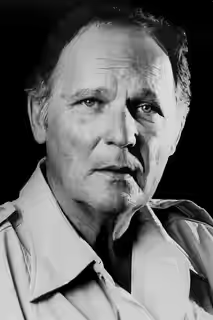
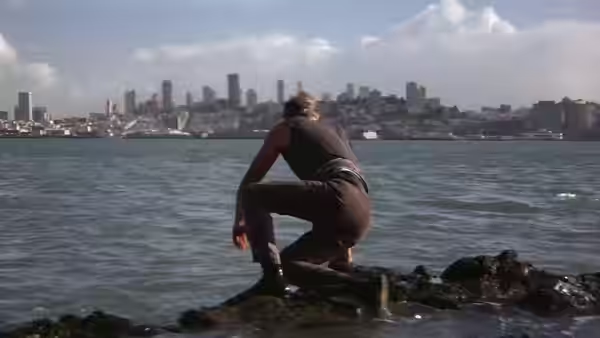
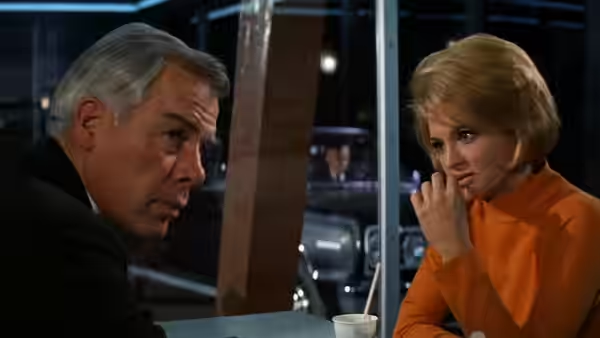
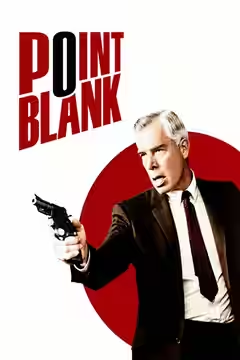
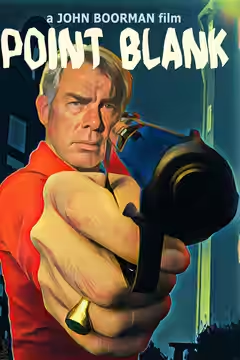
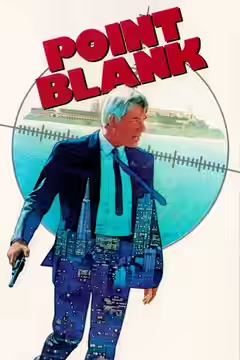
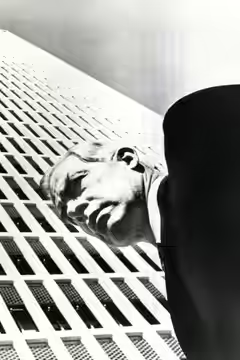
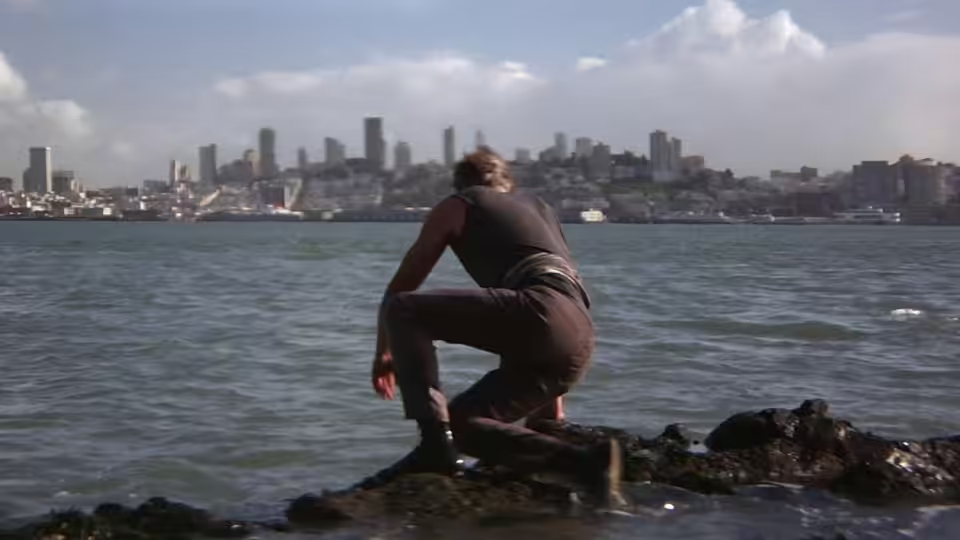
Walker (Lee Marvin) crouches on a rocky shoreline overlooking the city across the water
Film review

Point Blank

1967 · Directed by John Boorman · 1h 32m

In a sentenceLee Marvin has come for revenge; we are still trying to get our bearings

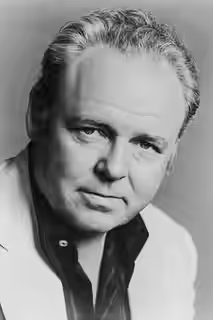
Walker (Lee Marvin) pursues revenge, but the violence behind his pursuit keeps returning through memory. Chris (Angie Dickinson) and Mal Reese (John Vernon) are among the people caught up in his story, alongside Yost (Keenan Wynn) and Brewster (Carroll O’Connor). As Walker presses on, fragments of the past break into the present. The account moves backwards as well as forwards, with earlier violence interrupting the sequence of events. Following his pursuit means following those returns to the past, as memory complicates the path towards retribution.

Plays from YouTube when you press play; nothing loads from them until then.

Fi1m review

John Boorman’s fractured revenge thriller is worth the concentration, chiefly for Lee Marvin’s grim authority. The people around him can feel remote, but the film makes remembered violence disturbingly difficult to put aside.

John Boorman makes the simple business of following a revenge plot feel unsafe. Point Blank is a fine crime thriller, and its complications have a purpose: violence keeps returning when we would rather move on. Lee Marvin gives us a firm centre while the telling breaks into fragments around him. The reservation is that the people beside him can seem too remote to care about.

The screenplay is credited to Rafe Newhouse, Alexander Jacobs and David Newhouse, from a novel by Donald E. Westlake. Revenge gives the story an understandable direction, which matters when the sequence of events refuses to behave itself. A revenge thriller usually lets us share the lead’s certainty about what needs doing. Here, we can follow the pursuit without being allowed that comfort. John Boorman uses the familiar plot to keep us interested while making the telling considerably stranger.

Lee Marvin’s Walker is the reason this remains involving. His gravitas lets the film take risks with our bearings without losing its main source of interest. We do not need to find Walker agreeable to want to keep watching him, and Lee Marvin does not soften the character to win our affection. The danger is that such a commanding lead makes everyone around him too easily overlooked.

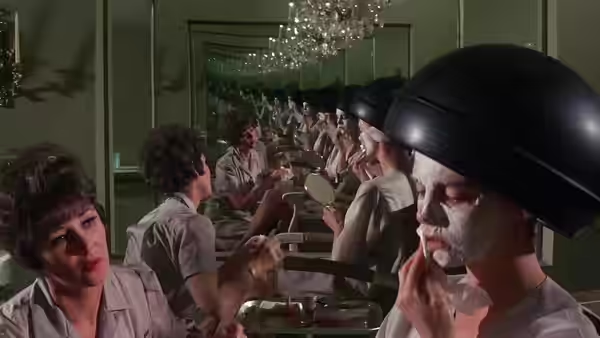
Philip H. Lathrop’s cinematography makes the landscape feel as unsettled as the telling. The visual strangeness keeps us looking, even when we cannot quite work out how one piece of the film fits beside another. That uncertainty is useful: the surroundings never become somewhere we can relax while waiting for the next confrontation. We remain alert to the images throughout, looking for something that will help us get our bearings.

Henry Berman’s editing gives remembered violence an uncomfortable persistence. The past interrupts the forward movement of revenge, so remembering becomes part of the action we are trying to follow. We felt unsettled by those returns to violence, because they made it difficult to believe that anything was safely over. This is where the fractured storytelling earns the concentration it asks of us: each interruption makes the pursuit feel less secure.

Johnny Mandel’s music contributes to that unease, although the images and the cutting are what stay with us. The limitation is John Boorman’s interest in keeping people at a distance. Angie Dickinson’s Chris and John Vernon’s Mal Reese can feel secondary to the business of tracking Walker through this broken sequence. We wanted more room for them to matter on their own terms. That leaves a chill which sometimes dulls our interest in the people, even while the thriller keeps us attentive.

The temptation is to treat every dislocation as a clue and spend the film trying to restore a tidy chronology. We would resist it on a first viewing. At 92 minutes, there is no great burden in letting John Boorman set the pace and leave a few questions open. See it when there is enough quiet to pay attention, rather than expecting a straightforward evening of revenge.
Critical consensus AI synthesised

76
Positive
7
Mixed
1
Negative
0

Most critics respond warmly to Point Blank, with praise clustering around Boorman’s unconventional visual style and fractured storytelling. The reviews repeatedly describe a disorienting, dreamlike crime film whose menace comes as much from disrupted memory and narrative as from its revenge plot. The Guardian singles out the way past violence haunts the story’s forward movement, while Empire and Film Comment emphasise Lee Marvin’s performance as an anchor for the film’s strangeness.

The differences are chiefly matters of emphasis and enthusiasm: some reviews celebrate the visual experimentation, while others concentrate on the force of the crime story or its elusive quality. There is little documented disagreement about particular weaknesses, and the available assessments range from measured approval to strong praise. The lowest-scored entry has no accessible review text, so it cannot support a specific reservation or establish a clear dissenting position.

Evening Standard
28 March 2013 · The Standard
90*

The critic calls it Boorman’s best film and a landmark thriller. They praise its brilliant cinematography and experimental approach to crime, punishment and revenge.

Read the full review →
Slant Magazine
13 April 2026 · ★★★★ · Nick Schager
80

Schager praises the film as a bleak, inventive noir masterpiece and calls the Criterion release generously supplemented. He singles out Boorman’s unconventional visual style and disorienting narrative for creating a powerful atmosphere of alienation.

Read the full review →
The Guardian
28 March 2013 · Peter Bradshaw
80*

Bradshaw finds the film an angular, disorienting thriller whose strange menace and cool intrigue endure. He singles out its treatment of memory, with past violence haunting the forward-driving revenge plot.

Read the full review →
Time Out
25 March 2013 · ★★★★ · Tom Huddleston
80

The review gives the film four out of five stars and describes it as a slippery beast. It singles out the film’s elusive quality as its defining feature.

Read the full review →
Sight and Sound
75*

The capsule is positive about the film’s modernist, dreamlike approach. It singles out Boorman’s fragmented landscape and narrative as especially effective.

Read the full review →
Empire
1 January 2012 · Clark Collis
70*

The review is positive, presenting the film as a stylish, hard-hitting crime story. It singles out Lee Marvin’s exceptional performance as the source of its force.

Read the full review →

Straight answers AI written, from our review

Is Point Blank worth watching?
Point Blank is worth watching for Lee Marvin’s grim authority and a revenge story that rewards concentration; we score it 84 out of 100. We find its fractured memories of violence unsettling, though the supporting characters can feel remote. It suits an attentive evening rather than a craving for straightforward action.
How long is Point Blank, and what is it rated?
Point Blank runs 1h 32m. It is a crime and thriller film.
Where can I watch Point Blank in Hong Kong?
Point Blank is not on any streaming or rental service in Hong Kong at the moment. It is available in 3 other countries; change your country at the top of the page to see where. Availability is checked daily.
How violent or frightening is Point Blank, and is it suitable for children?
Point Blank has a UK 15 certificate and is not suitable for children under 15. We find its repeated returns to remembered violence unsettling, particularly because the editing makes past events feel difficult to put aside. The unease comes from that fractured telling; anyone sensitive to violence should take the certificate seriously.
How does Point Blank compare to The Limey?
Point Blank and The Limey both fracture a revenge pursuit into memories, relying on a commanding lead to keep us involved. We recommend The Limey for a sharper sense of sadness, despite its thin underlying script; Point Blank is the choice for unsettling disorientation, though its supporting characters feel more remote.
Is Point Blank based on a true story or a book?
Point Blank is adapted from a novel by Donald E. Westlake, rather than based on a true story. We find that the revenge pursuit gives it an understandable direction without requiring familiarity with the book. The challenge is following the film’s broken chronology, as remembered violence repeatedly interrupts Walker’s progress.
What should I watch after Point Blank?
After Point Blank, try The Limey (1999, Fi1m 80): Another revenge pursuit broken into memories, with a lead worth following. Then Le Samouraï (1967, Fi1m 88): For controlled menace and a central performance that makes stillness count.

Cast

If you liked this, try…

  1. The Limey (1999, Fi1m 80)Another revenge pursuit broken into memories, with a lead worth following.

  2. Le Samouraï (1967, Fi1m 88)For controlled menace and a central performance that makes stillness count.

  3. The Hit (1984) · not on Fi1m yetA British crime film where professional composure proves difficult to maintain.

  4. Tokyo Drifter (1966) · not on Fi1m yetCrime plotting gives way to colour, strange spaces and deliberate disorientation.

  5. The American (2010) · not on Fi1m yetA withdrawn professional, patient suspense and little interest in easy reassurance.