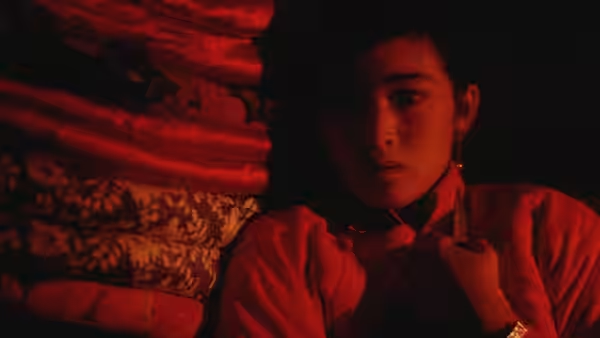
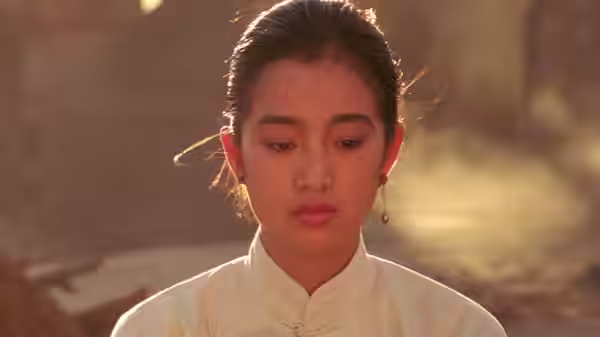
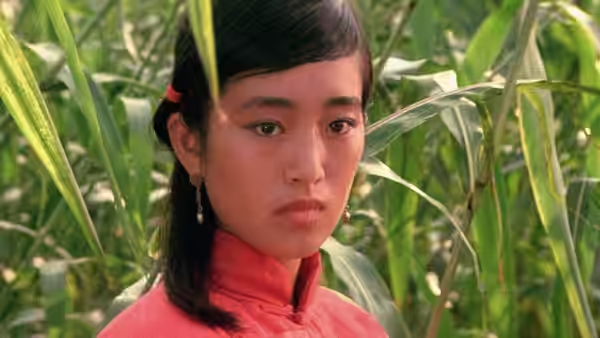
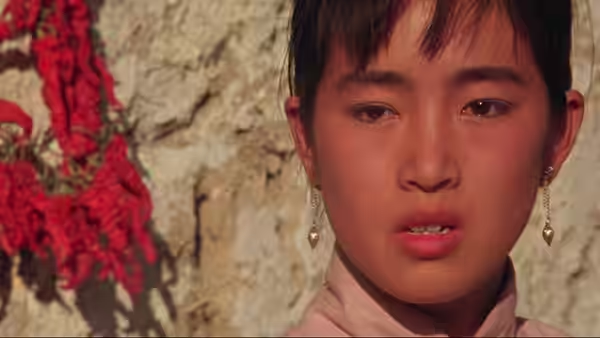
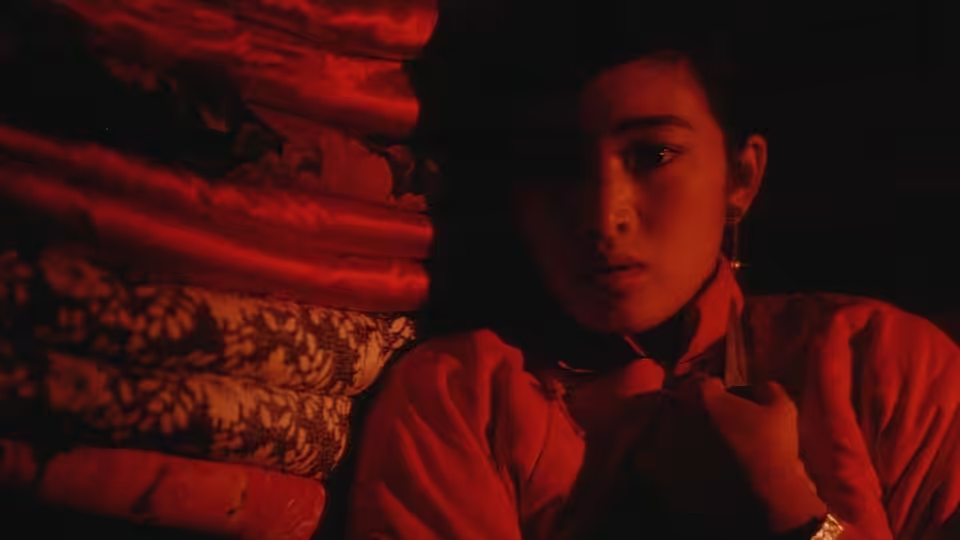
Jiu'er (Gong Li) clutches her clothes beside patterned bedding in a dim room
Film review

Red Sorghum

1988 · Directed by Zhang Yimou · 1h 31m

In a sentenceEverything is red, everyone is drunk, and the fields hide more than crops

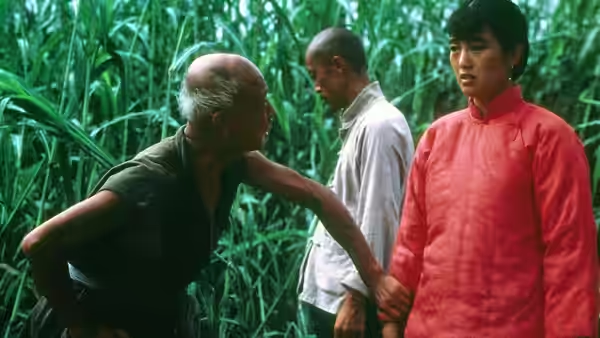
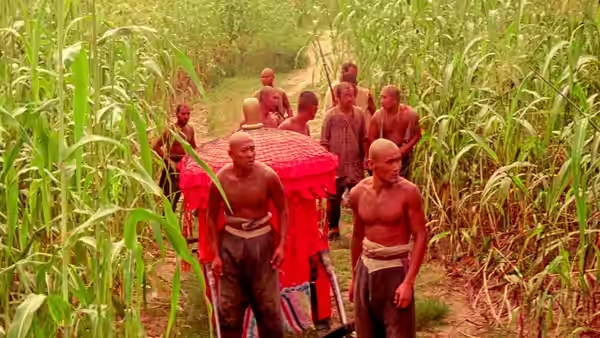
Jiu’er (Gong Li), a young bride, is carried in a red sedan chair across miles of bare open country to marry the owner of a sorghum-wine distillery, a man she has never met. The bearers, led by a bare-chested labourer called Yu (Jiang Wen), jolt the chair and sing bawdy songs at it to make the bride cry, as custom demands. She does not. On the way a masked bandit stops the party where the road runs through tall sorghum. Within days Jiu’er is a widow, and with the distillery’s foreman Uncle Luohan (Teng Rujun) and its workers she takes the place over and sets about making wine. Yu comes back, drunk and certain of his claim on her. So, in time, does the bandit chief Sanpao (Ji Chunhua).

Fi1m review

Zhang Yimou’s first film as a director is loud, bawdy and lit like a furnace, and Gong Li, also in her first film, holds the middle of it without saying much. The men are broadly drawn, but the last half hour still hits hard.

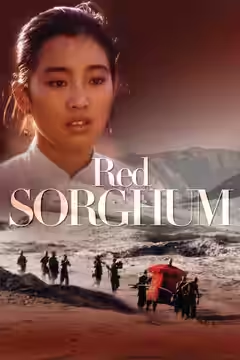
Red Sorghum opens with a voice telling us this is a family story, and then a red sedan chair sets off across a bare yellow plain. Zhang Yimou had not directed a film before this one. He had worked as a cameraman, and it shows in the best sense: he knows what a wide field and a swaying curtain will do, and he trusts them. The script, adapted by Zhu Wei, Chen Jianyu and Li Kezhi from Mo Yan’s novel, is a family legend told the way families tell them, with the dull parts left out and the shameful parts left in. The film runs 91 minutes and feels shorter.

Gong Li, in her first film, plays Jiu’er, a bride being delivered to a distillery owner she has never met. She spends the opening sequence inside a box, seen through a gap in the curtain, while the bearers outside bounce the chair and sing about what her husband will do to her. Jiang Wen, as the lead bearer Yu, grins through all of it, stripped to the waist and covered in dust. Gong does almost nothing. She looks out, she does not cry, and by the time the chair is set down we already know who is in charge of this story.

The scene that decided the film for us comes soon after, in the sorghum. A masked man carries Jiu’er off the road and into the crop, and the stalks are stamped into a circle, and Zhang holds on the field itself, the tops of the sorghum tossing in a wind that seems to be doing the acting. Zhao Jiping brings in drums and the wail of horns and nothing else. It is not a delicate scene and it is not meant to be. We were unsettled by it, and then moved, because the film makes plain that what happens in that circle is her choice, and Gong’s face, when we see it again, is a different face.

Gu Changwei shoots the whole thing in a palette of three or four colours. The chair is red, the bridal veil is red, the wine that comes out of the distillery’s stills is red, and the plain is a dry ochre under a white sky. Inside the distillery he lights with fire and steam, so the workers move through orange fog with their shirts off. It is not subtle. It is also not a look we had seen before in a Chinese film, and the sequence in which Teng Rujun’s Uncle Luohan leads the men in a song to the new wine, bowls raised, is as happy as anything we know in the cinema of the period.

The film is funnier and cruder than its reputation suggests. Yu turns up drunk to claim his woman and is dumped in a wine vat. Later he does something to a batch of the good stuff that we will not describe in a family publication; the workers’ reaction, and the outcome, made us laugh out loud and then wonder whether we were meant to. Ji Chunhua’s Sanpao, the local bandit, arrives in the middle stretch like a plot device wearing a hat, and that stretch is the weakest: Jiu’er has her distillery, Yu has Jiu’er, and for a while the film has nowhere obvious to go.

Then it does, and the second half takes a turn we will not spell out. What we can say is that the tone hardens, Du Yuan’s cutting gets quicker after an hour of long, held shots, and the colour red begins to mean something other than weddings and wine. Zhao’s score brings the drinking song back in a different key. The final ten minutes are as blunt as a hammer, and they left us shaken.

There are things to hold against it. The narration keeps telling us what we have just watched, as if Zhang did not yet believe his pictures. The men are types: the swaggerer, the loyal foreman, the villain. Jiu’er is looked at a great deal more than she is heard, and although Gong makes that work, a little more talk from her would not have hurt. The politics, when they arrive, are drawn with a very thick brush.

Zhang went on to make smoother films, and better-shaped ones. He did not make many that feel this alive. Watch it on the biggest screen you have, with the sound up, and give it a quarter of an hour to settle before deciding. The sedan chair earns your patience.

Critical consensus AI synthesised

2 of 6
Positive
1
Mixed
1
Negative
0
Los Angeles Times
20 October 1988 · SHEILA BENSON
90*

Benson finds the film a thrilling, funny, bawdy, beautiful, and dreadful epic. She especially praises Zhang Yimou’s visual sensuality and the vivid images that ground its sweeping story in intimate details.

Read the full review →
The New Yorker
11 October 2012 · Richard Brody
65*

Brody finds the film flawed but ultimately moving, with significant virtues he had missed before. He praises its use of memory, music, talk, and madness to convey personal history and collective suffering.

Read the full review →

Straight answers AI written, from our review

Is Red Sorghum worth watching?
Red Sorghum is worth watching for anyone who can take a loud, bawdy, furnace-lit family legend, and we scored it 82. Zhang Yimou's first film as director sags in its middle stretch and draws its men as types, but Gong Li holds the centre without saying much and the last half hour hits hard. Watch it on the biggest screen you have.
How long is Red Sorghum, and what is it rated?
Red Sorghum runs 1h 31m. It is a drama and romance film.
Where can I watch Red Sorghum in India?
Red Sorghum is not on any streaming or rental service in India at the moment. It is available in 2 other countries; change your country at the top of the page to see where. Availability is checked daily.
How does Red Sorghum compare to Days of Heaven?
Red Sorghum is the louder and cruder of the two, where Days of Heaven is the quieter and more remote. Both let fields, a rich husband and a labourer do the storytelling, but Zhang's film is drunk, red and blunt, while Malick's is beautiful and uneasy. Choose Red Sorghum for energy and a hard ending, Days of Heaven for patience and light.
Is Red Sorghum based on a true story or a book?
Red Sorghum is based on Mo Yan's novel, adapted for the screen by Zhu Wei, Chen Jianyu and Li Kezhi. The film tells it as a family legend, narrated by a descendant, with the dull parts left out and the shameful parts kept in. You do not need to know the book; the pictures carry the story on their own.
What should I watch after Red Sorghum?
After Red Sorghum, try Days of Heaven (1978, Fi1m 85): Another film where wheat fields, a rich husband and a labourer do the storytelling. Then Ugetsu (1953, Fi1m 89): Mizoguchi’s tale of war reaching a village; the same shift from ordinary life to horror.

Cast

Awards

International Submission to the Academy Awards, 1989

Nominated
International Submission to the Academy Awards

Berlin International Film Festival, 1988

Won
Golden Bear

If you liked this, try…

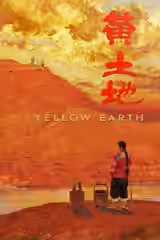
  1. Yellow Earth (1984) · not on Fi1m yetZhang shot this one for Chen Kaige; the same plains, quieter and sadder.

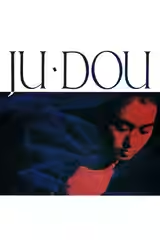
  2. Ju Dou (1990) · not on Fi1m yetZhang and Gong Li again, indoors this time, in a dye works full of red cloth.

  3. Days of Heaven (1978, Fi1m 85)Another film where wheat fields, a rich husband and a labourer do the storytelling.

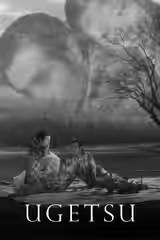
  4. Ugetsu (1953, Fi1m 89)Mizoguchi’s tale of war reaching a village; the same shift from ordinary life to horror.

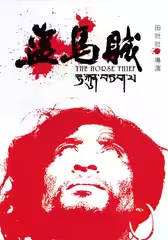
  5. The Horse Thief (1986) · not on Fi1m yetTian Zhuangzhuang’s Tibetan drama: little dialogue, hard landscape, ritual shot as spectacle.

Red Sorghum (1988) review: Zhang Yimou’s debut burns red and loud (India) | Fi1m