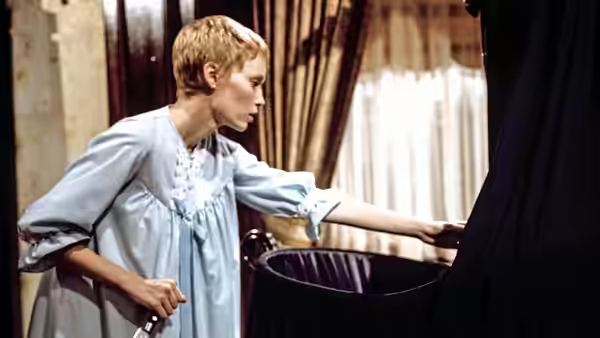
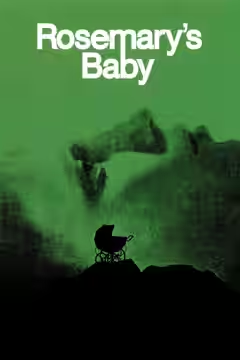
A woman peers over the edge of a dark piece of furniture
Film review

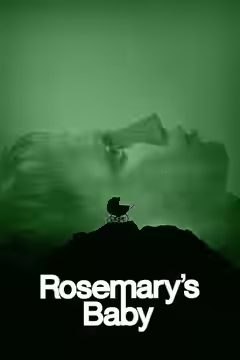
Rosemary's Baby

1968 · Directed by Roman Polanski · 2h 18m

In a sentenceEveryone has an opinion about Rosemary’s pregnancy, and nobody seems to need hers

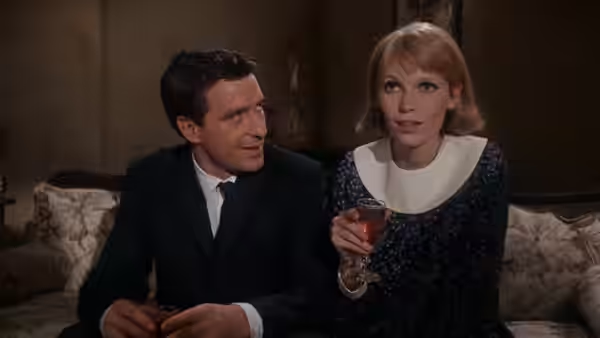
Rosemary Woodhouse (Mia Farrow) faces pregnancy with growing doubts about the people around her. Guy Woodhouse (John Cassavetes) and the eccentric Minnie Castevet (Ruth Gordon) are among those whose involvement in her life becomes difficult to separate from interference. Rosemary wants to understand what is happening to her and retain control over her own decisions. Ordinary concerns about pregnancy become entangled with suspicions she cannot easily substantiate. The question is whom she can trust, and how much weight to give her own judgement when other people seem so sure of theirs.

Plays from YouTube when you press play; nothing loads from them until then.

Fi1m review

Roman Polanski makes pregnancy and everyday interference frightening, with Mia Farrow giving Rosemary’s anxiety a painful human weight. There are slow patches, but we would recommend it even to those who usually avoid horror.

At 138 minutes, Rosemary’s Baby gives uncertainty plenty of time to become unbearable. Roman Polanski’s adaptation of Ira Levin’s novel is a frightening, patient film that earns the attention it demands. Pregnancy supplies the ordinary worries, and the people around Rosemary Woodhouse make those worries difficult to separate from suspicion. The film understands how exhausting it can be to explain a fear to someone who has already decided it is unreasonable.

Mia Farrow gives that exhaustion a human scale. We can follow Rosemary’s attempts to understand what is happening without feeling that the performance has settled every question for us. She holds our attention through doubts that could easily become tedious, and makes the question of who gets to decide what happens to her feel urgent. Her vulnerability never reduces her to someone we are simply waiting to see frightened again.

Ruth Gordon makes Minnie Castevet funny without giving us a comfortable break from the anxiety. We laughed at Minnie, then felt uneasy about how much we had excused because she was amusing. The eccentricity is entertaining enough to distract us from Rosemary’s need to be heard, and that distraction matters. John Cassavetes, as Guy Woodhouse, adds a harder quality; beside him, Mia Farrow’s uncertainty can seem painfully exposed, though his performance sometimes presses the unease more firmly than it needs to.

William A. Fraker’s cinematography makes us want to inspect the frame for something we have missed. Richard Sylbert’s production design feels close enough to ordinary life that we keep scrutinising surroundings which ought to be reassuring. Their work encourages this nervous attention without making the setting more interesting than the people. We find ourselves watching Rosemary and watching what is around her, unsure which deserves more of our attention.

Editors Bob Wyman and Sam O’Steen allow time for that unease to develop. The measured pace makes us sit with doubts instead of treating each one as a problem to be disposed of before the next scene. Krzysztof Komeda’s music feels tender in a way we cannot quite welcome. It suits the discomfort of a film about pregnancy in which apparent care can feel intrusive, and it avoids making the fear seem grander than the woman experiencing it.

That patience has a cost. Some passages prolong uncertainty after we have understood why Rosemary cannot easily make herself believed, and the waiting starts to feel a little managed. The script occasionally seems too pleased with its ability to keep us undecided. It is a small limitation, but a real one: at this length, another turn of the same doubt does not always deepen our concern.

As pregnancy horror, the film is particularly alert to how readily concern can become permission to interfere. We would recommend it to people who usually avoid supernatural stories, with a warning that its attention to a woman’s loss of control can be difficult company. Allow it the time it asks for. Anyone hoping that familiar faces and ordinary manners will provide reassurance should choose something else.


Critical consensus AI synthesised

80
Positive
6
Mixed
1
Negative
0

Most critics respond warmly to Rosemary’s Baby, with praise clustering around Polanski’s control of atmosphere and the performances of Mia Farrow and Ruth Gordon. The reviews repeatedly credit the film with making paranoia persuasive, allowing uncertainty to build slowly rather than forcing the horror. Farrow draws particular praise for her performance and casting, while Gordon’s comic eccentricity is another strength. The adaptation also earns approval for its intelligence and fidelity to its source.

The differences are chiefly differences of emphasis, with few explicit reservations in the available text. Slant Magazine stresses the violation of women’s autonomy and the way the film encourages viewers to dismiss Rosemary’s suspicions; other reviews concentrate on suspense, performance and the intrusion of horror into ordinary pregnancy. The scores suggest some variation in enthusiasm, but the RogerEbert.com entry contains no accessible verdict, so it cannot establish a substantive dissent.

Radio Times
★★★★★ · Alan Jones
100

Jones praises the film as an impeccable, faithful adaptation. He singles out Mia Farrow’s casting and Polanski’s atmospheric handling of paranoia.

Read the full review →
Variety
31 December 1967 · Variety Staff
85*

The review calls the film excellent and says Polanski triumphs in his first U.S.-made picture. It singles out Mia Farrow’s performance and the film’s suspenseful climax for praise.

Read the full review →
Empire
1 January 2000 · Angie Errigo
80*

Errigo praises the film as expertly made, high-class horror. She singles out Ruth Gordon’s inspired performance as Minnie, whose comic eccentricity makes her role in the satanic conspiracy especially effective.

Read the full review →
Slant Magazine
22 June 2013 · ★★★★ · Eric Henderson
80

Henderson sees the film as an enduring cautionary tale about women’s autonomy being violated. He praises Polanski’s slow-burn uncertainty, which makes viewers question Rosemary’s suspicions and implicates them in dismissing her.

Read the full review →
Time Out
· GA
70*

The review describes the film as a supremely intelligent and convincing adaptation. It singles out the adaptation’s handling of Ira Levin’s Satanist thriller for praise.

Read the full review →
RogerEbert.com
65*

The URL identifies a review of the specified film, but the blocked page reveals no critical verdict. No praise or complaint can be confirmed from the available text.

Read the full review →

Straight answers AI written, from our review

How long is Rosemary's Baby, and what is it rated?
Rosemary's Baby runs 2h 18m. It is a drama and horror film.
Where can I watch Rosemary's Baby in Estonia?
Rosemary's Baby is available to rent from Apple TV from €3.99. Availability is checked daily; the links above go straight to each service.

Cast

Awards

Academy Awards, 1969

Nominated
Best Writing, Adapted Screenplay
Won
Best Supporting Actress

David di Donatello for Best Foreign Actress, 1969

Won
David di Donatello for Best Foreign Actress

David di Donatello for Best Foreign Director, 1969

Won
David di Donatello for Best Foreign Director

Golden Globes, 1968

Won
Best Supporting Actress – Motion Picture

If you liked this, try…

  1. The Innocents (1961) · not on Fi1m yetAnother patient horror film that makes uncertainty almost impossible to bear.

  2. The Stepford Wives (1975) · not on Fi1m yetDomestic comfort becomes threatening when everyone agrees how a woman should behave.

  3. Safe (1995) · not on Fi1m yetA woman’s distress becomes harder to explain as everyone offers an explanation.

  4. The Babadook (2014, Fi1m 86)Motherhood and fear share a home, with neither politely keeping its distance.

  5. The Tenant (1976) · not on Fi1m yetFor more neighbours whose interest in somebody else’s life feels distinctly unhealthy.

Rosemary’s Baby (1968) review: Slow horror with no easy comfort (Estonia) | Fi1m