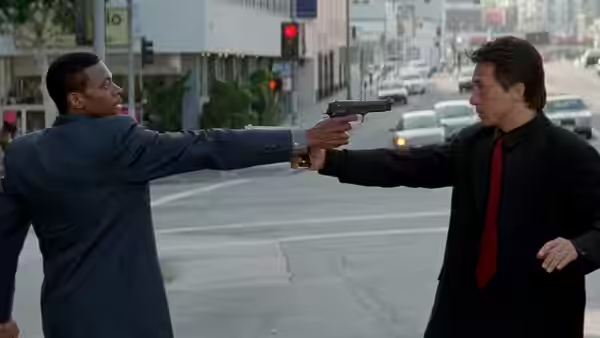
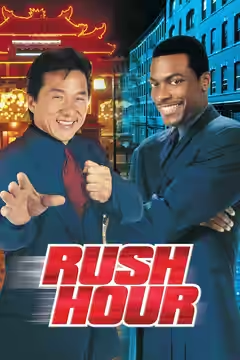
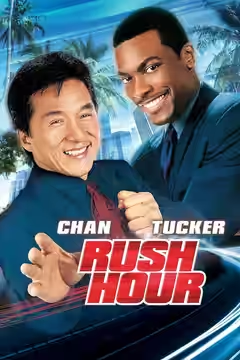
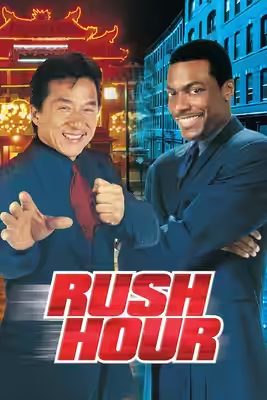
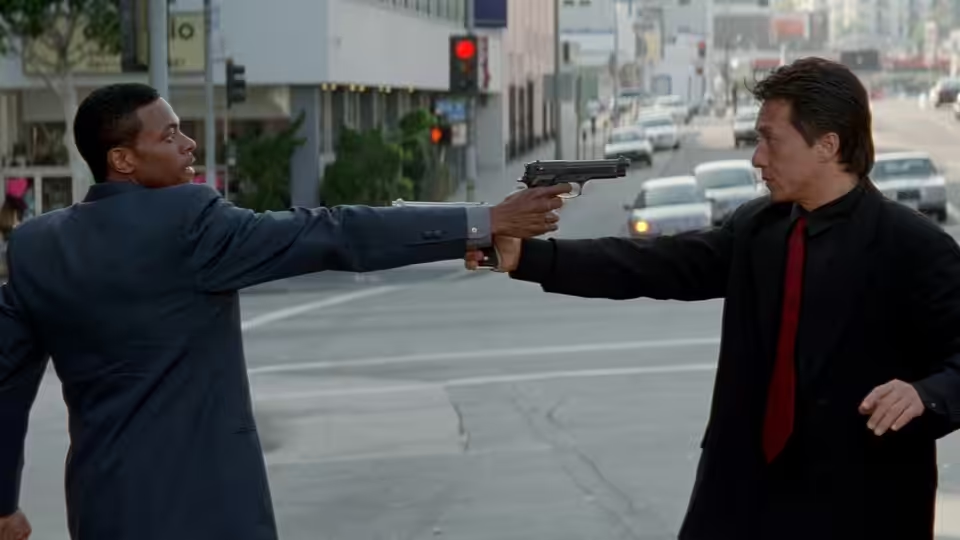
Carter (Chris Tucker) points a gun at Lee (Jackie Chan) in a city intersection
Film review

Rush Hour

1998 · Directed by Brett Ratner · 1h 37m

In a sentenceChris Tucker talks for ninety-seven minutes and Jackie Chan climbs the Hollywood sign to get away from him

Hong Kong, the last days before the 1997 handover. Lee (Jackie Chan), a police inspector, raids a dockside warehouse and recovers a hoard of stolen Chinese antiquities, but the gangster Sang (Ken Leung) slips away. When Consul Han (Tzi Ma) takes up a diplomatic post in Los Angeles, his young daughter is snatched on the way to school, and Han asks for Lee. The FBI agents Russ (Mark Rolston) and Whitney (Rex Linn) want no outsider on their case, so they ask the LAPD for someone to keep him busy. Captain Diel (Philip Baker Hall) hands them Carter (Chris Tucker), a loudmouth whose last arrest ended with a car in flames. Carter collects Lee from the airport, Lee pretends not to understand a word of English, and within the hour one of them is hanging off the Hollywood sign.

Plays from YouTube when you press play; nothing loads from them until then.

Fi1m review

Brett Ratner’s buddy comedy has a plot you could write on a napkin and two leads who make you forget to look at it. Tucker does the talking, Chan does the falling, and for 97 minutes that is enough.

Brett Ratner’s film puts a Hong Kong policeman who hardly speaks and a Los Angeles policeman who hardly stops in the same car and asks them to find a kidnapped child. Ross LaManna and Jim Kouf’s script would fit on a napkin, and Rush Hour knows it, and spends its 97 minutes getting out of the way of two men who are funnier together than either has any right to be. That is enough for an evening, and not much more.

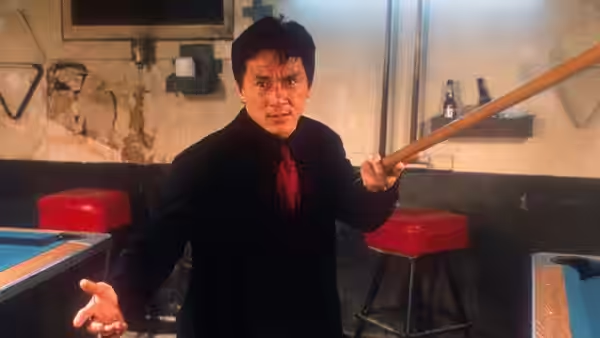
Jackie Chan plays Lee as a polite, tidy man who is embarrassed by violence and extremely good at it. The opening raid on a Hong Kong dock is over before we have worked out who anyone is, but once Lee reaches Los Angeles the action settles into Chan’s own rhythm: a brawl in a pool hall he did not start, and a scrap in a Chinatown restaurant where he does more with a chair and a stool than most films manage with a stunt team. Adam Greenberg shoots most of it wide enough that we can see it is Chan doing the work, and Mark Helfrich holds the takes longer than an American action film of 1998 usually would.

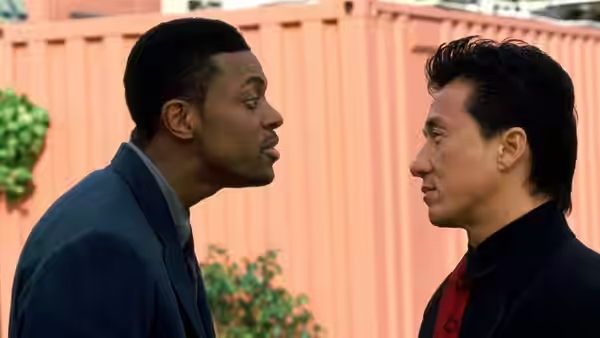
Chris Tucker plays Carter at a pitch only dogs should hear. He talks to everyone, and most of all to Lee, who he has been told does not speak English and who lets him believe it for a long time. “Do you understand the words that are coming out of my mouth?” is the line everyone remembers, but the moment that won us over is smaller: Carter alone in his Corvette, singing along to Edwin Starr’s “War”, and then later the same song with Lee joining in, flat and delighted. We laughed, properly and more than once, and almost all of it was the two faces together, Tucker’s mouth going and Chan’s eyebrows answering.

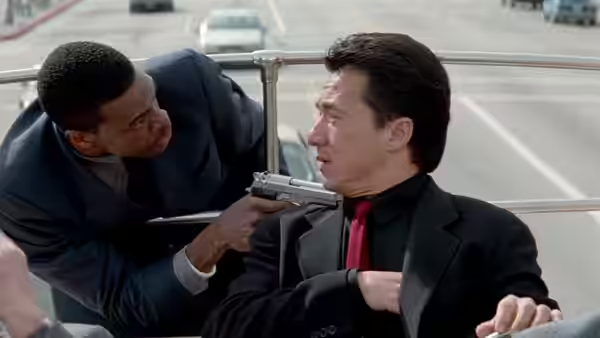
Chan, it turns out, is a fine straight man. He listens. When Carter abandons him on a tour bus and he ends up on the Hollywood sign, the joke is not the stunt but the patient expression he wears while doing it. Neither actor is trying to win the scene from the other, and the film has the sense to keep them in the same frame.

Everyone else is scenery. Tom Wilkinson, as Griffin, and Tzi Ma, as the anxious father Consul Han, are given rooms to stand in and lines to deliver gravely. Mark Rolston and Rex Linn’s agents exist to be wrong. Philip Baker Hall does his weary-captain voice in two scenes. Elizabeth Peña, as Johnson, is mostly there to be flirted at. Ken Leung’s Sang is a good sneer in a bad haircut.

Lalo Schifrin’s score is the film’s best supporting player: brass, bongos and wah-wah guitar from the man who scored Dirty Harry (1971), so that Carter walks into every room as if that year had never ended. Robb Wilson King gives Los Angeles a Chinatown of red lanterns and back kitchens and a consulate that looks like a bank. Sharen Davis puts Lee in one grey suit and Carter in shirts you can hear. Greenberg lights the city bright and flat, as a comedy should be lit.

Somewhere past the hour the film remembers it has a plot, and for a quarter of an hour the leads are separated while agents explain things to each other. We felt the drop. We were waiting, a little impatiently, for the next car journey, and so, plainly, was the film. Some of the comedy has not aged kindly either: the pool-hall scene turns on a word the film uses first for a laugh and then for a fight.

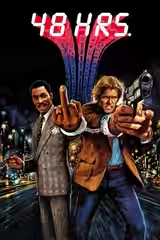
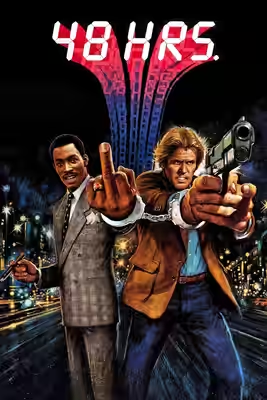
Against 48 Hrs. (1982) and Lethal Weapon (1987), this is the gentler version, a 12 rather than a bloodbath, with the mismatched-partners machinery running on charm rather than threat. Ratner points the camera at two funny men and keeps still, which was the right decision. Watch it at home with someone who laughs easily. It runs 97 minutes, which is exactly how long the joke lasts.

Critical consensus AI synthesised

71
Positive
5
Mixed
3
Negative
0

Most critics find Rush Hour an enjoyable, familiar action comedy whose chief strength is the partnership between Jackie Chan and Chris Tucker. Praise centres on their contrasting comic styles, with Chan’s acrobatic action playing effectively against Tucker’s more frantic humour. The reviews repeatedly credit that rapport with making the material work, even when the plot offers little surprise, and Chan’s action sequences receive particular approval.

The main difference is how far the double act compensates for the formula. Radio Times finds that the pairing lifts the film above the usual buddy comedy, while Empire calls it an effective crowd-pleaser but faults the weak script and slow start. The Los Angeles Times praises the brisk pacing, though it finds a Hong Kong sequence elliptical. The assessable verdicts therefore range from qualified enjoyment to firm enthusiasm, with reservations clustering around the writing rather than the stars.

Radio Times
★★★★ · Alan Jones
80

The critic says the film rises above the usual buddy-movie formula. Chan and Tucker’s inspired double act is singled out for praise.

Read the full review →
Los Angeles Times
18 September 1998 · KEVIN THOMAS
75*

Thomas finds the action comedy formulaic but funny, with Chan and Tucker making an effective team. He praises the stars’ contrasting comic styles and the film’s brisk pacing, while faulting an elliptical Hong Kong sequence.

Read the full review →
The New York Times
18 September 1998 · Janet Maslin
70*

Maslin gives the action comedy a positive verdict. She singles out the comic chemistry between Jackie Chan and Chris Tucker.

Read the full review →
Variety
21 September 1998 · Joe Leydon
70*

Leydon finds the formulaic action comedy raucously entertaining and sees it as a savvy career move for Jackie Chan. He praises the lively chemistry between Chan’s acrobatics and Chris Tucker’s manic humor.

Read the full review →
Empire
1 January 2000 · Caroline Westbrook
65*

Westbrook finds the film an effective, if brainless, crowd-pleaser despite its weak script and slow start. She singles out Jackie Chan’s balletic action sequences as the highlight.

Read the full review →
RogerEbert.com
65*

The page URL identifies a RogerEbert.com review of the 1998 film, but the review text is inaccessible. Its verdict and any specific praise or complaint cannot be determined.

Read the full review →

Straight answers AI written, from our review

Is Rush Hour worth watching?
Rush Hour is worth watching for Jackie Chan and Chris Tucker’s comic partnership, and we score it 70 out of 100. Chan’s patient reactions and inventive physical comedy make Tucker’s relentless chatter work, though the thin kidnapping plot becomes a drag whenever the film separates them.
How long is Rush Hour, and what is it rated?
Rush Hour runs 1h 37m. It is an action and comedy film.
Where can I watch Rush Hour in the Philippines?
Rush Hour is not on any streaming or rental service in the Philippines at the moment. It is available in 24 other countries; change your country at the top of the page to see where. Availability is checked daily.
How violent or frightening is Rush Hour, and is it suitable for children?
Rush Hour carries a UK 12 certificate and mixes comic fights and stunts with a child-kidnapping story, making it more suitable for teenagers than younger children. We find it gentler than its harder-edged buddy-thriller predecessors, but the kidnapping premise may unsettle younger viewers, and some of the language-based comedy has aged poorly.
How does Rush Hour compare to 48 Hrs.?
Rush Hour is the gentler, more playful choice beside 48 Hrs., relying on Chan and Tucker’s charm rather than the convincing hostility between Nolte and Murphy. We favour 48 Hrs. for a leaner, harder-edged thriller, though its racial abuse has dated badly; Rush Hour is the better fit for an easy evening of physical comedy.
What should I watch after Rush Hour?
After Rush Hour, try 48 Hrs. (1982, Fi1m 78): The rougher original: Nolte and Murphy loathe each other with real conviction. Then Midnight Run (1988, Fi1m 88): Two men, one journey, and the best bickering ever put in a car; and Hot Fuzz (2007, Fi1m 84): The buddy-cop formula taken to a Gloucestershire village and played dead straight.

Cast

If you liked this, try…

  1. 48 Hrs. (1982, Fi1m 78)The rougher original: Nolte and Murphy loathe each other with real conviction.

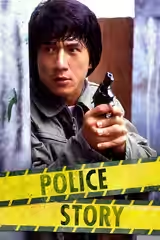
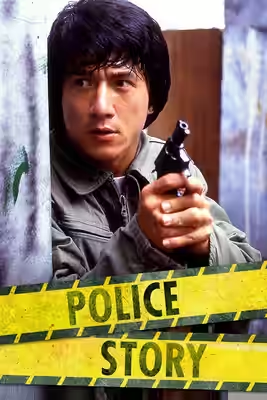
  2. Police Story (1985) · not reviewed yetChan at full stretch in Hong Kong, with fights that run long and hurt.

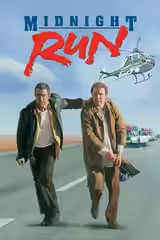
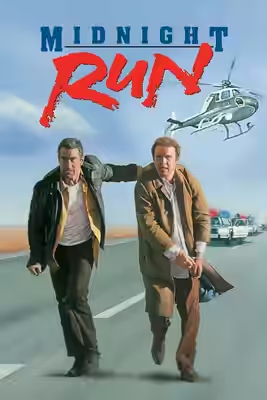
  3. Midnight Run (1988, Fi1m 88)Two men, one journey, and the best bickering ever put in a car.

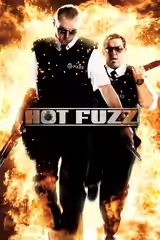
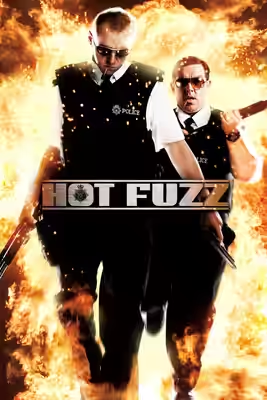
  4. Hot Fuzz (2007, Fi1m 84)The buddy-cop formula taken to a Gloucestershire village and played dead straight.

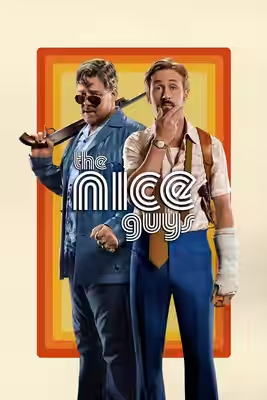
  5. The Nice Guys (2016) · not reviewed yetGosling and Crowe fumble through 1970s Los Angeles; the jokes are sharper than the case.

Free account

Know what to watch tonight

Two lists that know where things are streaming, collections you can share, your own score beside ours, and Discover that remembers what you have seen.

  • Want to see, sorted by what is streaming now
  • Seen, with your score out of ten
  • No adverts, ever