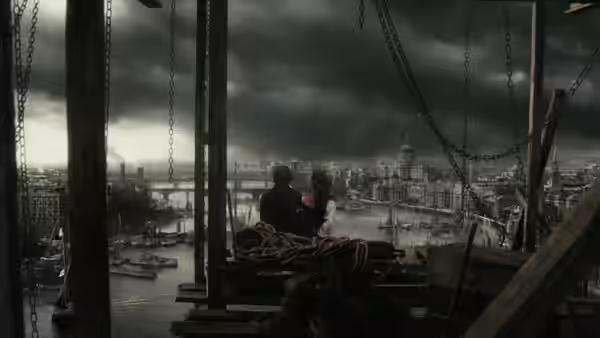
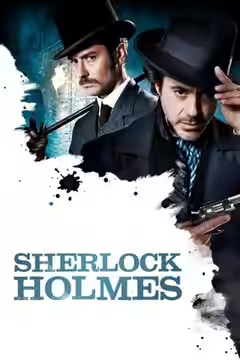
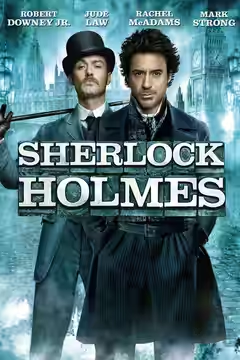
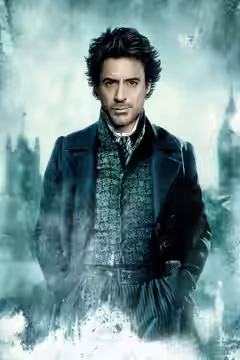
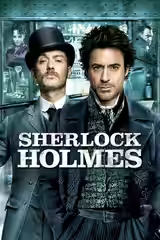
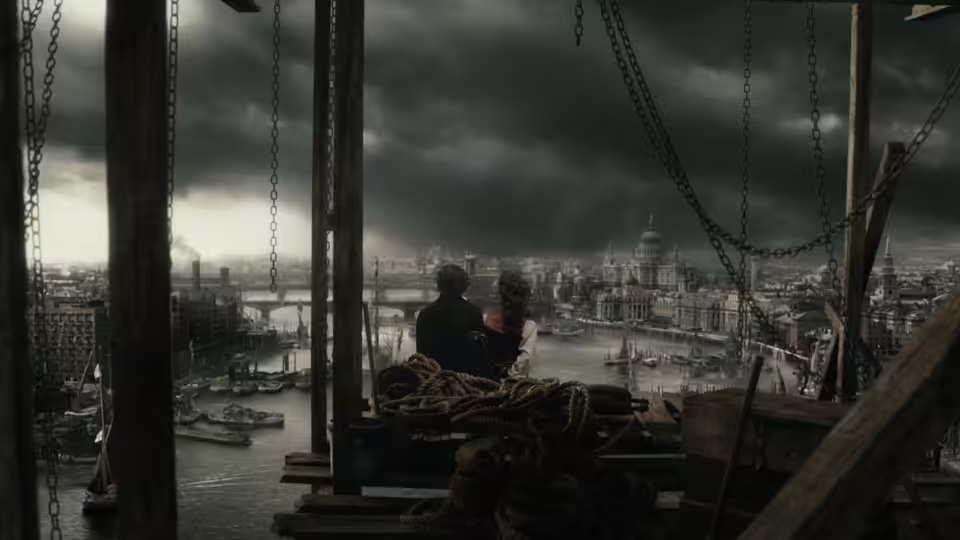
Two men stand on a timber platform overlooking London’s river and rooftops
Film review

Sherlock Holmes

2009 · Directed by Guy Ritchie · 2h 09m

In a sentenceThe detective would rather fight than deduce, and honestly so would the film

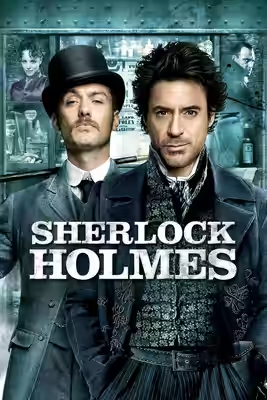
London, in the reign of Victoria. Sherlock Holmes (Robert Downey Jr.) and Dr. John Watson (Jude Law) break up a ritual murder in a crypt and hand its author, Lord Henry Blackwood (Mark Strong), to Inspector Lestrade (Eddie Marsan). Blackwood is hanged and Watson certifies him dead. Back at Baker Street, Holmes sulks without a case, shoots at the wallpaper and experiments on the dog, while Watson tries to pack up and marry Mary Morstan (Kelly Reilly). Then Irene Adler (Rachel McAdams), the one woman who ever got the better of Holmes, arrives with a job from a client she will not name, and Blackwood’s tomb is found broken open from the inside, with a witness swearing he walked out of it.

Plays from YouTube when you press play; nothing loads from them until then.

Fi1m review

Guy Ritchie turns Conan Doyle’s detective into a bare-knuckle boxer with a chemistry set, and for long stretches it is good fun, mostly because Robert Downey Jr. and Jude Law bicker so well. The mystery underneath them is thin, and the film knows it.

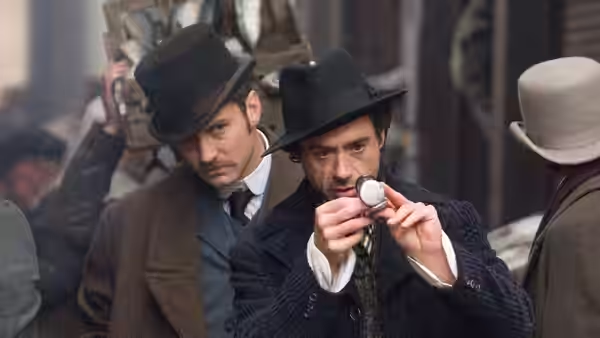
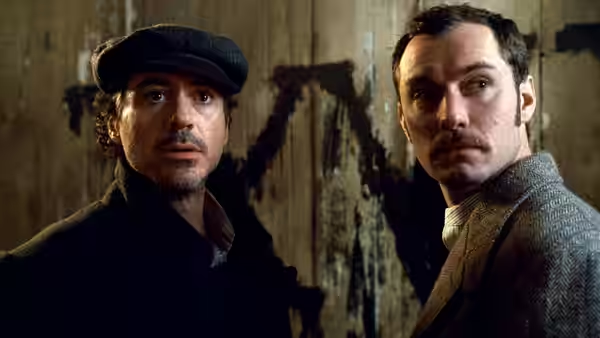
Guy Ritchie’s Sherlock Holmes takes the detective out of the armchair and puts him in a boxing cellar, a slaughterhouse and a shipyard, and the surprise is how much of that works. Robert Downey Jr. plays Holmes as a man who cannot stop noticing things and would rather hit somebody than explain them, and Jude Law’s Watson is the only person in London who can stand to share a room with him. It is a good double act in want of a case worth their time. The case the script gives them is not that, and it keeps a likeable film from being more than likeable.

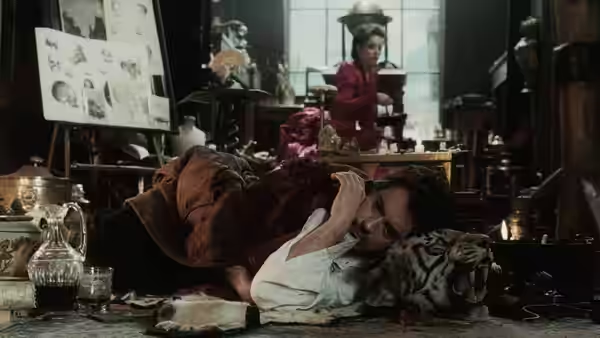
Downey plays Holmes between cases as a wreck: unshaven, firing a revolver at the wallpaper, experimenting on Watson’s dog, unable to bear an afternoon without a problem. Law makes Watson competent, armed and tired, a doctor who has decided to marry Mary Morstan (Kelly Reilly) and move out of Baker Street and who keeps not quite managing it. Their scenes are written as one long quarrel and played as a marriage. We laughed a good deal, and most of it was Law, who can show a man’s whole weariness with a friend he loves in one look across a restaurant table while Holmes insults his fiancée.

Ritchie’s signature is the fight that is solved before it starts. Holmes narrates in voice-over the blows he intends to land, each one shown slow and close while Downey murmurs about cracked ribs and ringing ears; then James Herbert cuts the same fight at full speed in about three seconds. The first time, in the boxing cellar, we grinned; it is a neat way to show thinking as something a body does. By the third time it has become a trick, and the film reaches for it when it has run out of other ideas. The larger set pieces, including a brawl with a giant called Dredger (Robert Maillet) that ends with a ship coming off its blocks, have plenty of noise and not much geography, so we were never sure who was standing where.

Philippe Rousselot shoots the city in browns and greys under a fog that never lifts, with daylight arriving through dirty glass. Sarah Greenwood’s production design is the film’s steadiest pleasure: Baker Street rooms heaped with bottles and papers, a slaughterhouse with a working bandsaw, and a Tower Bridge still half built, all girders and chains, which the film has the sense to save for last. Hans Zimmer’s score runs on a piano that sounds as if it had been left out in the rain, with a sawing fiddle over the top. It is cheeky and quick, and it suits Ritchie’s film rather better than it suits Holmes.

The case is this. Lord Blackwood (Mark Strong), hanged for a string of ritual killings, is seen walking out of his own tomb, and London panics. Strong plays him with a stillness that is more frightening than anything he is asked to do, and he is asked to do a secret society, a plan to take the country, and a great deal of standing in dark rooms. The three credited writers, Michael Robert Johnson, Anthony Peckham and Simon Kinberg, build a mystery that nobody but Holmes could solve and then have him explain it, at length, in the closing minutes. A good Holmes story makes us feel slow; this one has simply not shown us the pieces. By the ninety-minute mark we were no longer curious, only waiting for the explanation we knew was coming.

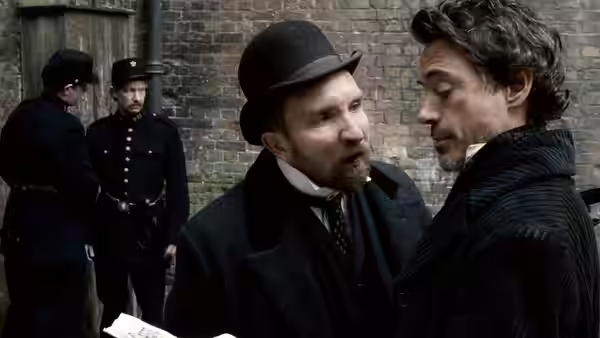
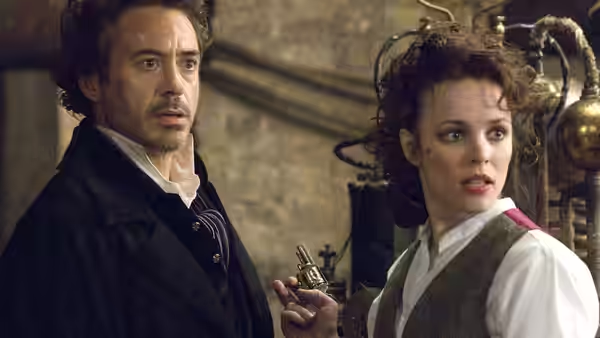
Rachel McAdams’s Irene Adler is introduced as the one woman who ever beat Holmes and is then given a run of frocks and a man in the shadows to report to. McAdams is game and never once dangerous. Eddie Marsan’s Lestrade is good value, a policeman who gave up understanding Holmes years ago and settled for using him. Geraldine James gets three lines as Mrs. Hudson and builds a landlady out of them.

Conan Doyle’s Holmes boxed and took cocaine, so Ritchie is not inventing much. What has gone missing is the pleasure of being shown a thing and then shown what it meant; Ritchie is better at the moments before and after a deduction than at the deduction itself. See it for the pair, at home on a wet evening, where its 129 minutes feel about right and the fog looks less expensive. Do not try to solve it. The film has not given you the pieces, and it does not appear to mind.

Critical consensus AI synthesised

60
Positive
6
Mixed
6
Negative
2

Most critics come down mildly in favour, and the praise lands in the same two places. Robert Downey Jr’s twitchy, restless Holmes is the asset nearly everyone names, with several reviews calling his double act with Jude Law the reason the film works at all. The grimy, crowded Victorian London is the other point of agreement: the production design and cinematography are admired even by those who dislike the rest, and one or two also note the score.

The reservations cluster on the balance between action and deduction. Many feel the set pieces crowd out the detective work, the mystery is thin, and the script sags or plods; Total Film finds the climax a letdown and the Los Angeles Times thinks Rachel McAdams is miscast. The spread is wide. Nearly half the reviews are mixed, and two dissent outright: The Guardian dismisses it as dull, muddled hack work, while The Hollywood Reporter calls it noisy and overstuffed.

Evening Standard
10 April 2012 · The Standard
78*

The critic finds the film erratic but hugely enjoyable, praising its affectionate take on Holmes and Victorian London. They single out the Downey Jr–Law double act and the film’s vivid atmosphere, while noting that the script feels baggy.

Read the full review →
The AV Club
23 December 2009 · B · Keith Phipps
77

Phipps finds the film a highly entertaining, propulsive blockbuster that makes a distinctive and convincing Holmes of Robert Downey Jr. He especially praises Downey’s twitchy performance and the sequences that slow down to show Holmes plotting.

Read the full review →
RogerEbert.com
24 December 2009 · ★★★/4 · Roger Ebert
75

Ebert finds the film an entertaining, energetic take on Sherlock Holmes. He particularly praises the chemistry between Robert Downey Jr. and Jude Law.

Read the full review →
Empire
3 December 2009 · William Thomas
70*

Thomas finds the film an entertaining, promising reintroduction, though it works better as a setup than as a satisfying standalone story. He especially praises the lively Holmes–Watson partnership, while noting that the plot can feel simplistic and plodding.

Read the full review →
Screen Daily
4 January 2010 · Tim Grierson
64*

The page identifies this as a review of the 2009 film, but the review text is behind a paywall. The critic’s verdict and any specific praise or complaint are unavailable.

Read the full review →
Slant Magazine
24 December 2009 · ★★½/4 · Ryan Stewart
62

The review sees the modernization as welcome but finds the film’s relentless action often overwhelms its likable characters. It praises the gritty, immersive Victorian London while wishing for more of Holmes and Watson’s comic interplay.

Read the full review →

Straight answers AI written, from our review

Is Sherlock Holmes worth watching?
Sherlock Holmes is worth watching for anyone who wants a loud, funny Victorian action film rather than a mystery, and we scored it 65. Robert Downey Jr. and Jude Law bicker like an old married couple and carry it between them. The case itself is thin and is explained rather than solved, so do not expect to work it out ahead of Holmes.
How long is Sherlock Holmes, and what is it rated?
Sherlock Holmes runs 2h 09m. It is an action and adventure film.
Where can I watch Sherlock Holmes in Ukraine?
Sherlock Holmes is streaming on Apple TV in Ukraine, and it is also available to rent from Apple TV from ₴3.99. Availability is checked daily; the links above go straight to each service.
How violent or frightening is Sherlock Holmes, and is it suitable for children?
Sherlock Holmes is a 12A, with bare-knuckle boxing, a ritual murder broken up in a crypt, a slaughterhouse set piece with a working bandsaw, and a villain who appears to walk out of his own tomb. The violence is quick and cut for comedy more than pain, and nothing lingers. It suits most children of secondary-school age; younger ones may find the crypt and Mark Strong's stillness unsettling.
How does Sherlock Holmes compare to Sherlock Holmes?
Sherlock Holmes is the fighter and the modern-dress television series it is most often set beside is the thinker: Ritchie's film is better at the moments before and after a deduction than at the deduction itself, while the series, at least in its first run, does the reasoning Ritchie skips. Choose the film for Downey and Law's quarrelling and the set pieces; choose the series if you want to be shown the clues and feel slow.
What should I watch after Sherlock Holmes?
After Sherlock Holmes, try Sherlock (2010, Fi1m 65): The modern-dress series that does the deduction Ritchie skips, at least in its first run. Then Without a Clue (1988, Fi1m 64): Michael Caine as a fraud Holmes, Ben Kingsley as the brains; the double act played for farce.

Cast

Awards

Academy Awards, 2010

Nominated
Best Original Score
Nominated
Best Production Design

If you liked this, try…

  1. The Private Life of Sherlock Holmes (1970) · not reviewed yetBilly Wilder’s melancholy Holmes, where the jokes hurt and the case actually matters.

  2. Sherlock (2010, Fi1m 65)The modern-dress series that does the deduction Ritchie skips, at least in its first run.

  3. The Hound of the Baskervilles (1959) · not reviewed yetHammer’s Holmes, with Peter Cushing and a moor that looks properly dangerous.

  4. Without a Clue (1988, Fi1m 64)Michael Caine as a fraud Holmes, Ben Kingsley as the brains; the double act played for farce.

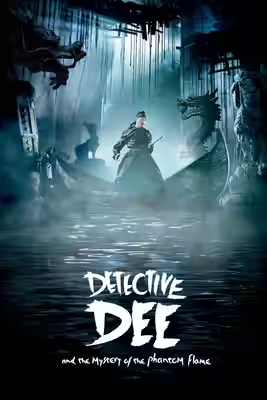
  5. Detective Dee and the Mystery of the Phantom Flame (2010) · not reviewed yetTsui Hark’s Tang-dynasty sleuth fights more than he thinks too, and with more wit.

Free account

Know what to watch tonight

Two lists that know where things are streaming, collections you can share, your own score beside ours, and Discover that remembers what you have seen.

  • Want to see, sorted by what is streaming now
  • Seen, with your score out of ten
  • No adverts, ever