Greg Kwedar’s drama about a theatre programme inside a New York prison is patient, funny and quietly moving, and it is carried by Divine Eye’ Maclin, a former inmate who never once looks like he is acting. The plot around him is thinner than the rehearsal room.
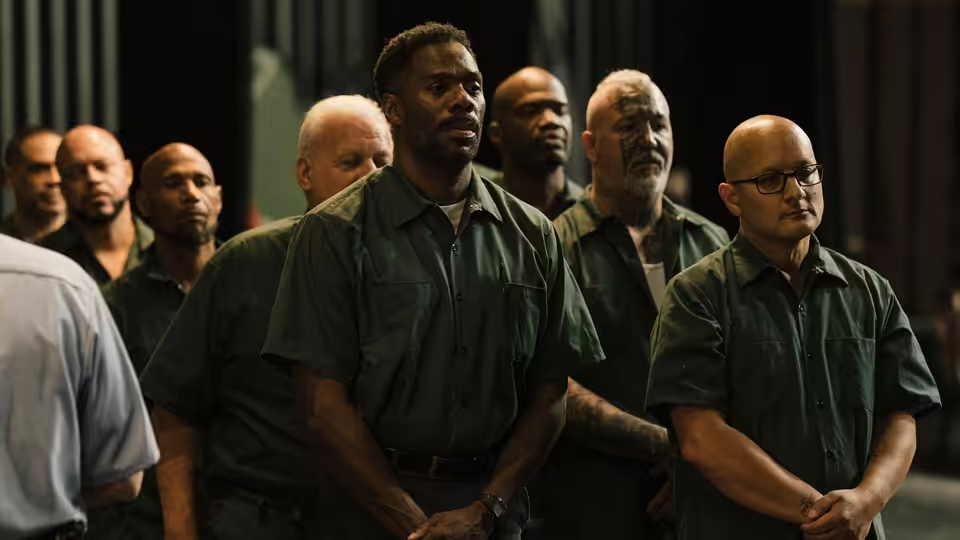
The film opens with Colman Domingo in a costume, on a stage, speaking Shakespeare to an audience we cannot see, and then cuts to him being locked back into a cell. That is the whole idea in two shots. John ‘Divine G’ Whitfield is in Sing Sing for a killing he maintains he did not commit, and while he waits for a clemency hearing he keeps himself upright by running the prison’s theatre group. Greg Kwedar directs from a screenplay he wrote with Clint Bentley, working from a story the two of them share with Whitfield and Divine Eye’ Maclin, who were both in the programme. Most of the faces on screen belong to men who have been through it too.
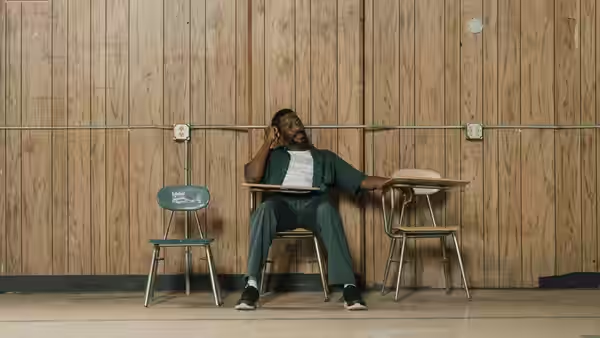
It is a very good film, and the reason is a decision Kwedar makes early and sticks to. The things prison films are usually about, the fights, the guards, the cell searches, happen at the edges of the frame or off it altogether. The camera stays in the rehearsal room, a bare hall with plastic chairs, and treats a man reading a line badly and then reading it better as an event worth our full attention. We were not sure this would hold for 107 minutes. It holds.
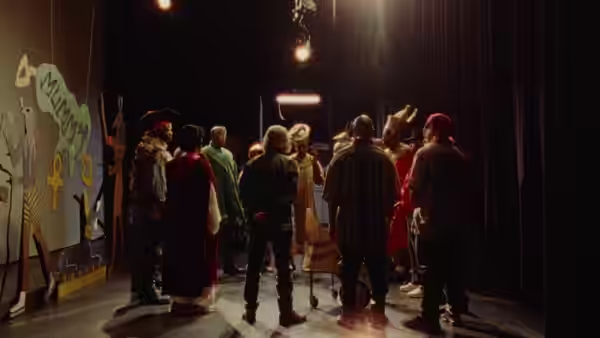
Pat Scola shoots close and handheld, in a soft grain, and rarely lets a face go until it has finished doing something. Ruta Kiskyte’s production design keeps the prison the colour of old paint and gives the group’s costume box the only bright things in the building. Desira Pesta dresses everyone in the same state-issue green until that box comes out, at which point grown men in cardboard armour become, briefly, the most vivid thing in the film. Bryce Dessner’s score is strings, used sparingly, and Parker Laramie cuts to the rhythm of the rehearsal rather than the script.
The scene that got us comes early. Brent Buell, the volunteer director played by Paul Raci, asks the men to close their eyes and describe somewhere they would rather be. One by one they do: a kitchen, a porch, a street. Scola holds on each face while the man speaks and Laramie does not cut away to anyone reacting. It moved us more than we expected, and what did it was not the words but the effort in the faces, men who have trained themselves for years to give nothing away, giving something away on purpose.
Divine Eye’ Maclin, playing Divine Eye, is the reason to see it. He arrives all shoulders and stare, treats the group as a soft option, and then is handed a Shakespeare speech and discovers he understands it. Maclin cannot be caught acting; there is no moment where you see him prepare. Domingo, beside him, is a professional among amateurs and it shows in both directions. He is generous, listening more than he speaks, and he has a breakdown scene late on that is technically superb. But you can see the technique, and once or twice we were watching an actor at work while the men around him were simply there. A minority of critics have made the same point and we think they are half right. Domingo is the film’s spine; Maclin is its pulse.
The plot outside the rehearsal room is where the film is weakest. Divine G’s clemency case is set up carefully and then handled in a hurry, and a development in the second half, which we will not describe, is dealt with in a couple of scenes when it needed a couple more. The play itself, an original comedy Buell writes for the group that jumps between periods and genres, is glimpsed rather than seen, and we wanted more of it. The film’s last movement reaches for a warmth it has mostly earned and slightly overreaches.
None of that spoiled it for us. Kwedar has made a prison film in which the tension is whether a man will say his lines in front of other men, and he has made that feel like a life-or-death matter, which for these men it more or less is. Buell himself appears in the cast. So do the Sing Sing walls, and the film does not pretend they go anywhere.
It is a 15 certificate and there is almost nothing in it a younger teenager could not watch; the rating is for language. See it with someone who thinks they know what a prison film is.