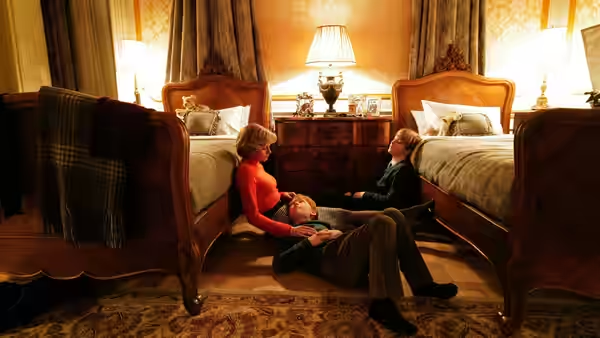
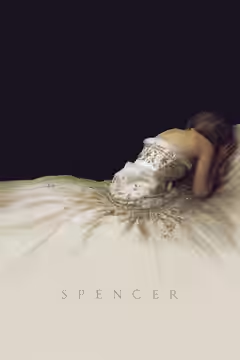
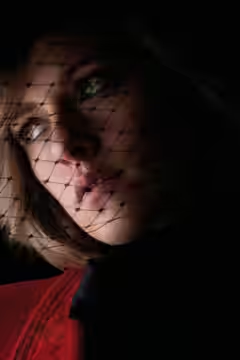
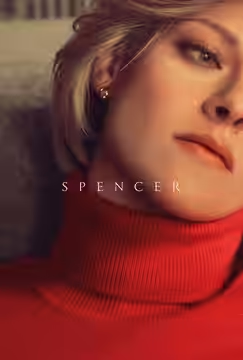
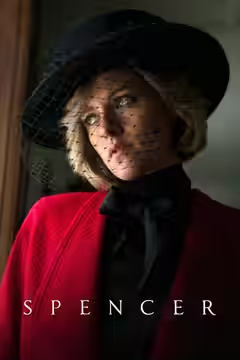
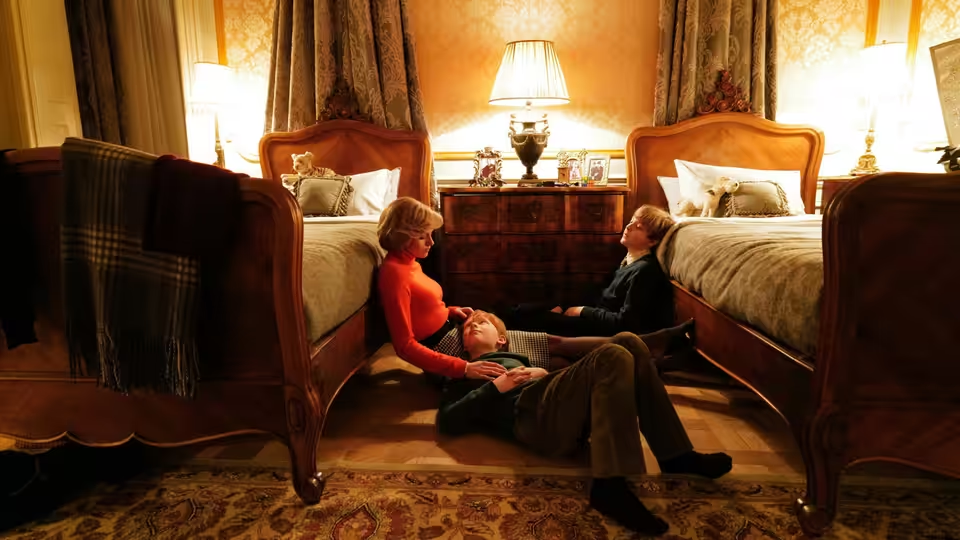
Diana (Kristen Stewart) sits on the floor between two beds with her sons
Film review

Spencer

2021 · Directed by Pablo Larraín · 1h 56m · MC 13+

In a sentenceChristmas with the in-laws, only the in-laws own the country and someone has sewn the curtains shut

Christmas Eve at Sandringham, the royal estate in Norfolk. Diana (Kristen Stewart) drives herself there alone, gets lost on roads she grew up on and arrives late. Major Alistair Gregorys (Timothy Spall), brought in to keep order, has the guests weighed on arrival, and the curtains in her room are soon sewn shut. Charles (Jack Farthing) gives her a set of pearls she believes he has also given someone else. Her dresser Maggie (Sally Hawkins) and the head chef Darren (Sean Harris) are the only people who talk to her plainly. She wants three days with William (Jack Nielen) and Harry (Freddie Spry) and then out; the house wants her on time, in the right dress and quiet. A book about Anne Boleyn has been left on her bed.

Plays from YouTube when you press play; nothing loads from them until then.

Fi1m review

Kristen Stewart is remarkable as Diana over three Christmas days at Sandringham, and Claire Mathon and Jonny Greenwood build her a proper haunted house. Steven Knight’s script keeps announcing what we can already see, and the one note wears thin.

Pablo Larraín opens with a title card calling this “a fable from a true tragedy”, which is a polite request that we not check the facts, and we are happy to oblige. Spencer takes three days at Sandringham, Christmas Eve to Boxing Day, and stages them as a horror film in which the monster is a timetable. Diana (Kristen Stewart) arrives late, is weighed in the hall, finds her dresses hung with cards saying which meal each is for, and spends the rest of the film looking for a room where nobody is listening. Larraín did something close to this with Jacqueline Kennedy in Jackie in 2016: one woman, a few days, the camera rarely more than an arm’s length from her face.

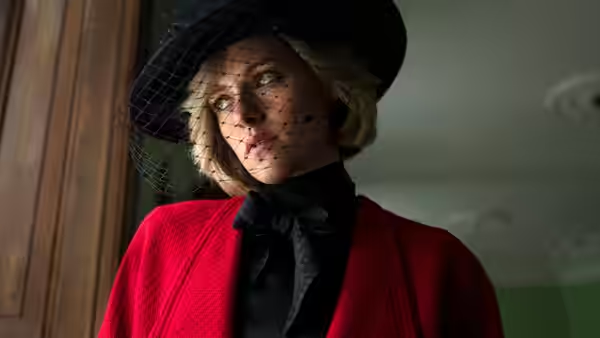
Stewart is good, and not in the way we expected. The tilted head and the upward glance are there, but she does not build the performance out of them. What she plays is a woman who can no longer tell which of her own gestures are hers and which were issued to her. Watch her in the corridor outside the dining room, getting her breathing under control before a door opens, or at the kitchen table with the head chef, Darren (Sean Harris), being allowed for a minute to talk like a person. The accent holds. The pauses are placed, not fumbled.

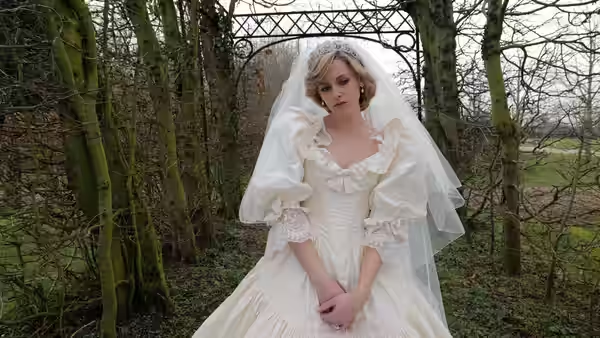
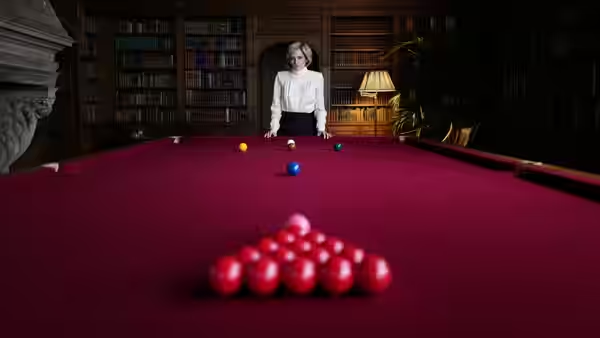
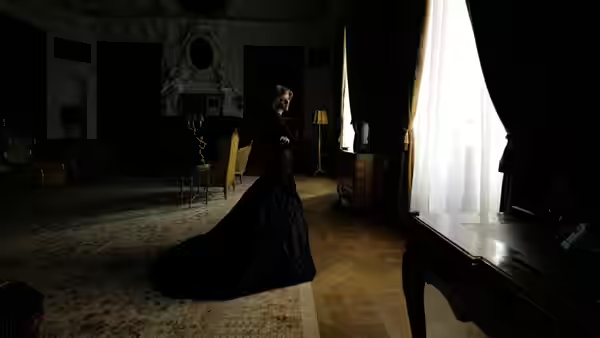
Claire Mathon shoots the house in soft, grainy light, as if there were always a little mist in the air, and keeps Stewart in close-up with ceilings and portraits crowding in behind her. Guy Hendrix Dyas gives Sandringham long corridors and cold reds, a house built to be walked through by staff. Jacqueline Durran’s costumes are the film’s neatest idea, because the schedule is hung on the rail with them: this dress for lunch, that one for church. Jonny Greenwood’s score sets a string quartet playing something stately until a jazz drummer barges in and the strings lose their place. It is the best thing in the film. Sebastián Sepúlveda cuts to it, letting a scene run long and then jumping without warning to a field or an empty stairwell.

The Christmas Eve dinner is where the film got at us. Diana sits at the long table with the family watching and cannot leave alone the pearls Charles (Jack Farthing) has given her, the same pearls, she believes, he has given someone else. What she does with them we will not describe, but Greenwood’s drums come up, Mathon holds on her mouth, and we flinched and kept flinching. It is the one scene where Larraín’s horror manners pay off completely. Nobody at the table reacts.

The trouble is Steven Knight’s script, which cannot leave anything unsaid. The Queen (Stella Gonet) tells Diana that the only portrait that matters is the one on the ten pound note. Charles explains that there have to be two of you, the real one and the one they photograph. Major Alistair Gregorys (Timothy Spall), brought in to run the house to the minute, delivers speeches about soldiers and duty that Spall does his best to make sound like a man talking. Each of these lines tells us something Mathon’s camera had already shown. Then there is Anne Boleyn (Amy Manson), who turns up first in a book left on Diana’s bed and then in the flesh, in case anyone had missed the point about a king who tired of his wife.

By the second day we were bored, and then irritated at being bored, because everything in front of us was made with such care. The film has one note, Diana suffering in a beautiful room, and it holds that note for 116 minutes. Only Harris and Sally Hawkins, as her dresser Maggie, are allowed to change the temperature. Hawkins is warm and quick in a handful of scenes and the film brightens every time she walks in. She does not walk in often enough.

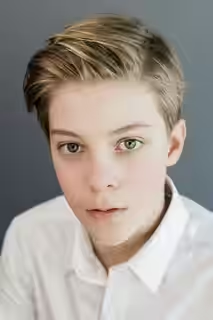
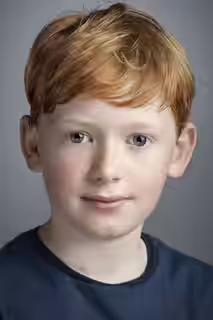
Against Larraín’s own standard it is a step down from Jackie, which used the same approach and had more to say with it. Against the usual British royal drama it is a relief: nobody defers and nobody explains the constitution. It is a 12A, and the scenes with William (Jack Nielen) and Harry (Freddie Spry), whispering with their mother under a blanket, are the gentlest thing in it.

Watch it alone if you can. It is a film about a woman who wants to be left by herself in a room, and it plays best to someone who already is.
Critical consensus AI synthesised

78
Positive
25
Mixed
5
Negative
0

Most critics like Spencer, and they like it for the same reason. Of the thirty reviews, twenty-five are positive and none negative, and the praise lands almost without exception on Kristen Stewart, whose Diana is described as precise, fragile and transformative. Many also admire Pablo Larraín’s decision to treat the royal household as a setting for gothic horror rather than a conventional biopic. Claire Mathon’s cinematography and Jonny Greenwood’s score are named repeatedly as the film’s other strengths.

The reservations cluster on the script. Several critics find the dialogue too on the nose and the ideas spelled out, and the Anne Boleyn metaphor and dream sequences are called heavy-handed. The New Yorker thinks the film unjust to the royals it invents accusations against, and Slant finds its handling of Diana’s mental health at times exploitative. The spread is narrow; the sharpest dissent comes from The AV Club, almost alone in finding Stewart’s performance a caricature of frazzled nerves.

Evening Standard
4 November 2021 · ★★★★★ · Charlotte O'Sullivan
100

O’Sullivan finds the film gripping and wrenching, praising its nuanced portrait that lets no one off the hook. She especially singles out Kristen Stewart’s subtle, uncannily precise performance as Diana.

Read the full review →
The Guardian
3 September 2021 · festival review · Xan Brooks
90*

Brooks finds the film magnificent, intoxicating and unreverential in its portrayal of royal life. He particularly praises Kristen Stewart’s compelling performance as Diana, trapped by the monarchy’s dress-up game.

Read the full review →
Variety
3 September 2021 · Critics Pick · Owen Gleiberman
85*

Gleiberman calls the film magnificent and at least as good as Jackie, praising Kristen Stewart’s transformative performance as Diana. He singles out the moment Diana stands up to her sons’ hunting as especially moving.

Read the full review →
Vulture
17 September 2021 · festival review · Alison Willmore
85*

Willmore finds the film a compelling, sympathetic portrait of Diana and her misery within royal life. She especially praises Kristen Stewart’s ability to capture Diana’s charisma while playing her suffering sincerely.

Read the full review →
Little White Lies
1 November 2021 · 3/4/2 · David Jenkins
80

Jenkins finds the film slow and inert, with a problematic, often witless script. He praises Kristen Stewart’s graceful performance and her expressive portrayal of Diana’s yearning for freedom.

Read the full review →
Radio Times
5 November 2021 · ★★★★ · Helen Daly
80

The review presents Spencer as a harrowing portrait of a marriage’s collapse and Diana’s troubled mind. It praises Kristen Stewart’s performance but says some aspects of the story need not have been shown.

Read the full review →

Straight answers AI written, from our review

Is Spencer worth watching?
Spencer is worth watching for anyone who wants a close, patient portrait of Diana over three Christmas days at Sandringham, and we scored it 73. Kristen Stewart is remarkable and Jonny Greenwood's score is the best thing in it, but Steven Knight's script keeps saying what the camera has already shown. Watch it alone if you can.
How long is Spencer, and what is it rated?
Spencer runs 1h 56m and is rated 13+ by the MC in Thailand. It is a drama film.
Where can I watch Spencer in Thailand?
Spencer is streaming on Netflix in Thailand. Availability is checked daily; the links above go straight to each service.
How violent or frightening is Spencer, and is it suitable for children?
Spencer is a UK 12A and contains no violence between people; what it has is dread, a house run to the minute and a woman in distress. The Christmas Eve dinner, with a string of pearls, made us flinch and keep flinching, and the film's one note is Diana suffering in a beautiful room. Older teenagers will be fine; younger children will be bored rather than frightened.
How does Spencer compare to Jackie?
Spencer is a step down from Jackie, which used the same method, one woman and a few days with the camera close on her face, and had more to say with it. Both films have a script that explains what we can already see, but Jackie holds its argument longer. Come to Spencer for Stewart and Greenwood; come to Jackie for the tighter film.
What should I watch after Spencer?
After Spencer, try Jackie (2016, Fi1m 80): Larraín’s first go at the same method, with a widow and more to say. Then Marie Antoinette (2006, Fi1m 74): Sofia Coppola’s bored queen in a gilded box; the shoes get more attention than the state; and Repulsion (1965, Fi1m 88): Polanski watches Catherine Deneuve come apart in a flat, one cracked wall at a time.

Cast

If you liked this, try…

  1. Jackie (2016, Fi1m 80)Larraín’s first go at the same method, with a widow and more to say.

  2. Marie Antoinette (2006, Fi1m 74)Sofia Coppola’s bored queen in a gilded box; the shoes get more attention than the state.

  3. Repulsion (1965, Fi1m 88)Polanski watches Catherine Deneuve come apart in a flat, one cracked wall at a time.

  4. Portrait of a Lady on Fire (2019, Fi1m 89)Claire Mathon’s camera on two women and a coastline, with nothing announced aloud.

  5. The Queen (2006, Fi1m 84)Frears on the same family from the other side of the door, the week Diana died.