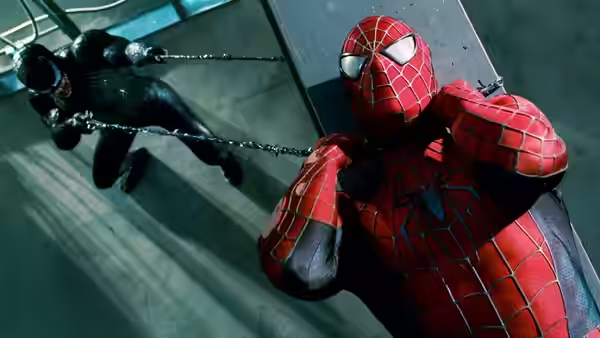
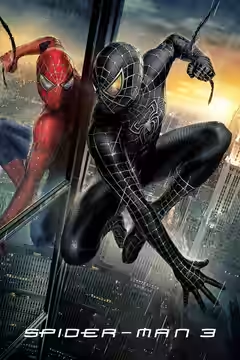
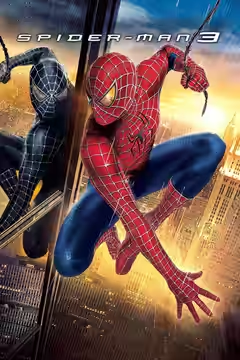
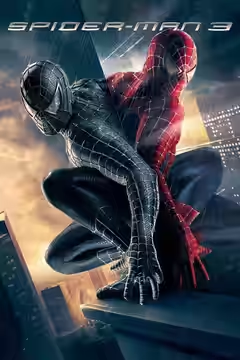
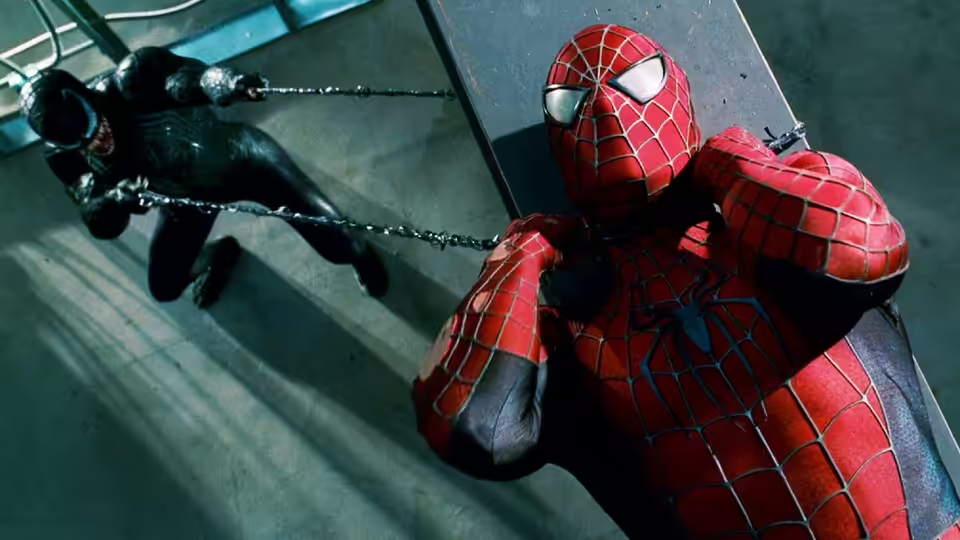
Spider-Man braces against a chain as a black-clad figure swings across a rooftop
Film review

Spider-Man 3

2007 · Directed by Sam Raimi · 2h 19m · MPA PG-13

In a sentenceThree villains, two Peter Parkers and one dance number; the dance number wins, and not in a good way

New York, and Peter Parker (Tobey Maguire) is having a good year. The city has taken to Spider-Man, Mary Jane Watson (Kirsten Dunst) is opening on Broadway, and Peter is carrying the engagement ring his aunt May (Rosemary Harris) gave him. Harry Osborn (James Franco) knows Peter’s secret, blames him for his father’s death and has his father’s glider. Flint Marko (Thomas Haden Church), a convict with a sick daughter, escapes prison and stumbles into a physics experiment that turns him to sand. A meteorite lands in Central Park beside Peter’s scooter, trailing something black and alive. At the Bugle, J. Jonah Jameson (J.K. Simmons) hires a rival photographer, Eddie Brock (Topher Grace), and lab partner Gwen Stacy (Bryce Dallas Howard) soon needs rescuing from a runaway crane.

Plays from YouTube when you press play; nothing loads from them until then.

Fi1m review

Sam Raimi’s third outing has one of the best scenes in the series, a man made of sand trying to pick up a locket, and then buries it under two more villains and a jazz-club dance. Worth it for Thomas Haden Church; brace for the rest.

Peter Parker (Tobey Maguire) begins Spider-Man 3 happy, and that is the first thing the film has to fix. The script, by Sam Raimi, Ivan Raimi and Alvin Sargent, sets about spoiling it from three directions at once: Harry Osborn (James Franco), who knows who Peter is and has his father’s equipment; Flint Marko (Thomas Haden Church), an escaped convict who wanders into a physics experiment; and a black, oily something that falls out of the sky in Central Park. That is a lot of trouble for one 139-minute film, and the film knows it.

The Marko strand is the one that works. Church plays him as a tired, decent man who has done an indecent thing for his sick daughter, and the scene in which he becomes the Sandman is the best in the picture. He wakes in a pit of sand, tries to stand and falls apart; then the sand gathers itself and reaches for a locket with her photograph, fails, and tries again. Bill Pope lights it in a flat grey half-light so you cannot tell where the man ends and the ground begins, and Christopher Young gives it a low, grieving theme with no brass in it at all. We were moved more than we expected to be, and we were moved by a pile of sand.

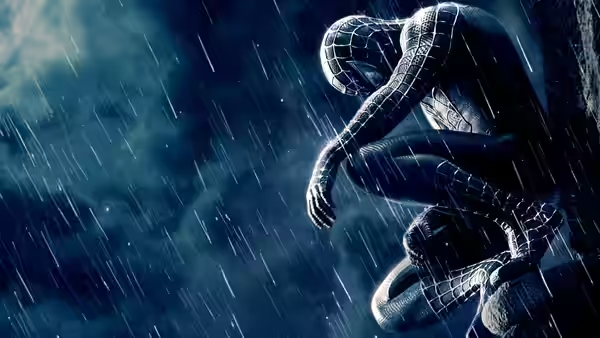
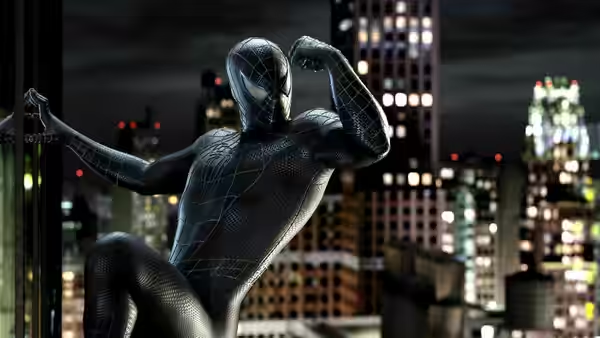
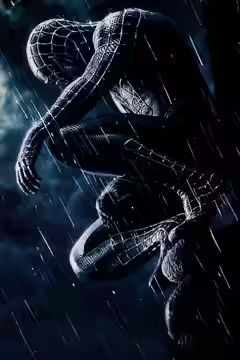
Then there is Peter in black. The suit, which James Acheson and Katina Le Kerr have given a raised webbing that looks grown rather than sewn, makes him stronger and nastier, and Raimi decides to play the nastiness as comedy. Peter gets a fringe, struts down a pavement pointing at women, and performs a dance number in a jazz club that goes on just past the point of being a joke. We laughed, then sat there unsure whether we had been meant to. Raimi has always liked slapstick. Here it sits inside a film asking, in the same breath, to be taken seriously about grief and revenge, and the two never agree on a tone.

Overcrowding does the rest of the damage. Franco has the best material after Church, a man who hates his oldest friend and keeps changing his mind about what to do about it, but his story is put down every time another needs picking up. Topher Grace’s Eddie Brock is a rival photographer at the Bugle, slippery and funny for two scenes and then a prop; what he becomes we will leave to the credits. Bryce Dallas Howard’s Gwen Stacy is Peter’s lab partner and exists so other people can see her with him. Dunst is given a bad week and asked to cry through it, and Mary Jane’s trouble is never as interesting as anyone else’s. Only J.K. Simmons, bellowing at a desk about his blood pressure, comes out exactly as he went in.

The action is handled with more care than the plot. Bob Murawski cuts the opening fight between Peter and Harry fast and low, through alleys and under fire escapes, so the camera is always a beat behind them, and the sequence in which a runaway crane takes the side off an office block is shot by Pope among the falling glass, with the fall itself held long enough to hurt. Neil Spisak and J. Michael Riva’s Manhattan is the same brownstone-and-newsroom city as before. The final fight is loud, everyone is in it, and it is the point at which we stopped minding who won.

Raimi’s previous film in the series had one villain, one problem and one idea, and it was better for the arithmetic. This one has three of each and the sums do not add up. Most critics landed where we have, split down the middle, and we understand the half that enjoyed it: there is a decent two-hour film in here about a man made of sand and a boy who misses his father.

See it for Church, who gives the series its saddest villain and gets about twenty minutes to do it in. For the rest, keep the remote within reach; the dance number is shorter than it feels, but only just.

Critical consensus AI synthesised

54
Positive
5
Mixed
4
Negative
6

The reviews split almost evenly, and few critics are indifferent. Where they agree is on the Sandman. Thomas Haden Church’s performance and the scene of his transformation are named as the film’s best moments across the whole spread, from the warmest notices to the coldest. The visual effects are admired nearly everywhere, and several reviews single out the aerial fights, the skyscraper battle in particular, as the action done well.

The reservations cluster on crowding. Most critics find the film overstuffed, with too many villains, too much plot and a slapstick streak from Raimi that sits awkwardly beside the serious scenes. The spread is wide: Total Film and /Film call it a satisfying finale, while The New Yorker and Eye for Film find it chaotic and thin. Time Out is the lone dissenter on length, enjoying the sprawl as something like a television season in a box.

Time Out
1 May 2007 · ★★★★ · Ben Walters
80

The review finds the film’s sprawling length oddly enjoyable, like watching a season of television in a box set. It singles out that expansive, episodic feel as a positive.

Read the full review →
Total Film
4 May 2007 · ★★★★ · Total Film
80

The critic finds it a hugely entertaining, deftly handled finale, despite its lack of the expected darkness. They praise Thomas Haden Church’s sympathetic performance and the thrilling final action set-piece.

Read the full review →
The Hollywood Reporter
21 April 2007 · Michael Rechtshaffen
75*

The review finds the film entertaining and likely to please fans, though it is less tightly executed than its predecessor. It especially praises the spectacular visual-effects sequences and the performances of Thomas Haden Church and Topher Grace.

Read the full review →
The AV Club
2 May 2007 · B- · Noel Murray
70

Murray finds the film a letdown despite its superb action and weighty theme. He praises the aerial action but faults Raimi’s overdone slapstick and scenes of serious conversation.

Read the full review →
Empire
27 April 2007 · Chris Hewitt
65*

The critic finds the film consistently enjoyable but overstuffed, and says it falls short of completing the trilogy on a high note. They praise Tobey Maguire’s performance and the emotional intensity of Peter’s relationship with Mary Jane.

Read the full review →
The Guardian
15 October 2007 · Rob Mackie
65*

Mackie finds the film overlong and less charming than its predecessor, but still an enjoyable thrill-ride. He praises the performances of Thomas Haden Church and Bryce Dallas Howard, while finding the villains less compelling.

Read the full review →

Straight answers AI written, from our review

Is Spider-Man 3 worth watching?
Spider-Man 3 is worth watching for Thomas Haden Church's Sandman and not much else, and we scored it 55. Three villains, a jazz-club dance number and 139 crowded minutes smother the one strand that works, a tired convict trying to pick up his daughter's locket. Fans of the first two films who can forgive a lot will get an evening out of it; anyone else should start elsewhere.
How long is Spider-Man 3, and what is it rated?
Spider-Man 3 runs 2h 19m and is rated PG-13 by the MPA in the US. It is an action and adventure film.
Where can I watch Spider-Man 3 in the US?
Spider-Man 3 is streaming on Hulu and Disney+ in the US, and it is also available to rent from Amazon Prime Video from $3.99. It leaves Hulu on 1 October. Availability is checked daily; the links above go straight to each service.
How violent or frightening is Spider-Man 3, and is it suitable for children?
Spider-Man 3 is a 12A, with comic-book fights, a runaway crane that takes the side off an office block, and no blood to speak of. The Sandman's transformation is sad rather than frightening, and Peter in the black suit is nasty and strutting rather than scary. Children of ten or so should be fine; the youngest may find the crane sequence and the loud final fight too much.
How does Spider-Man 3 compare to Spider-Man: Into the Spider-Verse?
Spider-Man 3 is the weaker of the two: Spider-Man: Into the Spider-Verse is funnier, better written and puts several Spider-Men on screen without feeling crowded, where Raimi's film sinks under three villains. The animated film is the one we would choose for most evenings, with a small caveat that its busiest action sometimes loses the people in it. Pick Spider-Man 3 only for live action and Church's Sandman.

Cast

If you liked this, try…

  1. Spider-Man 2 (2004) · not on Fi1m yetThe one before, with one villain, one problem and a train, and all the better for it.

  2. Spider-Man: Into the Spider-Verse (2018, Fi1m 87)Several Spider-Men at once and somehow not a crowd; the sharpest script the character has had.

  3. Darkman (1990) · not on Fi1m yetRaimi’s own disfigured hero, made cheap and angry, with the slapstick and the grief in balance.

  4. Superman II (1980) · not on Fi1m yetA hero gives up his powers for a woman and learns what that costs, in under two hours.

  5. The Heroic Trio (1993) · not on Fi1m yetHong Kong superheroines, wire work and real melancholy; proof that excess can be disciplined.