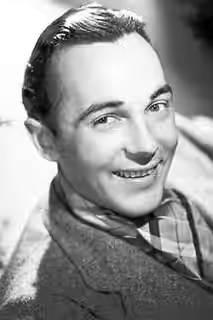
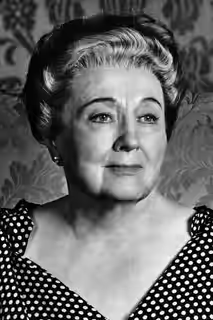
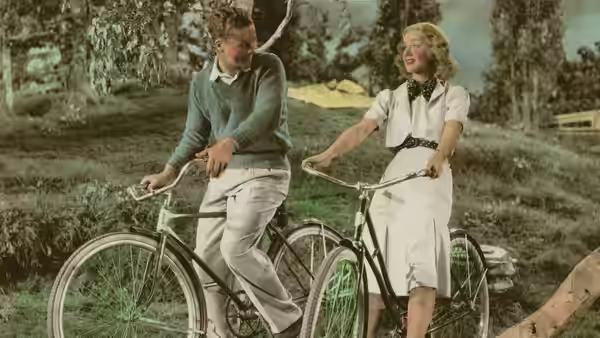
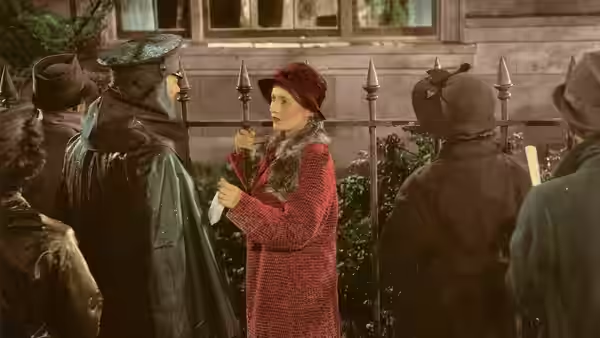
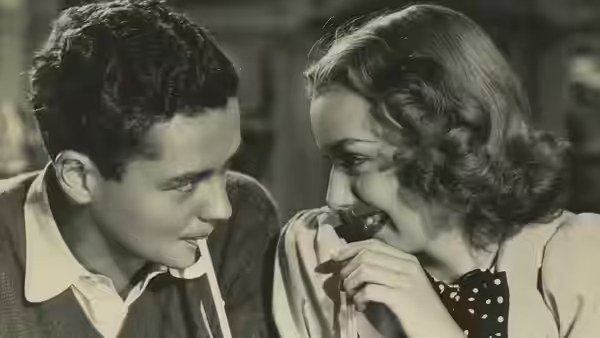
Laurel Dallas (Anne Shirley) and Richard Grosvenor (Tim Holt) ride bicycles together
Film review

Stella Dallas

1937 · Directed by King Vidor · 1h 46m

In a sentenceBarbara Stanwyck makes the tears respectable, even when the wardrobe department gets carried away

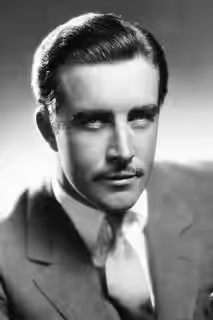
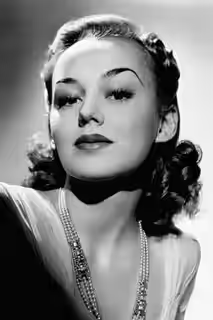
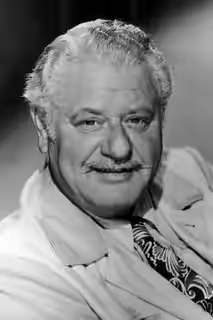
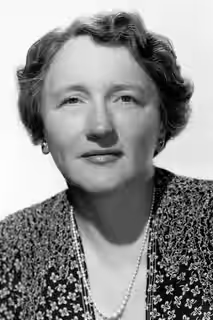
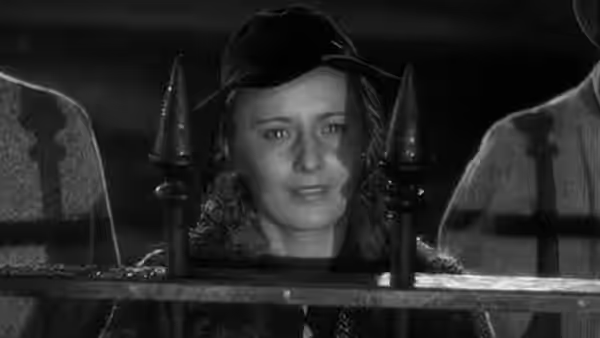
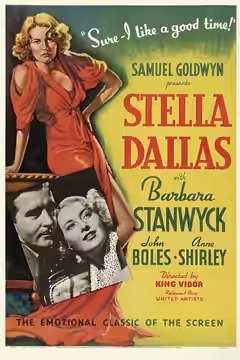
Stella Dallas (Barbara Stanwyck) is at the centre of this drama, alongside Stephen Dallas (John Boles) and Laurel “Lollie” Dallas (Anne Shirley). Their story also involves Helen Morrison (Barbara O’Neil), Ed Munn (Alan Hale) and Mrs. Martin (Marjorie Main). Adapted from Olive Higgins Prouty’s novel by Victor Heerman and Sarah Y. Mason, the film brings together drama and romance under the direction of King Vidor. Its approach is sentimental, with the emphasis on Stella and Laurel and the emotions conveyed through their performances.

Plays from YouTube when you press play; nothing loads from them until then.

Fi1m review

Barbara Stanwyck and Anne Shirley make Stella Dallas worth surrendering to. King Vidor’s sentimental drama sometimes presses too hard, particularly through its costumes, but the performances give its emotional demands weight.

Stella Dallas is a persuasive argument for giving a sentimental film a fair hearing. King Vidor wants to move us, and there is nothing coy about the invitation. We recommend it for Barbara Stanwyck and Anne Shirley, whose performances make that invitation difficult to refuse. The reservation is equally plain: the film sometimes insists on an emotion that its actors have already made clear, and the insistence can interrupt our involvement.

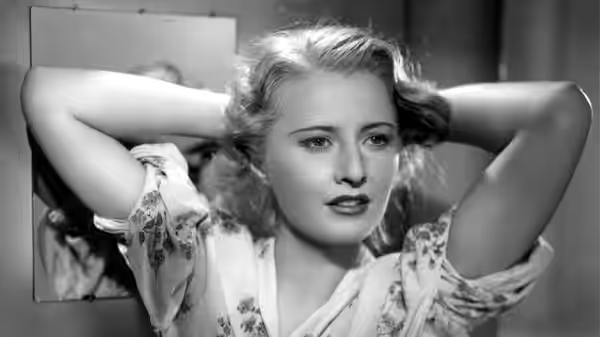
Stanwyck plays Stella Dallas with enough conviction to make the prospect of a tear-jerker considerably less alarming. The pleasure is in taking the character seriously rather than waiting for the next opportunity to feel sorry for her. We were moved by Stanwyck and Shirley together; their performances give the sentiment a human credibility that the more emphatic presentation occasionally threatens. That distinction matters, because a film asking for this much sympathy needs people worth attending to between its emotional appeals.

Shirley, as Laurel “Lollie” Dallas, deserves more than a supporting mention in the praise for Stanwyck. Her contribution is essential to the film’s ability to sustain feeling without making every moment seem like preparation for tears. There is a temptation with a performance as celebrated as Stanwyck’s to describe everyone else as useful assistance. Here that would badly undervalue Shirley, whose work gives us another person to care about, with an importance of her own.

The screenplay by Victor Heerman and Sarah Y. Mason, adapted from Olive Higgins Prouty’s novel, accepts sentimentality without embarrassment. That is largely to its credit: the film would be tiresome if it kept apologising for wanting an emotional response. Yet accepting the approach does not mean accepting every application of pressure. The strongest reason to stay with it is the acting, and there are stretches when we wish the presentation would place a little more confidence in that.

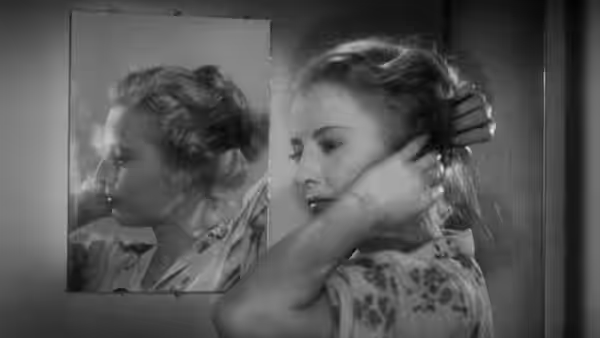
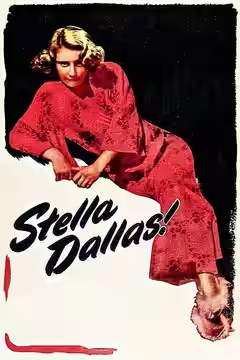
Omar Kiam’s costume design supplies the clearest reservation. The excess can make Stella seem too heavily labelled, as though the clothes must settle our judgement before Stanwyck has had her say. We found that distracting because the performance needs no such assistance. Costumes have a legitimate dramatic job, but there is a point at which making a character immediately readable becomes a restriction on the actor wearing them.

Rudolph Maté is the cinematographer, Sherman Todd the editor and Alfred Newman the composer. In judging their contributions here, the useful question is how much room the film gives the performances, rather than how much attention the photography, cutting or music can attract individually. Our reservation about the film’s emphasis should not obscure how consistently it holds attention. Nor should that effectiveness excuse the moments when the emotional prompting feels unnecessary: Stanwyck and Shirley have already earned our interest.

Within the tear-jerker’s familiar demands, Vidor achieves something substantial by allowing these performances such importance. The sentiment will remain a barrier for some, and affection for Stanwyck will not make the costumes less insistent. But the film earns more of its tears than it demands on credit. Give it an evening when being moved sounds like a reasonable use of the time, and do not mistake a willingness to cry for a failure of judgement.


Critical consensus AI synthesised

72
Positive
4
Mixed
2
Negative
0

Most critics respond warmly to Stella Dallas, with praise clustering around the performances rather than the story. Barbara Stanwyck draws repeated approval, while Anne Shirley also receives strong notices for her work alongside her. King Vidor’s direction earns praise too, and the favourable reviews find the film’s emotional appeal persuasive. Empire gives that enthusiasm a broader context, treating the film as an important precursor to more searching psychological dramas about women.

The reservations concern how readily viewers accept the sentimentality and, in one case, how the central character is presented. The New Yorker’s recommendation depends on a tolerance for sentiment, while Variety finds the tear-jerking effective and the story restrained, but objects to Stanwyck’s excessive costuming in later scenes. The recorded scores occupy a fairly narrow range, with no outright negative verdict, though some of the available review material is partial.

Radio Times
★★★★ · Tony Sloman
80

Sloman argues that Barbara Stanwyck deserved an Oscar for her performance. He singles out her work as magnificent and calls this the definitive screen version of the story.

Read the full review →
Empire
27 June 2006 · David Parkinson
75*

Parkinson finds the film fascinating and an important precursor to deeper female psychological dramas. He praises the sterling performances of Barbara Stanwyck and Anne Shirley.

Read the full review →
The New Yorker
23 July 1937 · Russell Maloney
75*

Maloney recommends the film to viewers who can accept its sentimentality, calling it a satisfying production. He praises King Vidor’s direction and singles out Anne Shirley’s performance as nearly perfect.

Read the full review →
Time Out
· SJo
70*

The available description suggests a positive verdict. It singles out Barbara Stanwyck’s performance as wonderful.

Read the full review →
Variety
31 December 1936 · Variety Staff
65*

The critic regards the film as an effective, high-grade tear-jerker, while noting that its story is not overdone. They praise several emotionally powerful scenes but fault Barbara Stanwyck’s excessive costuming in the later scenes.

Read the full review →
The New York Times
6 August 1937
64*

The available page does not reveal the critic’s verdict. It provides no specific praise or complaint to report.

Read the full review →

Straight answers AI written, from our review

Is Stella Dallas worth watching?
Stella Dallas is worth watching for Barbara Stanwyck and Anne Shirley’s moving performances, and we score it 80 out of 100. We recommend it to anyone receptive to sentimental drama, with one reservation: the emotional prompting, particularly through the costumes, sometimes presses harder than the acting needs.
How long is Stella Dallas, and what is it rated?
Stella Dallas runs 1h 46m. It is a drama and romance film.
Where can I watch Stella Dallas in Greece?
Stella Dallas is not on any streaming or rental service in Greece at the moment. It is available in 5 other countries; change your country at the top of the page to see where. Availability is checked daily.
How does Stella Dallas compare to Imitation of Life?
Stella Dallas offers more consistently persuasive central performances than Imitation of Life, though both make maternal feeling painfully vulnerable to social judgement. We favour Stanwyck and Shirley’s drama for its acting; the sharper appeal of Imitation of Life lies in Juanita Moore and Susan Kohner’s story beneath the glossy, thinner Broadway weepie.
Is Stella Dallas based on a true story or a book?
Stella Dallas is adapted from Olive Higgins Prouty’s novel, with a screenplay by Victor Heerman and Sarah Y. Mason, rather than presented as a true story. We cannot judge its fidelity to the book, but no prior reading is needed: Stanwyck and Shirley’s performances make its emotional concerns clear.
What should I watch after Stella Dallas?
After Stella Dallas, try Imitation of Life (1959, Fi1m 86): Another melodrama in which maternal feeling makes social judgement painfully personal. Then Late Spring (1949, Fi1m 92): For family affection expressed more quietly, with no less emotional force; and Secrets & Lies (1996, Fi1m 88): Family embarrassment and longing, carried by performances that resist easy judgement.

Cast

Awards

Academy Awards, 1938

Nominated
Best Actress
Nominated
Best Supporting Actress

If you liked this, try…

  1. Imitation of Life (1959, Fi1m 86)Another melodrama in which maternal feeling makes social judgement painfully personal.

  2. Late Spring (1949, Fi1m 92)For family affection expressed more quietly, with no less emotional force.

  3. All That Heaven Allows (1955) · not on Fi1m yetFor another woman whose neighbours consider her happiness their business.

  4. Secrets & Lies (1996, Fi1m 88)Family embarrassment and longing, carried by performances that resist easy judgement.

  5. The Earrings of Madame de... (1953) · not on Fi1m yetClothes, possessions and social appearances become matters of painful emotional consequence.