Mamoru Hosoda runs a family reunion and a cyber-war side by side, and the reunion wins. The old house, the quarrelling relatives and Sumiko Fuji’s matriarch are the film; the battle inside OZ is louder, brighter and thinner, and it only occasionally gets in the way.
Mamoru Hosoda, three years after The Girl Who Leapt Through Time, has made two films and stapled them together with some care. One is a family comedy about a dozen relatives descending on an old house in Ueda for a great-grandmother’s ninetieth birthday. The other is a disaster film about a rogue program eating a virtual world called OZ, through which Japan does its shopping, its banking and, it turns out, its traffic lights. Satoko Okudera’s screenplay keeps the two in the same room for 114 minutes, and the trick mostly holds. It is a good film with a thin villain, and the family half is good enough to carry the rest.
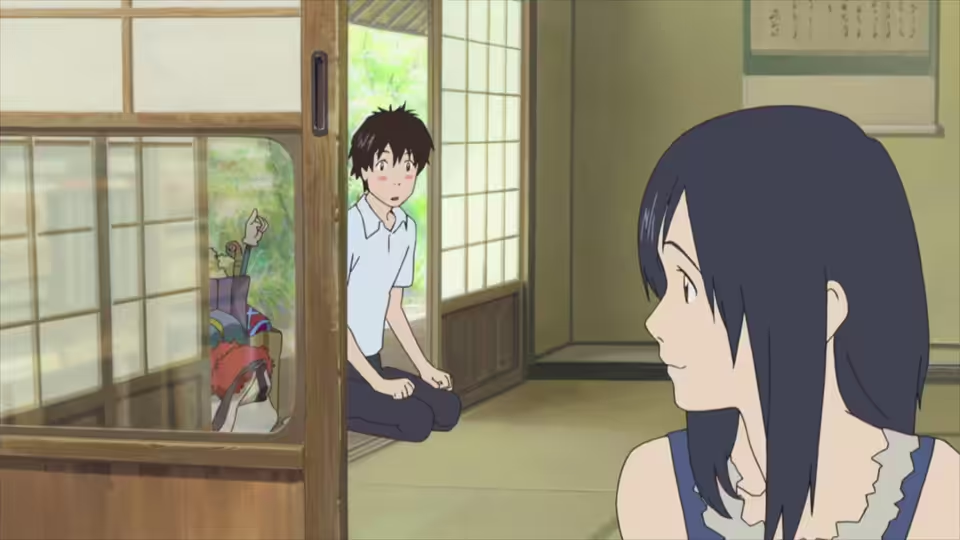
The house is where Hosoda does his best work. Yukihiro Masumoto lights it in the flat white of high summer, with deep shade under the eaves and the greens outside so bright they hurt, and when the relatives sit down to eat the frame is crammed edge to edge with elbows and rice bowls. Nobody is introduced. Uncles argue about the baseball on the television, aunts shuttle plates, children run the corridors, and for twenty minutes we had no idea who was married to whom. That is how arriving at someone else’s family reunion feels, and Hosoda is right to trust us with it.
Sumiko Fuji’s Sakae is the centre of it, a ninety-year-old who plays cards for money and is not to be lied to. The scene we will remember is hers: the morning after OZ falls over, with the news full of stalled trains and dead phone lines, she sits down at a black rotary telephone and rings everyone she has ever known, a doctor, a fire chief, a politician, and tells each of them plainly to get up and do their job. Fuji plays it without a tremble. It moved us a good deal more than an old woman on a telephone ought to, and the reason is that the film has already spent half an hour showing us how many people in that house owe her something.
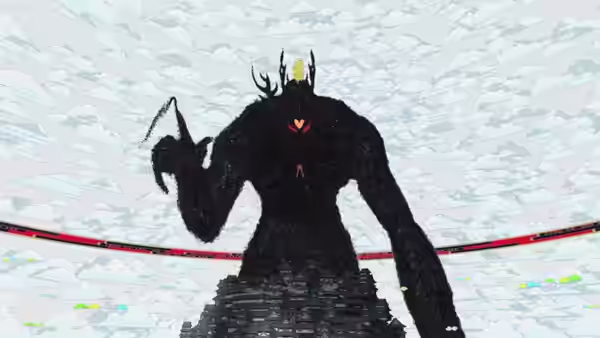
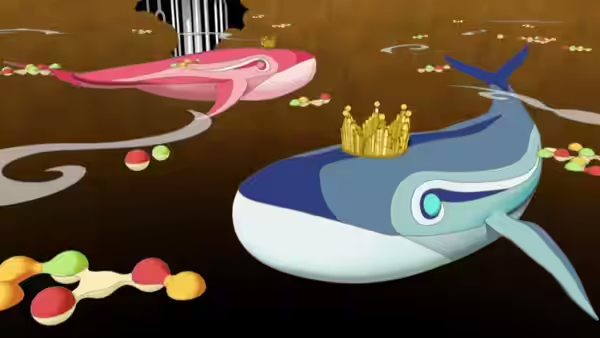
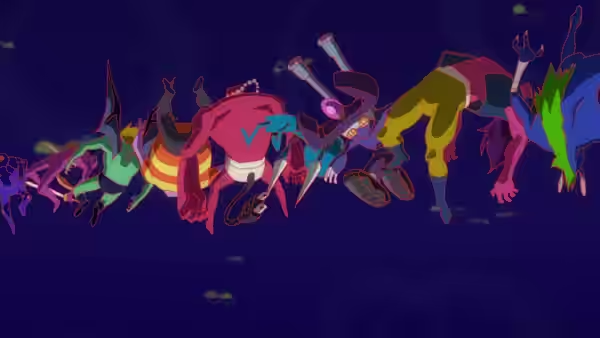
The trouble is in OZ. Hosoda draws it as a white void full of candy-coloured avatars, clean and easy to read, and for a while it is a pleasure to look at. The villain who takes it over, though, is a grinning doll’s head on a body of stolen accounts, and it wants nothing we can understand. It eats, it grows, it sets a countdown. Kazuma Ikezawa (Mitsuki Tanimura), the cousin who fights inside OZ as a boxing rabbit called King Kazma, gets several bouts with it, and the later ones are the first one again, bigger. Akihiko Matsumoto’s score answers each of them with brass and a choir, and by the last it is shouting at us.
The final half hour piles up deadlines, a satellite, a clock, one more fight, and Kenji Koiso (Ryunosuke Kamiki), the shy maths prodigy who followed Natsuki (Nanami Sakuraba) into all this, is asked to beat a supercomputer at arithmetic with a pencil. We did not believe it and we did not much mind, because Shigeru Nishiyama’s cutting keeps returning to the house, where the real stakes are, and because by then the film has earned a little nonsense. What it has not earned is the pace of those last scenes, which rush three endings into the space of one.
Set against Hosoda’s own record, the house is the part that lasts. Wolf Children (2012) and Mirai (2018) are family films with hardly any spectacle in them; Summer Wars is where he worked out which half he was better at.
It is a 12, it runs 114 minutes, and it suits a sofa with children who can keep up with subtitles, because the dinner scenes read better small and the OZ fights lose little. Expect to cry once and roll your eyes once, in that order.