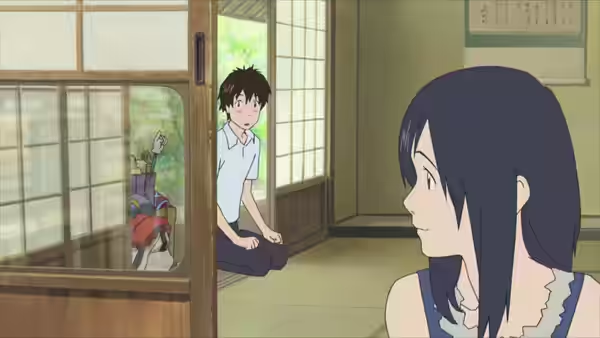
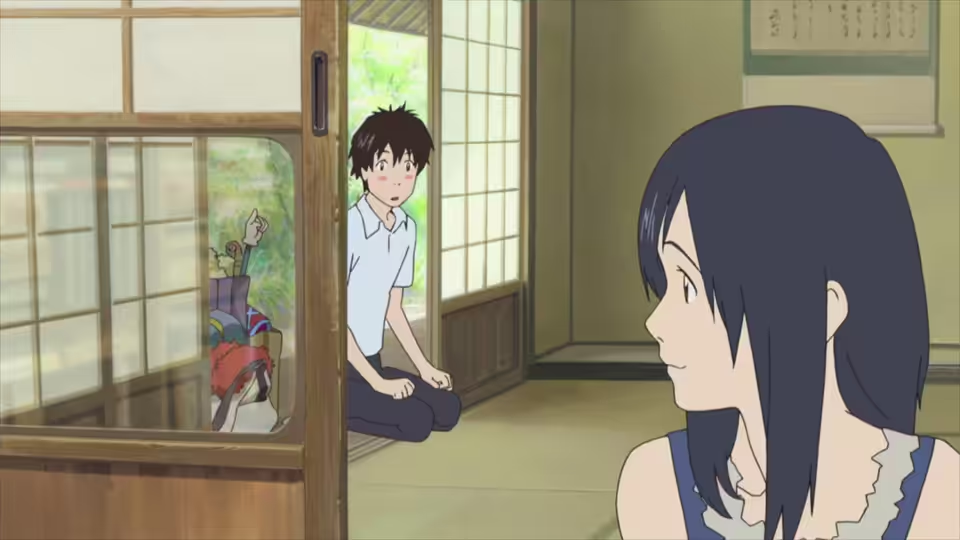
Kenji sits in a doorway behind Natsuki inside a traditional Japanese house
Film review

Summer Wars

2009 · Directed by Mamoru Hosoda · 1h 54m

In a sentenceA rogue AI declares war on Japan and the most dangerous thing in the house is a ninety-year-old with a rotary telephone

Kenji Koiso (Ryunosuke Kamiki), a shy teenage maths prodigy who missed the national team by one place, is spending the summer as a junior moderator of OZ, the virtual world that Japan runs its daily life through. Natsuki Shinohara (Nanami Sakuraba), an older girl he barely knows, hires him to come to her family’s old house in Ueda and pose as her fiancé at the ninetieth birthday of her great-grandmother, Sakae Jinnouchi (Sumiko Fuji). The relatives pour in, among them Kazuma Ikezawa (Mitsuki Tanimura), a cousin glued to his screen. That night Kenji’s phone receives a long string of digits and he solves it before bed. By morning his avatar has been hijacked, OZ is in chaos, and his face is on the news as the culprit.

Plays from YouTube when you press play; nothing loads from them until then.

Fi1m review

Mamoru Hosoda runs a family reunion and a cyber-war side by side, and the reunion wins. The old house, the quarrelling relatives and Sumiko Fuji’s matriarch are the film; the battle inside OZ is louder, brighter and thinner, and it only occasionally gets in the way.

Mamoru Hosoda, three years after The Girl Who Leapt Through Time, has made two films and stapled them together with some care. One is a family comedy about a dozen relatives descending on an old house in Ueda for a great-grandmother’s ninetieth birthday. The other is a disaster film about a rogue program eating a virtual world called OZ, through which Japan does its shopping, its banking and, it turns out, its traffic lights. Satoko Okudera’s screenplay keeps the two in the same room for 114 minutes, and the trick mostly holds. It is a good film with a thin villain, and the family half is good enough to carry the rest.

The house is where Hosoda does his best work. Yukihiro Masumoto lights it in the flat white of high summer, with deep shade under the eaves and the greens outside so bright they hurt, and when the relatives sit down to eat the frame is crammed edge to edge with elbows and rice bowls. Nobody is introduced. Uncles argue about the baseball on the television, aunts shuttle plates, children run the corridors, and for twenty minutes we had no idea who was married to whom. That is how arriving at someone else’s family reunion feels, and Hosoda is right to trust us with it.

Sumiko Fuji’s Sakae is the centre of it, a ninety-year-old who plays cards for money and is not to be lied to. The scene we will remember is hers: the morning after OZ falls over, with the news full of stalled trains and dead phone lines, she sits down at a black rotary telephone and rings everyone she has ever known, a doctor, a fire chief, a politician, and tells each of them plainly to get up and do their job. Fuji plays it without a tremble. It moved us a good deal more than an old woman on a telephone ought to, and the reason is that the film has already spent half an hour showing us how many people in that house owe her something.

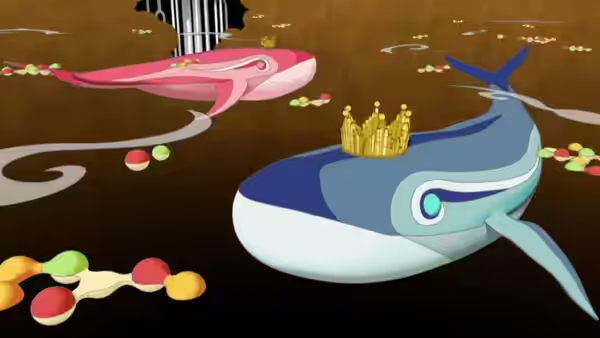
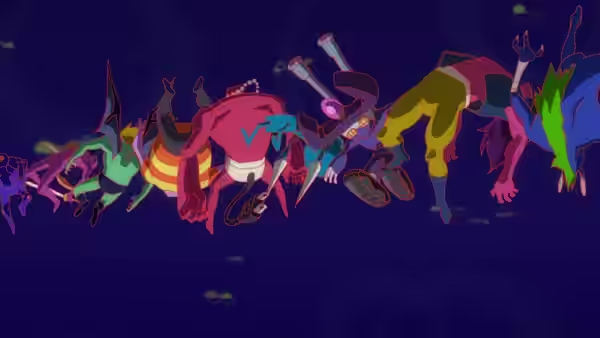
The trouble is in OZ. Hosoda draws it as a white void full of candy-coloured avatars, clean and easy to read, and for a while it is a pleasure to look at. The villain who takes it over, though, is a grinning doll’s head on a body of stolen accounts, and it wants nothing we can understand. It eats, it grows, it sets a countdown. Kazuma Ikezawa (Mitsuki Tanimura), the cousin who fights inside OZ as a boxing rabbit called King Kazma, gets several bouts with it, and the later ones are the first one again, bigger. Akihiko Matsumoto’s score answers each of them with brass and a choir, and by the last it is shouting at us.

The final half hour piles up deadlines, a satellite, a clock, one more fight, and Kenji Koiso (Ryunosuke Kamiki), the shy maths prodigy who followed Natsuki (Nanami Sakuraba) into all this, is asked to beat a supercomputer at arithmetic with a pencil. We did not believe it and we did not much mind, because Shigeru Nishiyama’s cutting keeps returning to the house, where the real stakes are, and because by then the film has earned a little nonsense. What it has not earned is the pace of those last scenes, which rush three endings into the space of one.

Set against Hosoda’s own record, the house is the part that lasts. Wolf Children (2012) and Mirai (2018) are family films with hardly any spectacle in them; Summer Wars is where he worked out which half he was better at.

It is a 12, it runs 114 minutes, and it suits a sofa with children who can keep up with subtitles, because the dinner scenes read better small and the OZ fights lose little. Expect to cry once and roll your eyes once, in that order.

Critical consensus AI synthesised

72
Positive
6
Mixed
2
Negative
0

Most critics like Summer Wars, and the reviews are consistently warm without tipping into raves. The praise clusters on two things: the look of Oz, the virtual world, where the blend of hand-drawn and computer animation is admired almost across the board, and the family story at the film’s centre, which several critics say grounds the spectacle and supplies its feeling. The extended family reunion and the communal Hanafuda match are singled out more often than any set piece in the digital world.

The reservations are about the plot rather than the heart. The Hollywood Reporter finds it convoluted, The Guardian thinks the finale rushed and the AI conflict increasingly weightless, and Variety wonders whether its distinctly Japanese details travel abroad. Slant is the most reserved, at three stars, though its complaints are mostly about the disc rather than the film. The spread is narrow: nobody is hostile, and the two mixed notices still find plenty to admire.

Los Angeles Times
6 January 2011 · Kevin Thomas
80*

Thomas praises the film as sophisticated, poignant family entertainment that balances science-fiction fantasy with a celebration of family. He singles out the detailed visuals of Oz and the well-drawn family reunion.

Read the full review →
Time Out
21 December 2010 · ★★★★ · Nick Schager
80

Schager gives the anime saga a strong endorsement, saying it often surpasses its spiritual predecessor. He highlights its sly homage and the way online conflict has real-world consequences.

Read the full review →
The Guardian
28 July 2025 · Phil Hoad
70*

Hoad finds the film impressive overall, though its finale feels rushed and its AI conflict increasingly inconsequential. He praises its layered storytelling and vivid imagery, especially the delicate scene of flowers blooming at night.

Read the full review →
The Hollywood Reporter
4 January 2011 · Frank Scheck
70*

Scheck finds the film overly convoluted but ultimately rewarding for its thematic ambition. He especially praises its dazzling blend of hand-drawn and CGI visuals.

Read the full review →
Variety
13 June 2010 · festival review · Peter Debruge
70*

Debruge finds the anime spectacular and surprisingly moving, though its cultural specificity may limit its staying power and appeal abroad. He especially praises the emotional family story, which gives the sci-fi spectacle deeper grounding.

Read the full review →
The New York Times
29 December 2010
65*

The article text is unavailable, so the critic’s verdict and specific praise or complaint cannot be verified. The page appears to be a review of Mamoru Hosoda’s film.

Read the full review →

Straight answers AI written, from our review

Is Summer Wars worth watching?
Summer Wars is worth watching, and we scored it 77. The family reunion in the old house in Ueda, with Sumiko Fuji's ninety-year-old matriarch at its centre, is the part that lasts; the battle inside the virtual world OZ is louder and thinner, with a villain that wants nothing we can understand. Expect to cry once and roll your eyes once, in that order.

How long is Summer Wars, and what is it rated?
Summer Wars runs 1h 54m. It is an animation and science fiction film.
Where can I watch Summer Wars in Romania?
Summer Wars is not on any streaming or rental service in Romania at the moment. It is available in 14 other countries; change your country at the top of the page to see where. Availability is checked daily.
How violent or frightening is Summer Wars, and is it suitable for children?
Summer Wars is a 12A in the UK and PG in the US, and its fights are cartoon bouts in a bright white virtual world rather than anything bloody. The rogue program is a grinning doll's head that eats accounts and sets a countdown, which may unsettle younger children, and the plot turns on stalled trains and dead phone lines. It suits a sofa with children who can keep up with subtitles.
How does Summer Wars compare to Paprika?
Summer Wars is the warmer and more coherent film, while Paprika is the stranger and finer to look at. Both are anime in which another world leaks into this one, but Hosoda's strength is a crowded family dinner and Kon's is the dream imagery, which his plot never quite keeps up with. Choose Summer Wars for a family evening and Paprika when you have patience to spare.
What should I watch after Summer Wars?
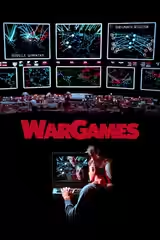
After Summer Wars, try Paprika (2006, Fi1m 80): Satoshi Kon’s shared-dream thriller; another anime in which the other world leaks into this one. Then WarGames (1983, Fi1m 82): A teenage hacker, a computer that wants to play, and a countdown that still works.

Cast

Awards

Annecy Cristal for a Feature Film, 2010

Nominated
Annecy Cristal for a Feature Film

Japan Academy Prize for Animation of the Year, 2010

Won
Japan Academy Prize for Animation of the Year

Mainichi Film Award for Best Animation Film, 2010

Nominated
Mainichi Film Award for Best Animation Film

Asia Pacific Screen Award for Best Animated Feature Film, 2009

Nominated
Asia Pacific Screen Award for Best Animated Feature Film

Golden Leopard, 2009

Nominated
Golden Leopard

If you liked this, try…

  1. The Girl Who Leapt Through Time (2006) · not reviewed yetHosoda’s previous film; the same summer light, one girl, and far less to blow up.

  2. Paprika (2006, Fi1m 80)Satoshi Kon’s shared-dream thriller; another anime in which the other world leaks into this one.

  3. Still Walking (2008) · not reviewed yetKore-eda’s family reunion in a seaside house, with the grief the cooking is covering.

  4. WarGames (1983, Fi1m 82)A teenage hacker, a computer that wants to play, and a countdown that still works.

  5. A Sunday in the Country (1984) · not reviewed yetTavernier’s old painter receives his grown children for one afternoon; nothing explodes and everything matters.