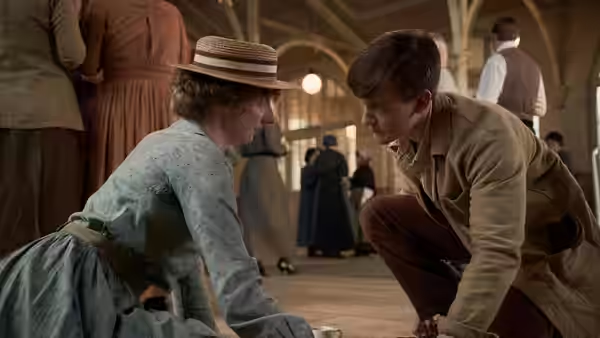
Alan Bennett and Nicholas Hytner send a choir master to a town emptied of its young men, and Ralph Fiennes gives him a quiet, exact grief. Around him the film tells too many small stories and finishes almost none of them.
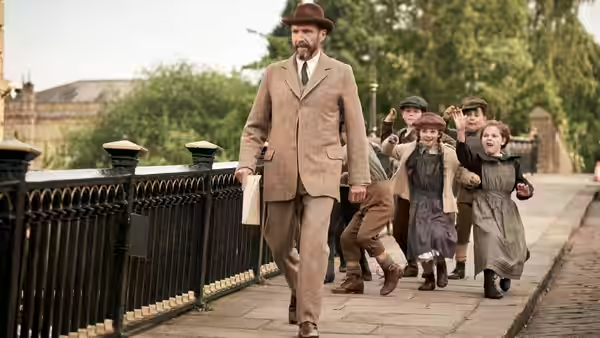
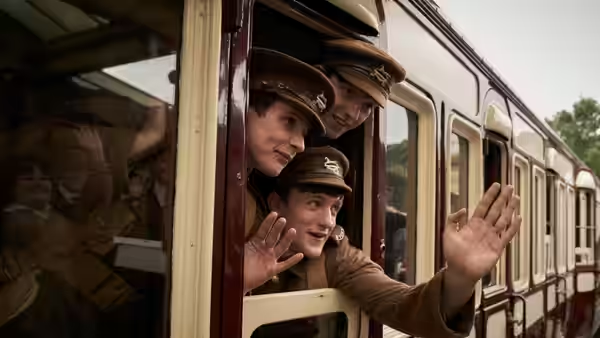
Alan Bennett has written and Nicholas Hytner has directed a film about a provincial choral society in the First World War, and if that sentence makes you feel comfortable you have already understood both its appeal and its problem. The men have gone to the front, the choir has gaps where its voices used to be, and Dr. Henry Guthrie (Ralph Fiennes) takes it in hand. It is gentle, well acted and civilised, and it is too slight to carry the war it keeps reminding us about.
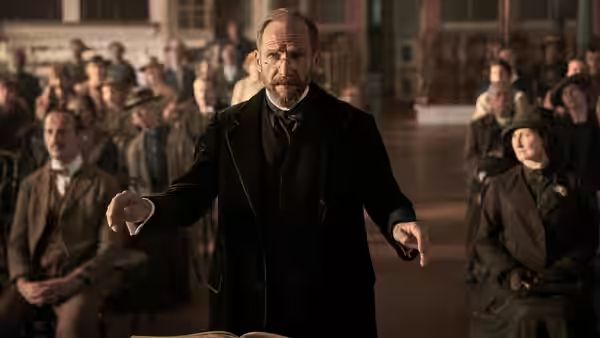
Fiennes is the reason to see it. He plays Guthrie as a man who has decided to be exact about everything because exactness is what he can control: he stands upright, speaks at rehearsal volume, and corrects a vowel as if a life depended on it. The film’s best scene has him with a wounded soldier, and it moved us more than we were prepared for. Fiennes sits a little way off, does not touch him, keeps his voice level and lets the pauses run on longer than most directors would allow. Nothing else in the film is as still as that, and nothing else earns its silence.
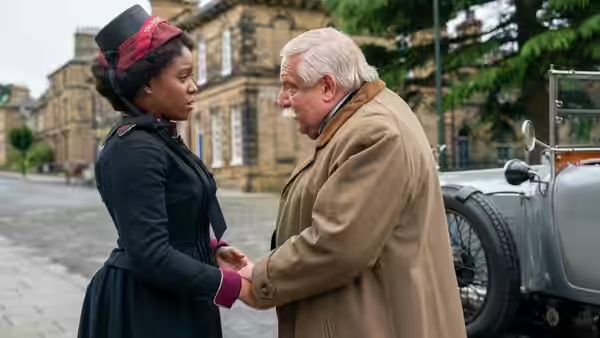
Around him Bennett has assembled the kind of committee he writes better than anyone: Alderman Duxbury (Roger Allam), Joe Fytton (Mark Addy), Herbert Trickett (Alun Armstrong) and the Reverend Woodhead (Ron Cook), each given one dry line per scene and a reason to disapprove of the next man. Allam makes civic self-importance funny without making it cheap. Simon Russell Beale appears briefly as Sir Edward Elgar and plays him as a tired, courteous man who has heard his own music performed badly before. It is the one scene where the comedy and the sorrow sit in the same room without elbowing each other.
The younger cast are where the film thins out. Mary Lockwood (Amara Okereke), Bella Holmes (Emily Fairn), Mitch (Shaun Thomas) and Clyde (Jacob Dudman) are given situations rather than stories, and the romantic strands among them are set up with care and then left to find their own way out. Robert Emms, as Robert Horner, and Lyndsey Marshal, as Mrs. Bishop, each get a scene that suggests a fuller film we did not see. Bennett’s script has a dozen people in it and a hundred-odd minutes to divide between them, and the arithmetic shows.
The craft is handsome and quiet. Mike Eley shoots in low grey daylight that comes through tall windows and sits on the faces, and Peter Francis’s rehearsal rooms look used rather than dressed, all scuffed boards and stacked chairs. Jenny Beavan’s clothes have been mended more than once, which tells you more about the town’s money than any line does. George Fenton knows when to stop writing and let the choir sing, and the singing is the best thing here after Fiennes: the auditions, in which people who have never sung in front of anyone stand up and do it, are funny and then, without warning, not. Tariq Anwar cuts the rehearsals with patience and the rest of the film with some anxiety, hopping between strands as if afraid we will forget one, which we did.
Hytner and Bennett made The History Boys and The Lady in the Van together, and both of those knew what they were about: a classroom, a driveway, one argument carried through. Hytner directs this one as if blocking it for a stage. People face each other across rooms and say their lines, the camera waits, and the war is reported rather than felt. By the middle hour we were bored, and then felt slightly mean about it, because nobody on screen is doing anything badly. They are doing it in a film that does not know which of its stories matters most.
Most critics have landed in the middle and so have we, a little above them. It is 113 minutes, a 12A, and it will do nothing to upset anyone, which is a fair description and not a recommendation. See it for Fiennes with a wounded soldier and a roomful of amateurs finding their note, and forgive the rest if you are in a forgiving mood. At home it will seem perfectly nice, and that is roughly the size of it.