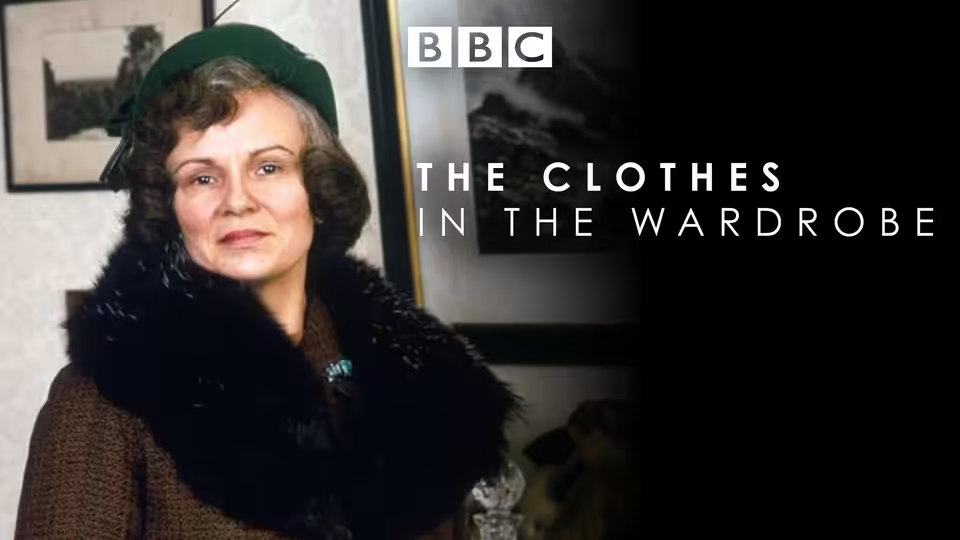
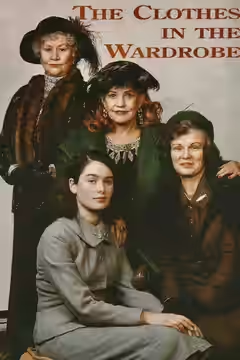
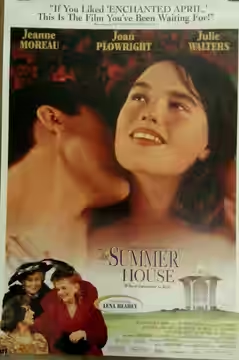
Waris Hussein’s small, dry adaptation of Alice Thomas Ellis gives Jeanne Moreau a suburban semi to wreck and Joan Plowright a garden to grieve in. It is slight and a little stiff in places, and it is worth your evening.
Alice Thomas Ellis’s novel is a short book about a wedding nobody should want, and Martin Sherman’s script has the sense to leave it short. Waris Hussein’s film runs 79 minutes, which is about right for a story in which the central event is a woman deciding whether to say no. It is a comedy of manners with a bruise underneath, and the bruise is what stays with you.
The setup is plain. Margaret is to marry Syl, who is twice her age, lives with his mother and smiles like a man who has been told he is charming. Her mother Monica wants it done and dusted. Then Lili comes to stay, and Jeanne Moreau walks into a net-curtained suburban living room as if she had been sent to inspect it. Moreau plays Lili with a lazy, amused cruelty, lighting cigarettes in rooms where people are trying to eat, telling the truth at exactly the moments it will do most damage. We laughed, out loud and more than once, mostly at the way she looks at Syl across a table and lets him finish a sentence.
She is the engine, but Joan Plowright is the heart. Mrs. Monro knows what her son is and loves him anyway, and Plowright plays that knowledge as a kind of permanent tiredness, pottering at the bottom of the garden with a glass in her hand. Her scenes with Moreau in the summer house, two old women drinking in the afternoon and saying things they would not say indoors, are the best in the film. One exchange about what mothers owe their sons moved us more than we expected from a piece this light; it is in the pause before Plowright answers, not in the line.
Lena Headey has the hardest job and does it well. Margaret barely speaks, and Headey makes her silence read as damage rather than blankness, a girl holding something behind her teeth. Julie Walters’s Monica is brisk, anxious and very funny about table linen, and Walters resists playing her as a monster; she is simply a woman who thinks marriage is a roof. David Threlfall gives Syl a wet, hopeful decency that is somehow worse than villainy would be. John Wood, as Robert, is drily good in his few scenes.
It looks like what it is, a modest British production of its period, and that is not entirely a complaint. Rex Maidment shoots the houses in browns and muted greens, wallpaper and antimacassars, so that the few scenes away from them feel like a window opening. Stuart Walker’s production design fills the Monro house with the clutter of people who have stopped noticing their own belongings. Odile Dicks-Mireaux and Leah Archer dress Lili in colour and everyone else in cardigans, which is the film’s joke in a single costume rack. Stanley Myers’s score is gentle and slightly over-present; it tells us to feel wistful in a couple of scenes where the actors had already managed it.
The flaws are those of scale. Ken Pierce cuts the flashbacks in abruptly, and some of them land as interruptions rather than as memory. The middle stretch sags; there is a limit to how many times Lili can walk into a room and unsettle it before we start to anticipate the rhythm. And Hussein directs several scenes as if for a stage, people arranged across a sofa, cutting between them on lines, which drains a little of the life Moreau keeps bringing in.
The second half resolves the question of the wedding in a way we will not describe. We will say the resolution is earned by what the actors have been doing all along rather than by anything the plot springs on us, and that the film has the good manners not to explain the ending twice.
It is a small film about a small house and the women who are stuck in it, and it knows its size. Watch it at home on a wet evening, with someone who likes watching good actors be unkind to each other over tea. Bring the book if you have it; the film is faithful to it, and shorter.