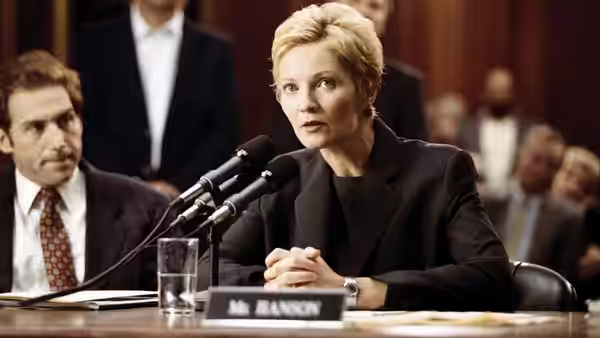
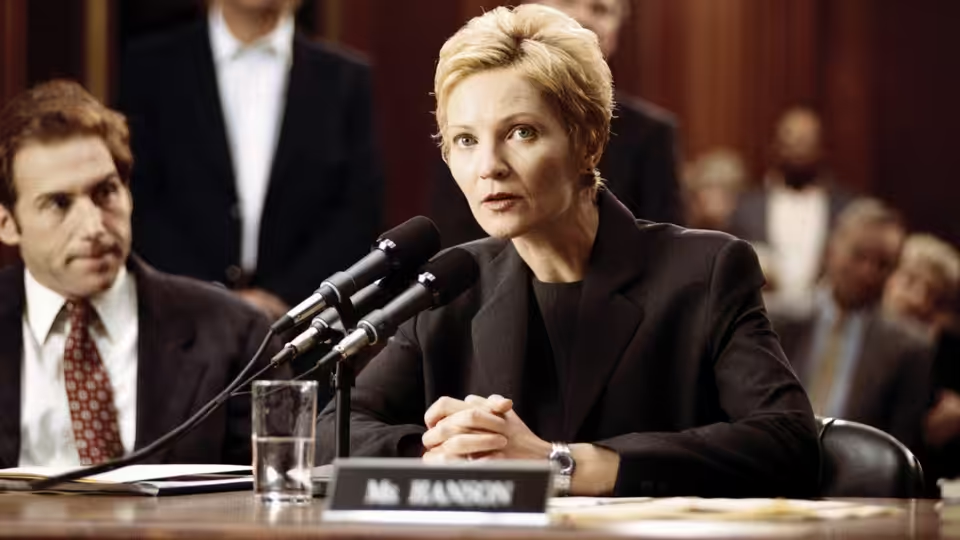
Laine Hanson (Joan Allen) sits before microphones at a Senate confirmation hearing
Film review

The Contender

2000 · Directed by Rod Lurie · 2h 06m

In a sentenceJoan Allen has our attention; someone should tell the composer

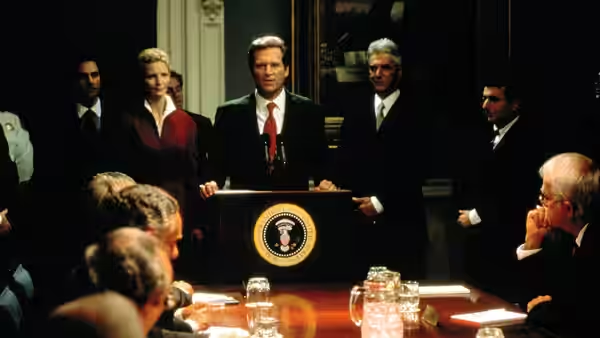
In Washington, Laine Hanson (Joan Allen), Shelly Runyon (Gary Oldman) and President Jackson Evans (Jeff Bridges) are involved in a struggle over political power and personal character. Political manoeuvring takes place under the scrutiny of an increasingly intrusive press. Reginald Webster (Christian Slater), Kermit Newman (Sam Elliott) and Jack Hathaway (William Petersen) are among the figures in the surrounding political drama. Questions about the people exercising power become inseparable from the contest itself, as the politicians’ public standing and the press’s appetite for personal scrutiny shape the proceedings.

Plays from YouTube when you press play; nothing loads from them until then.

Fi1m review

The Contender is an entertaining political drama weakened by a script that explains too much. Joan Allen, Gary Oldman and Jeff Bridges make it worth considering, provided a taste for Washington manoeuvring comes with patience for speeches.

Rod Lurie makes The Contender entertaining enough to keep a politically minded audience occupied, though its writing is too insistent to make it an easy recommendation. The interest lies in watching people use power, defend their beliefs and pass judgement on one another. Washington manoeuvring and an increasingly intrusive press provide ample pressure. The film is most convincing while its actors can make that pressure feel personal, before the screenplay begins explaining more than it needs to.

Joan Allen gives Laine Hanson the natural authority on which much of the film depends. We cared about her, because the performance makes a person emerge from material that could easily have reduced her to a political position. There is no need to be told repeatedly that someone with this much presence deserves our attention. Her work makes the more emphatic dialogue particularly frustrating: the film already has an actor capable of persuading us to listen.

Gary Oldman makes Shelly Runyon interesting by allowing a reactionary to seem sincere. His conviction gives the opposition weight, and Rod Lurie keeps the performance from overwhelming the rest of the cast. Jeff Bridges brings an engaging personality to President Jackson Evans, ensuring that the business of power-brokering remains a pleasure to watch. The three leads make the contest feel human, even where the screenplay arranges it too neatly. That is a considerable help once the plotting starts to strain.

Denis Maloney’s cinematography and Alec Hammond’s production design give the proceedings a credible, professional finish. Neither draws attention away from the performances, which is a sensible priority for this material. Michael Jablow’s editing has to contend with explanatory dialogue that repeatedly slows the political business down. The film is well made, but cutting cannot fix every difficulty in the writing. Too many exchanges spell out positions without allowing much possibility that anyone might reconsider them.

Larry Groupé’s score is less helpful, insisting on the importance of scenes that are already emphatic enough. It makes the speeches harder work and gives the actors less room than they deserve. The greater weakness, however, is Rod Lurie’s screenplay, whose early plausibility gives way to increasingly unconvincing plotting. We will not describe the later developments, but the loss of credibility matters in a drama that asks us to take its political judgements seriously.

A political thriller needs to let us weigh what people say against what they might want. This one is too keen to settle those questions for us, and at 126 minutes its explanations become wearing. Even so, the cast supplies enough uncertainty and personality to keep the film from turning into a lecture throughout. There is a worthwhile evening here for anyone with an appetite for Washington arguments. Choose it for Joan Allen, Gary Oldman and Jeff Bridges, and bring some patience for the speeches.

Critical consensus AI synthesised

64
Positive
2
Mixed
6
Negative
1

The reviews lean towards qualified approval, with praise clustering around the performances rather than the political plotting. Joan Allen is the clearest point of agreement: critics repeatedly single out her authority, while Jeff Bridges and Gary Oldman also receive praise. Even several less enthusiastic assessments find the Washington manoeuvring entertaining, crediting the ensemble with making the characters feel human amid the speeches and power-brokering.

Reservations centre on schematic storytelling and a final stretch that several critics find damaging to the drama; Total Film also objects to the overbearing score. The spread is wide: the Evening Standard warmly embraces the suspenseful political melodrama, while The Guardian finds it dramatically unconvincing and politically misleading despite a plausible start. The disagreement extends to its political intelligence: Eye for Film praises precisely its avoidance of stereotypes and simplistic politics. Performances command broader agreement than the film’s ideas.

Evening Standard
10 April 2012
90*

The critic finds the film hugely entertaining and praises its suspenseful political melodrama. They single out how character-driven performances make the political machinations feel human.

Read the full review →
Variety
11 September 2000 · Emanuel Levy
65*

Levy finds the film a clear improvement over Rod Lurie’s debut, though its verbose, schematic storytelling limits its political ambitions. He singles out Joan Allen’s commanding performance and the talented ensemble as the film’s chief strengths.

Read the full review →
The New York Times
13 October 2000
64*

The review’s verdict and specific praise or complaints cannot be determined from the available page. The article text was inaccessible, so its assessment is unknown.

Read the full review →
Time Out
· GA
64*

The available page metadata identifies this as a review, but provides no verdict. No specific element is available to identify as praised or criticized.

Read the full review →
Empire
1 January 2000 · Bob McCabe
60*

The review finds the film entertaining and well-crafted overall, but says it falters badly in its final moments. It praises the performances, especially those of Jeff Bridges, Joan Allen and Gary Oldman.

Read the full review →
Radio Times
★★★ · David Parkinson
60

Parkinson finds the film an assured, streetwise look at Washington power-brokering and increasingly base journalism. He praises Joan Allen’s Oscar-nominated performance and notes that Lurie wisely restrains Gary Oldman’s scene-stealing.

Read the full review →

Straight answers AI written, from our review

Is The Contender worth watching?
The Contender is worth considering for its strong performances and Washington manoeuvring, and we score it 64 out of 100. Joan Allen, Gary Oldman and Jeff Bridges hold our attention, but the explanatory speeches, intrusive music and increasingly unconvincing plotting make it a qualified recommendation for politically minded viewers.
How long is The Contender, and what is it rated?
The Contender runs 2h 06m. It is a drama and thriller film.
Where can I watch The Contender in Canada?
The Contender is streaming on Tubi in Canada, and it is also available to rent from Apple TV from CA$4.99. Availability is checked daily; the links above go straight to each service.
How violent or frightening is The Contender, and is it suitable for children?
The Contender has a US R certificate, which signals restricted viewing for younger audiences; no UK certificate is supplied here. That rating warrants caution for children, but we cannot give a specific warning about violence or frightening scenes: our review describes political pressure and personal scrutiny without detailing those kinds of content.
How does The Contender compare to State of Play?
The Contender offers an entertaining but over-explained Washington drama, while we recommend State of Play for a denser, more convincing conspiracy thriller involving political loyalties, reporting and compromised friendships. The latter is a six-part television programme rather than a film, so it asks for more time and concentration; the former chiefly rewards patience through its three leads.
What should I watch after The Contender?
After The Contender, try State of Play (2003, Fi1m 88): For a denser entanglement of political loyalties, reporting and compromised friendships. Then The Lives of Others (2006, Fi1m 84): For another measured central performance inside a much harsher political system; and Borgen (2010, Fi1m 84): Political bargaining receives patient attention, alongside the working lives of those doing it.

Cast

Awards

Academy Awards, 2001

Nominated
Best Actress
Nominated
Best Supporting Actor

If you liked this, try…

  1. Advise & Consent (1962) · not reviewed yetMore patient political manoeuvring, with personal principle tested by institutional pressure.

  2. The Candidate (1972) · not reviewed yetA drier look at how political ambition reshapes the person pursuing it.

  3. State of Play (2003, Fi1m 88)For a denser entanglement of political loyalties, reporting and compromised friendships.

  4. The Lives of Others (2006, Fi1m 84)For another measured central performance inside a much harsher political system.

  5. Borgen (2010, Fi1m 84)Political bargaining receives patient attention, alongside the working lives of those doing it.

Free account

Know what to watch tonight

Two lists that know where things are streaming, collections you can share, your own score beside ours, and Discover that remembers what you have seen.

  • Want to see, sorted by what is streaming now
  • Seen, with your score out of ten
  • No adverts, ever