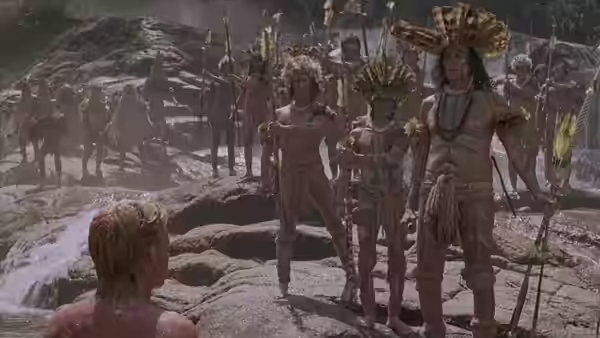
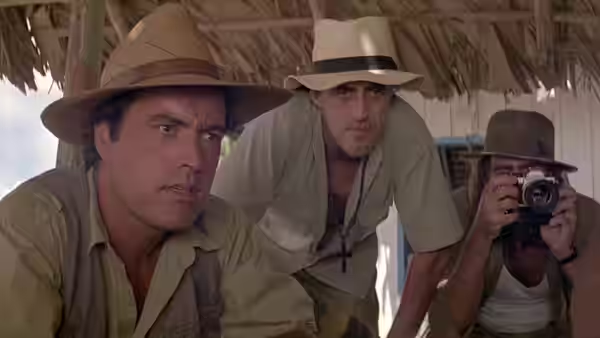
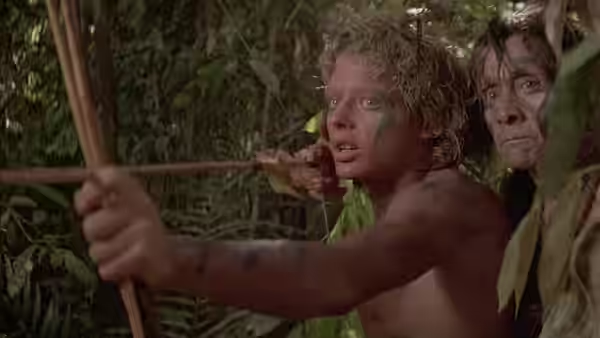
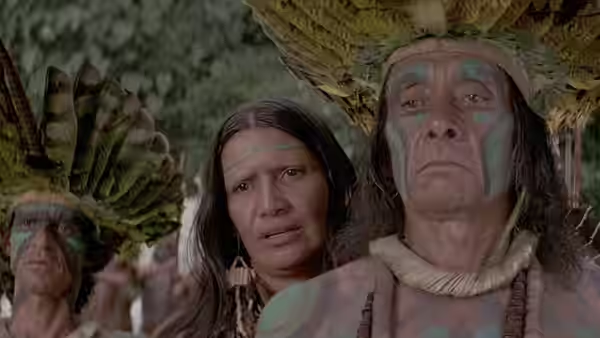
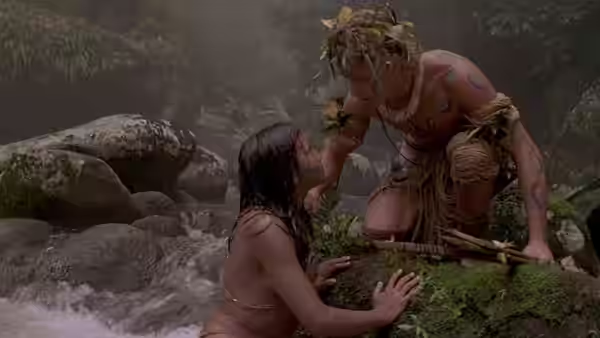
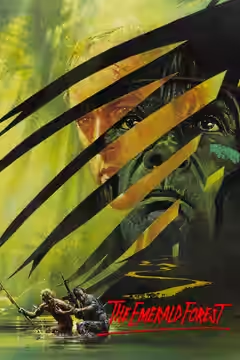
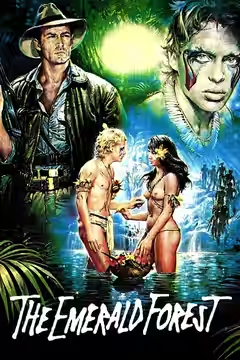
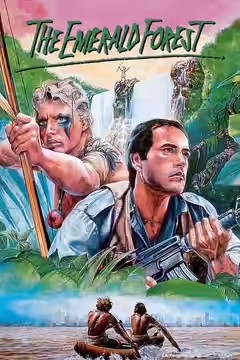
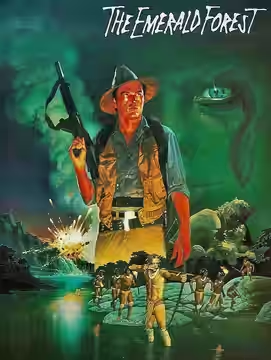
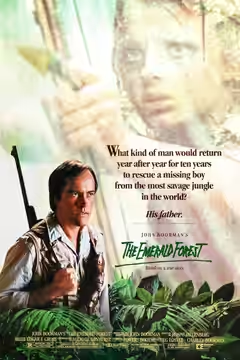
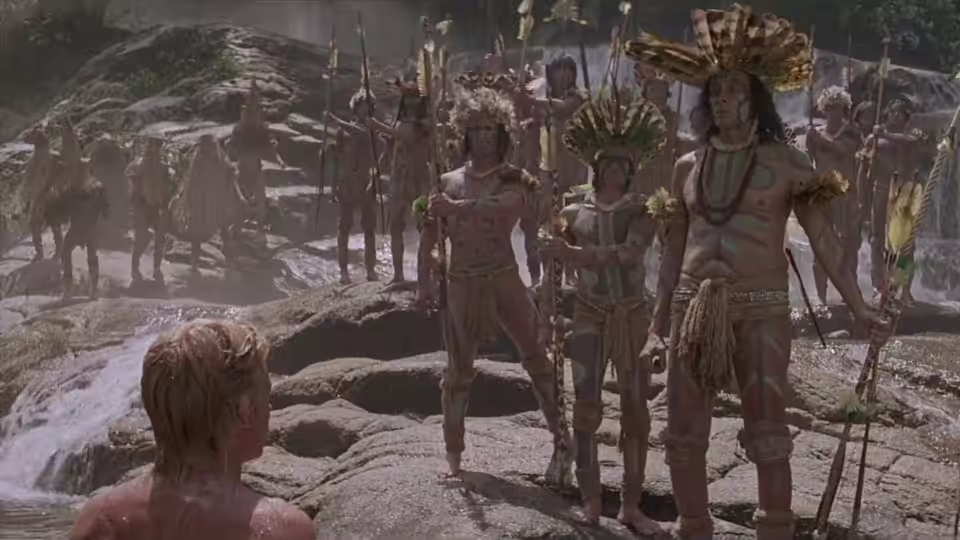
A blond man faces Indigenous people gathered among rocky riverbanks
Film review

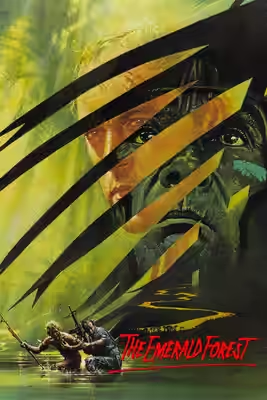
The Emerald Forest

1985 · Directed by John Boorman · 1h 54m

In a sentenceThe jungle makes a persuasive case for itself before anyone starts explaining it

Bill Markham (Powers Boothe) returns to the jungle year after year, searching for his missing son. Ten years pass, but he continues trying to bring the boy back to his family and Jean Markham (Meg Foster). The child grows from Young Tommy (William Rodriguez) into Tomme (Charley Boorman). The father’s search takes him among forest communities, their rituals and their relationship with the jungle around them. His wish to recover his child runs alongside a struggle over the forest and the people who make their homes there.

Fi1m review

The photography makes John Boorman’s jungle adventure worth considering, despite its clumsy plotting and insistent moral lessons. Powers Boothe gives a father’s search the weight that the writing cannot always supply.

The Emerald Forest is an involving jungle adventure with an unfortunate habit of lecturing us. John Boorman wants us to question what counts as civilisation, and takes the plight of the forest seriously. The screenplay by Rospo Pallenberg too often simplifies the people who must carry those concerns. Its strongest starting point is also its simplest: a father returning year after year for ten years to find his missing son.

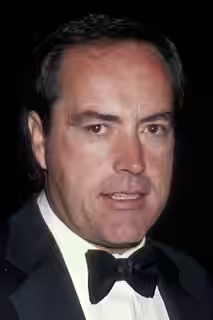
Powers Boothe gives the search a convincing weight. His Bill Markham has enough determination to hold our attention even when the plot becomes awkward, and the performance makes the father’s persistence comprehensible without making it seem easy. We felt for him, because the repeated journeys make a parent’s refusal to give up feel painfully costly. The film needs that human concern whenever its lessons about the forest threaten to take over.

Philippe Rousselot’s photography is the stronger reason to stay. The jungle has variations of light and colour that keep us looking even when the story has stopped surprising us; green need not mean visual monotony. The attention to ritual gives the forest communities a life beyond their function in the search, at least for stretches of the film. Simon Holland’s production design helps give these passages their physical interest, though the writing supplies less detail about the people taking part.

The music by Junior Homrich and Brian Gascoigne gives those passages a seriousness that largely works. It encourages us to attend to the rituals, although the film hardly needs further encouragement to be solemn. Ian Crafford’s editing gives the adventure enough forward movement to survive the screenplay’s clumsier passages. What it cannot do is make the switches between an absorbing journey and an environmental lesson feel consistently natural, and we sometimes become too aware of the point a scene has been arranged to make.

Charley Boorman is a less reliable centre as Tomme. There is an appealing openness to the performance, but also an awkwardness that becomes hard to ignore when the character needs more weight. The affection the film has for him does not supply the missing detail. Rospo Pallenberg’s writing gives the forest communities a related problem: they too often seem required to stand for a purer way of living, with too little room to be difficult, ordinary people.

An adventure can simplify a conflict without giving every character a complicated private life. Here, though, the forest communities are central to what John Boorman wants to say, so their idealisation weakens the film’s claim to take them seriously. We want to know more about these people than whether they confirm the director’s convictions. Try it if jungle adventure is a particular pleasure, with some patience for the lectures.
Critical consensus AI synthesised

69
Positive
3
Mixed
5
Negative
0

The reviews lean towards qualified approval, with praise clustering around the jungle photography and visual storytelling. Critics repeatedly single out the use of light, colour and movement, while the more enthusiastic accounts also admire the music and ritual detail. The adventure holds attention even for some who find the writing uneven. Praise for the performances is less consistent, though Powers Boothe receives favourable notice from Empire.

The spread runs from strong enthusiasm to mixed assessments, with no outright negative verdicts. Reservations centre on clunky plotting, thin characterisation and an environmental message that some find overly earnest or preachy. Slant Magazine offers a contrasting reading, finding thematic depth beyond a straightforward conservation plea. Charley Boorman particularly divides opinion: Radio Times finds his acting awkward, while Eye for Film considers him endearing. The latter nevertheless questions the tribal stereotyping, showing that sympathy for the film’s ecological concerns does not settle doubts about its portrayal of people.

Los Angeles Times
2 July 1985 · Sheila Benson
95*

Benson calls the film a powerful, beautiful surprise and suggests it may become a classic. She praises its vivid portrayal of tribal life, especially the lush cinematography, music, and ritual details.

Read the full review →
Slant Magazine
11 June 2010 · Robert C. Cumbow
85*

Cumbow presents the film as a lasting, thematically rich work rather than a simple environmental tract. He praises its vivid use of light, color, and movement to challenge assumptions about civilization and nature.

Read the full review →
Variety
31 December 1984 · Variety Staff
70*

The review finds the film engrossing despite flaws in its narrative and characterization. It particularly praises the film’s visual fascination, while noting tension between documentary realism and stylized direction.

Read the full review →
The New York Times
3 July 1985 · Janet Maslin
64*

The page could not be accessed, so the critic’s verdict cannot be confirmed. No specific praise or complaint is available from the supplied page text.

Read the full review →
Time Out
· DT
64*

The accessible page identifies this as a film review but provides no critic's verdict. It contains no review text indicating what the critic praised or criticized.

Read the full review →
Radio Times
★★★ · Tom Hutchinson
60

Hutchinson finds the film’s conservation message strengthens its appeal, despite an overly earnest approach. He praises Philippe Rousselot’s beautiful jungle photography but criticizes Charley Boorman’s awkward acting.

Read the full review →

Straight answers AI written, from our review

Is The Emerald Forest worth watching?
The Emerald Forest is worth considering if jungle adventure is a particular pleasure; we score it 66 out of 100. Philippe Rousselot’s photography and Powers Boothe’s convincing performance as a searching father keep us involved, but clumsy plotting and insistent environmental lessons make it harder to recommend beyond that audience.
How long is The Emerald Forest, and what is it rated?
The Emerald Forest runs 1h 54m. It is an action and adventure film.
Where can I watch The Emerald Forest in Italy?
The Emerald Forest is not on any streaming or rental service in Italy at the moment. It is available in 5 other countries; change your country at the top of the page to see where. Availability is checked daily.
How violent or frightening is The Emerald Forest, and is it suitable for children?
The Emerald Forest carries a UK 12 certificate, so we would not recommend it for younger children. That rating points towards viewers aged twelve and over, but does not by itself establish how graphic the violence or how intense the frightening moments are. We cannot give the squeamish a firm reassurance about either.
How does The Emerald Forest compare to Walkabout?
The Emerald Forest offers a more conventional jungle adventure, while Walkabout is the stronger choice for a moving, disquieting encounter with an unfamiliar landscape. We recommend the former for its photography and determined father’s search, provided the lectures do not put you off. Walkabout is less eager to explain, though its contrast between wilderness and civilisation also sometimes simplifies people.
What should I watch after The Emerald Forest?
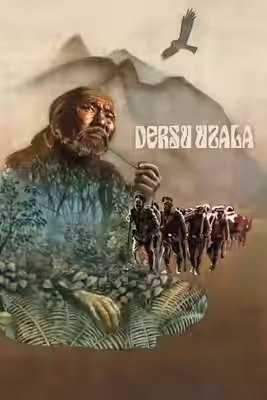
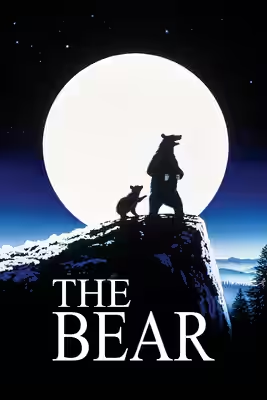
After The Emerald Forest, try Walkabout (1971, Fi1m 85): Children encounter an unfamiliar landscape in a film less eager to explain. Then Dersu Uzala (1975, Fi1m 82): Friendship and practical knowledge give its concern for the wilderness human weight; and The Bear (1988, Fi1m 78): An animal adventure that lets physical danger do most of the talking.

Cast

If you liked this, try…

  1. Walkabout (1971, Fi1m 85)Children encounter an unfamiliar landscape in a film less eager to explain.

  2. Dersu Uzala (1975, Fi1m 82)Friendship and practical knowledge give its concern for the wilderness human weight.

  3. The Bear (1988, Fi1m 78)An animal adventure that lets physical danger do most of the talking.

  4. Princess Mononoke (1997, Fi1m 88)The struggle over a forest allows competing needs and uncomfortable sympathies.

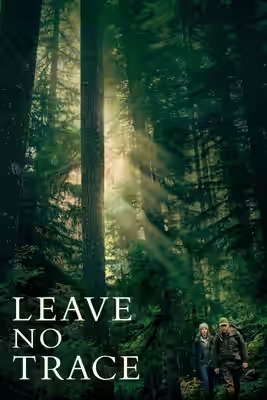
  5. Leave No Trace (2018, Fi1m 88)A father and daughter find that living apart from society has costs.

Free account

Know what to watch tonight

Two lists that know where things are streaming, collections you can share, your own score beside ours, and Discover that remembers what you have seen.

  • Want to see, sorted by what is streaming now
  • Seen, with your score out of ten
  • No adverts, ever