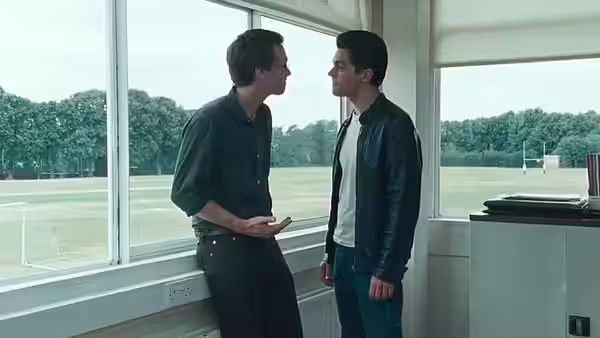
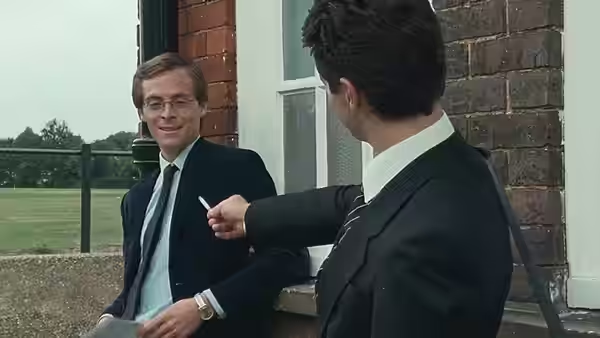
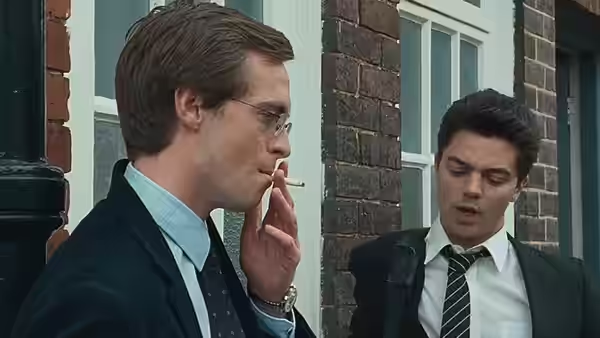
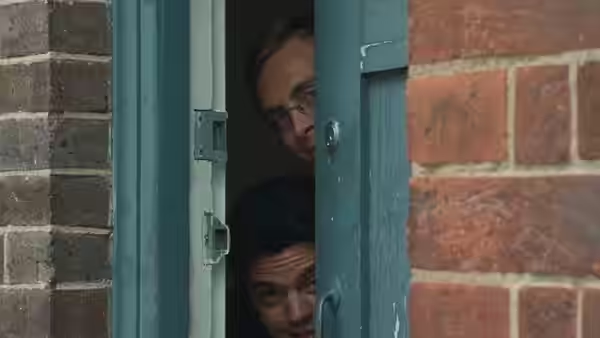
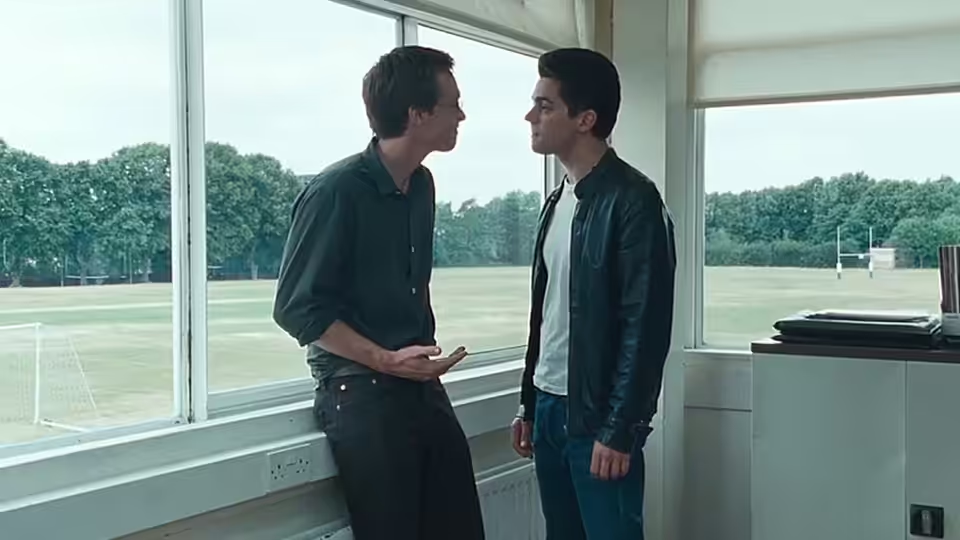
Irwin (Stephen Campbell Moore) and Dakin (Dominic Cooper) face each other beside the school playing field
Film review

The History Boys

2006 · Directed by Nicholas Hytner · 1h 49m

In a sentenceEight boys who all talk like Alan Bennett, which is the pleasure and the problem

Sheffield, 1983. Eight sixth-formers at a boys’ grammar school have done well enough in their A-levels to try for Oxford and Cambridge, and the Headmaster (Clive Merrison) wants them in. Their general studies teacher, Hector (Richard Griffiths), fills his lessons with poetry, French conversation and songs from old films, and refuses to say what any of it is for. The Headmaster hires a young supply teacher, Irwin (Stephen Campbell Moore), to coach the boys in the kind of contrary cleverness that impresses examiners. The boys, among them the confident Dakin (Dominic Cooper) and the small, lovelorn Posner (Samuel Barnett), play the two men off against each other. Mrs Lintott (Frances de la Tour), who got them this far, watches from the staffroom. Hector gives the boys lifts home on his motorbike.

Fi1m review

Alan Bennett’s play comes to the screen with its original cast and most of its wit intact. Nicholas Hytner has filmed it rather than remade it, and the result is talky, generous, often funny and only intermittently a film.

Alan Bennett’s play about a classroom of clever boys and the two men fighting over how to teach them was a hit at the National Theatre, and Nicholas Hytner, who directed it there, has brought it to the screen with the same cast and the same words. The History Boys runs 109 minutes and carries a 15 certificate, and for most of that time it is good company. It is also, plainly, a play with a camera pointed at it. If you want the argument and the jokes, they are here. If you want the thing to have been rethought for cinema, it has not been.

The argument is the point, and it is a proper one. Hector, played by Richard Griffiths with his great bulk wedged behind a desk and his voice pitched somewhere between a sermon and a sigh, believes that poetry is learnt for the day you will need it, and that the day may be forty years off. Irwin, Stephen Campbell Moore’s thin, careful young man in a cheap suit, believes an examiner can be won by taking the wrong side and taking it well. Bennett gives both men their best case and declines to referee. Campbell Moore is the quieter success: he plays Irwin as someone who is already a little ashamed of his own method and uses it anyway.

The boys are played by the stage cast, and the first thing you notice is that they are not boys. Dominic Cooper’s Dakin has the stubble and the ease of a man who has already left school, and his seduction of everyone in the building, teachers included, is more plausible because of it. James Corden’s Timms is the class clown who knows exactly how much he can get away with. Russell Tovey’s Rudge is the rugby player nobody expects to get in, and his speech about what history is gives the film its tagline. Jamie Parker’s Scripps keeps a diary and watches, and Sacha Dhawan, Samuel Anderson and Andrew Knott fill out the back row with less to do than they deserve.

Samuel Barnett’s Posner is the heart of it. He is small, Jewish, gay, in love with Dakin and from Sheffield, and he lists all of this as a catalogue of bad luck. Midway through, he stands up in class and sings Bewitched, Bothered and Bewildered to the boy he wants, and most critics go quiet. We had expected to be amused by it. We were moved instead, more than the scene seemed to be asking for, because Barnett sings it straight, to a face that will not look back, and Hytner holds the shot and lets him finish. Frances de la Tour’s Mrs Lintott, meanwhile, gets the best dry lines in the film and delivers each one as if setting down a cup of tea.

Where it goes wrong is wherever it stops talking. Hytner and the editor John Wilson stitch the term together with montages cut to 1980s pop, boys running down corridors, boys on bicycles, boys in the library, and every one of them feels like a stage direction nobody knew how to film. Andrew Dunn lights the classrooms in flat, even daylight, the colour of a wet Tuesday, which is honest about the setting and does nothing for the eye. John Beard’s school is a real-looking place of parquet and radiators, well chosen and barely explored. George Fenton’s score is modest and mostly gives way to the songs, which is the right decision.

There is also the motorbike. Hector gropes the boys he gives lifts to, and the film knows it from early on and treats it as a sadness about him rather than a danger to them. Bennett’s view is that the boys can handle it and that Hector is the one damaged. We found ourselves going along with that in the dark, and then uneasy afterwards about how easily we had. The film does not pretend the question is not there, but it answers it faster than it should.

As a record of a very good stage production this is close to ideal, and as a Bennett script it has a line worth keeping in almost every scene. As a film it is a Tuesday-evening pleasure rather than a Saturday-night one. Watch it with someone who will want to argue about Hector afterwards, because the argument is better than the montages.

Critical consensus AI synthesised

65
Positive
4
Mixed
4
Negative
2
The AV Club
14 December 2006 · A- · Nathan Rabin
90

Rabin finds the film clever and deeply sad, with its heartbreak earned rather than sentimental. He singles out the classroom’s dazzling verbal sparring and a student’s poignant song for praise.

Read the full review →
Radio Times
★★★★ · Adam Smith
80

The review says the stage play makes an efficient transition to the screen. It praises Alan Bennett’s screenplay for its wit and intellect.

Read the full review →
The New York Times
21 November 2006 · A.O. Scott
70*

The review is broadly positive about the film. The article text is unavailable, so its specific praise cannot be verified.

Read the full review →
Time Out
10 October 2006 · Dave Calhoun
65*

The available description suggests the review sees something of Joe Orton in the play. It notes the screen transfer retains the original director, but the full verdict is unavailable.

Read the full review →
Screen Daily
11 October 2006 · Geoffrey Macnab
64*

The page identifies this as a review, but the critic’s verdict is unavailable in the accessible text. No praise or complaint can be confirmed from the paywall shell.

Read the full review →
Slant Magazine
31 October 2006 · ★★½/4 · Jason Clark
62

Clark finds the adaptation holds up despite uneven direction, with Bennett’s writing and the performances carrying it. He particularly praises Stephen Campbell Moore’s richly detailed portrayal, while criticizing the perfunctory montages and inconsistent tone.

Read the full review →

Straight answers AI written, from our review

Is The History Boys worth watching?
The History Boys is worth watching for anyone who wants Alan Bennett's argument about teaching and his jokes delivered by the cast who made them work on stage, and we scored it 67. Richard Griffiths, Stephen Campbell Moore and Samuel Barnett are all good, and Posner's song is the moment that moved us. It is a filmed play rather than a film, and the montages between scenes show it.
How long is The History Boys, and what is it rated?
The History Boys runs 1h 49m. It is a drama film.
Where can I watch The History Boys in Azerbaijan?
The History Boys is not on any streaming or rental service in Azerbaijan at the moment. It is available in 18 other countries; change your country at the top of the page to see where. Availability is checked daily.
How violent or frightening is The History Boys, and is it suitable for children?
The History Boys carries a UK 15 certificate and has no violence or frights to speak of; the concern is its adult subject matter. Hector gropes the boys he gives motorbike lifts to, and the film treats this as a sadness about him rather than a danger to them, which some viewers will find harder to accept than the film does. It is for older teenagers and adults, not children.
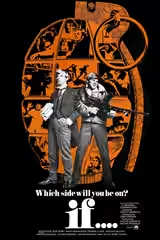
How does The History Boys compare to if....?
The History Boys and if.... both see the English school as a place that shapes boys in ways the staff do not control, but they want opposite things from it. Bennett's film stays indoors and argues about what teaching is for; Lindsay Anderson's wants the place torn down and is angrier and more visually alive. The earlier film is the better piece of cinema, and the later one the better evening of talk.
What should I watch after The History Boys?
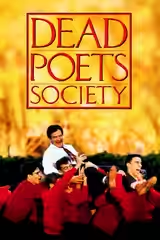
After The History Boys, try If.... (1968, Fi1m 82): The English school as a place to be escaped from, violently if necessary. Then Dead Poets Society (1989, Fi1m 80): The American version of the same argument, with more tears and fewer jokes.

Cast

If you liked this, try…

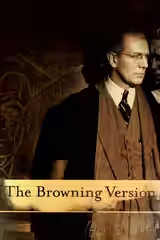
  1. The Browning Version (1951) · not on Fi1m yetRattigan’s unloved classics master, played by Michael Redgrave with devastating restraint.

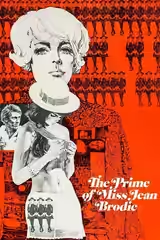
  2. The Prime of Miss Jean Brodie (1969) · not on Fi1m yetA charismatic teacher whose influence on her girls is far from benign.

  3. If.... (1968, Fi1m 82)The English school as a place to be escaped from, violently if necessary.

  4. Dead Poets Society (1989, Fi1m 80)The American version of the same argument, with more tears and fewer jokes.

  5. The Class (2008) · not on Fi1m yetA Paris classroom filmed as if nobody told the pupils where the camera was.